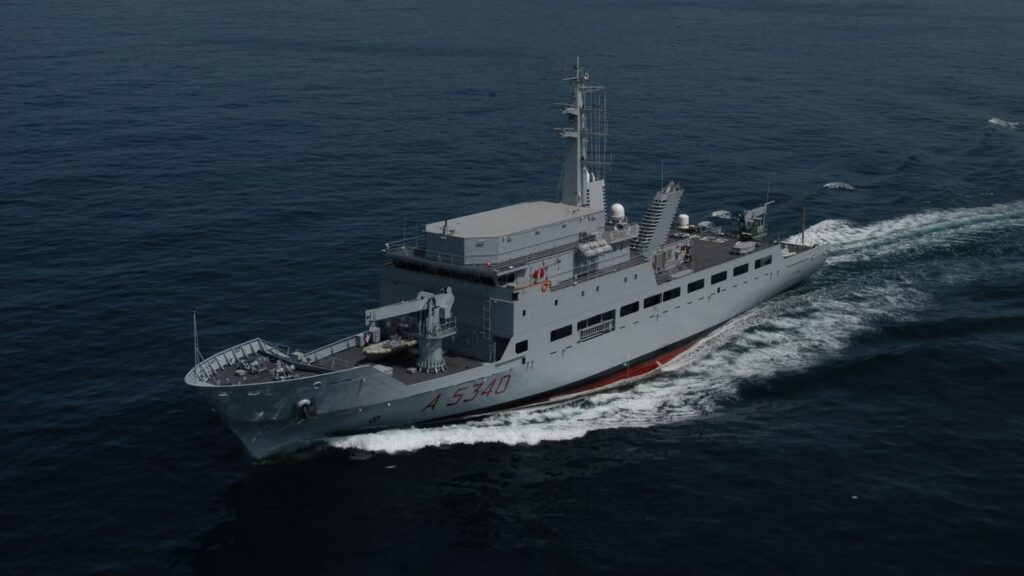
Nave Elettra Overview
Nave Elettra is an Italian Navy multirole support and research ship built by Fincantieri for specialized surveillance, intelligence-support and maritime research missions. The vessel carries the hull number A 5340 and is associated with the Elettra class of auxiliary general intelligence and support ships.
Fincantieri describes Elettra as a ship derived from the NATO research vessel Alliance and designed for research and surveillance activities. In Italian Navy service, the ship is used for tasks that include special operations support, data collection, assessment of acoustic and electromagnetic emissions, seabed survey support, hydro-oceanographic research and underwater acoustics.
Development and Construction
Elettra was developed to provide the Italian Navy with a purpose-built, quiet and highly automated platform for long-endurance missions requiring low acoustic signature and extensive onboard mission-system capacity. The vessel was built by Fincantieri at Riva Trigoso, launched on July 24, 2002, and is listed by Fincantieri with a 2003 delivery date.
The ship’s name recalls the historic yacht Elettra used by Guglielmo Marconi as a floating laboratory for radio and telecommunications experiments. The modern vessel continues that association with electromagnetic research and surveillance, but as a naval auxiliary optimized for military and governmental missions.
Design and Mission Profile
Nave Elettra has a 93 m overall length, 15.5 m beam and approximately 3,000 t full-load displacement. Its hull form and internal arrangement reflect its research-vessel ancestry, with emphasis on seakeeping, endurance, quiet operation and mission flexibility rather than combatant speed or heavy armament.
The ship’s public mission fit includes an integrated defense and intelligence suite with COMINT, EMINT and ELINT elements. These systems support the collection and assessment of communications, electromagnetic and electronic emissions, while the ship’s low acoustic signature also supports underwater research and acoustic-measurement work.
Propulsion and Performance
Elettra is notable for its integrated diesel-electric propulsion arrangement using two permanent-magnet electric motors, each rated at 1,500 kW. Fincantieri identifies the ship as the first surface vessel powered by this type of permanent-magnet electric propulsion system.
The propulsion configuration was selected for reliability, efficiency, reduced maintenance burden and very low underwater radiated noise. Power is supplied by two propulsion diesel generators and two harbor diesel generators, with two propellers, two rudders and a 400 kW bow thruster supporting maneuverability.
The ship has a maximum speed of 16.5 kn and a range of 8,000 nmi at 12 kn, enabling long-duration deployments without frequent replenishment. These characteristics are particularly important for intelligence, survey and monitoring missions that require persistent presence in designated operating areas.
Mission Systems and Armament
Navigation equipment publicly listed for Elettra includes two X-band navigation radars, an electromagnetic ship log, echo sounder, two gyrocompasses, automatic pilot and GMDSS communications. The specialist mission fit includes integrated COMINT, EMINT and ELINT capabilities.
The vessel is not a front-line combatant and carries only a light defensive armament. Italian Navy public information lists two Alenia OtoBreda-Oerlikon KBA 25/80 mm guns. Its principal operational value lies in surveillance, signals-related intelligence support, acoustic and electromagnetic measurement, and support to embarked teams rather than in offensive combat power.
Operational Role
Nave Elettra serves as a specialized Italian Navy platform for intelligence support, research and operational assistance to embarked forces. Its combination of endurance, quiet electric propulsion, surveillance systems and flexible mission spaces allows it to contribute to naval situational awareness, special operations support and scientific or technical maritime tasks.