Andrea Doria Class Destroyer Overview
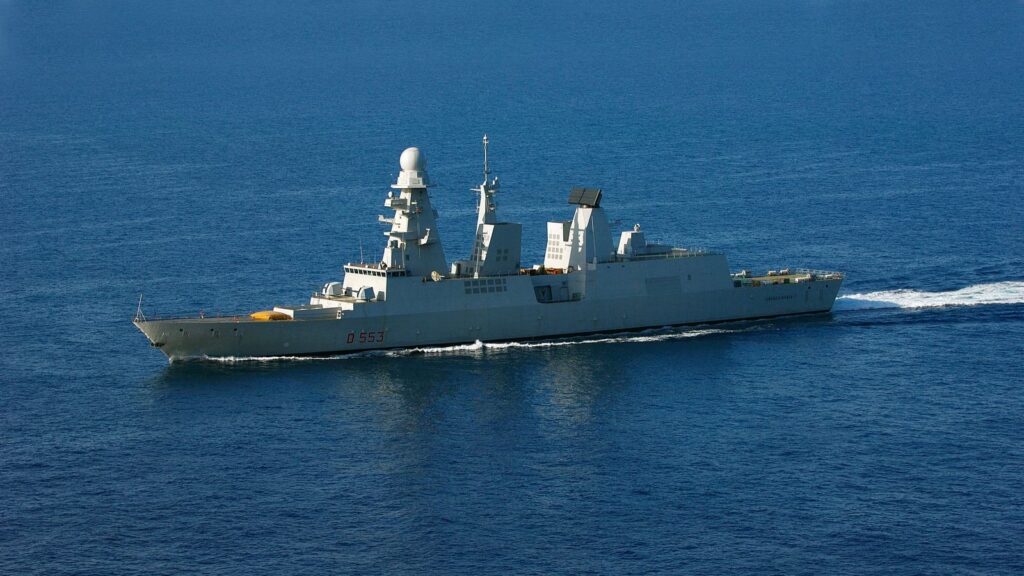
The Andrea Doria class, marketed by Fincantieri as the Doria Class, is the Italian Navy’s two-ship air-defense destroyer component of the Franco-Italian Horizon/Orizzonte program. The class consists of ITS Andrea Doria (D 553) and ITS Caio Duilio (D 554), built for high-end fleet escort, air-defense command-and-control, and protection of carrier groups, amphibious forces, convoys, and deployed naval task groups.
Although the broader Horizon program is often described internationally as a frigate program, the Italian Navy operates the Andrea Doria and Caio Duilio as guided-missile destroyers. Their principal mission is area air defense, supported by a layered combat system integrating long-range surveillance, PAAMS surface-to-air missiles, electronic warfare, decoys, guns, torpedoes, and embarked helicopter operations.
Development and Construction
The ships were ordered under the Italian-French Horizon program, which followed earlier European work to define a common next-generation air-defense surface combatant. Fincantieri received the Italian Navy’s two Orizzonte-class ships under a contract signed in October 2000. Andrea Doria was built at Riva Trigoso, launched in October 2005, and delivered to the Italian Navy in December 2007. Caio Duilio followed as the second Italian unit, launched in October 2007 and delivered in 2009, with final outfitting and combat-system work carried out at Muggiano.
The class replaced older Italian air-defense destroyers and provided the fleet with a modern platform optimized around reduced crewing, high automation, and NATO-interoperable command-and-control. The Italian ships form part of the same Horizon family as the French Navy’s Forbin and Chevalier Paul, but retain national differences in weapons fit, support arrangements, and Italian Navy classification.
Ship Design and Propulsion
The Andrea Doria class is a large surface combatant with a full-load displacement of about 7,050 t, an overall length of 152.87 m, and a beam of 20.30 m. The hull and superstructure are arranged to support area air-defense sensors, forward vertical-launch cells, medium-caliber guns, anti-surface missile launchers, boat handling, and a helicopter flight deck and hangar aft.
Propulsion is based on a combined diesel-or-gas arrangement, using two 20.5 MW gas turbines and two 4.32 MW diesel engines, supported by four 1.6 MW diesel generators. The propulsion plant drives controllable-pitch propellers and gives the destroyer a maximum speed of 29 kn. In diesel cruising mode, the class has a stated range of 7,000 nmi at 18 kn, enabling sustained escort and presence missions with allied naval forces.
Combat System and Sensors
The class is centered on a combat management system integrated with PAAMS, the Principal Anti-Air Missile System developed through Italian, French, and British cooperation. The baseline combat system also includes a long-range 3D radar, radar/electro-optical fire-control systems, IFF, navigation radars, electronic support and countermeasures, infrared alerting, integrated internal and external communications including SATCOM and tactical data links, a multifunction sonar, and an underwater telephone.
The ships are designed to manage airspace over a naval force, coordinate air-defense engagements, and protect high-value units against aircraft and anti-ship missile threats. Their sensor and weapon architecture allows them to operate either as an escort within a national task group or as part of a NATO or coalition formation.
Armament and Defensive Systems
The principal air-defense weapon is PAAMS, using a 48-cell vertical-launch system for Aster 15 and Aster 30 surface-to-air missiles. Gun armament comprises three 76 mm Super Rapido main-caliber guns and two 25 mm secondary guns. The class is also fitted with a surface-to-surface missile system arranged as four twin launchers, a lightweight torpedo system, decoy launchers, and the SLAT torpedo self-defense system.
A flight deck and hangar support an EH101 or NH90 helicopter, giving the destroyer additional over-the-horizon surveillance, anti-submarine, surface-search, and utility capability depending on the embarked aircraft and mission package.
Modernization and Operational Relevance
The Horizon class is undergoing a mid-life upgrade program led by Naviris and eurosam, with Fincantieri, Naval Group, Leonardo, Thales, SIGEN, and MBDA involved in major work packages. The modernization is intended to address obsolescence and improve the ships’ air-defense and electronic-warfare capabilities into the 2030s.
For the Italian ships, integration of new systems is scheduled to begin with the first-of-class from mid-2026, followed by the second Italian ship from the end of 2027. Planned changes focus on the PAAMS and long-range radar architecture, including an enhanced Aster missile capability, upgraded launch and command-and-control elements, new AESA radars, and updated electronic-warfare systems. The program is intended to keep Andrea Doria and Caio Duilio effective against modern air and missile threats while preserving their role as the Italian Navy’s principal area-air-defense destroyers.