



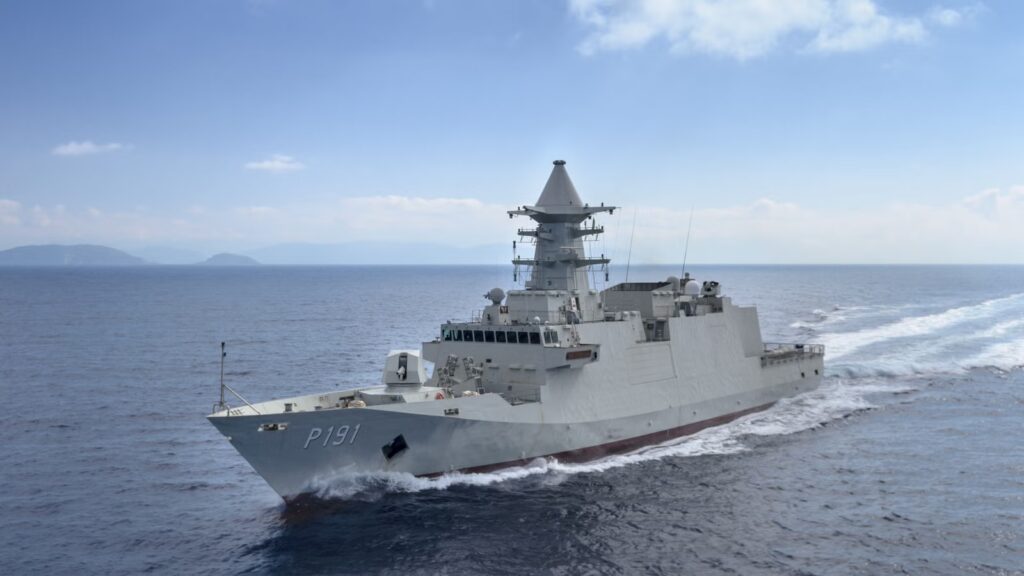
Abu Dhabi Class corvette overview
The Abu Dhabi Class is a Fincantieri-designed and built corvette developed for the United Arab Emirates Navy. The class is represented by the single ship Abu Dhabi (P191), a compact ocean-going combatant optimized for patrol and surveillance while retaining meaningful anti-submarine, anti-surface and point air-defense capability.
The design is based on the Comandante Cigala Fulgosi lineage built for the Italian Navy, but adapted to Emirati requirements with a dedicated ASW sensor fit, tactical data-link capability, a flight deck and retractable hangar, and a balanced missile and gun armament. It fills the gap between smaller patrol craft and larger frigate-type surface combatants in the UAE Navy’s force structure.
Development and delivery
Fincantieri announced the Abu Dhabi Class order in 2009, with the program including crew training and logistic support for the UAE Navy. The ship was launched in February 2011 and delivered at Fincantieri’s Muggiano shipyard in La Spezia in January 2013, alongside the Ghantut patrol vessel from the Falaj 2 program.
The contract included an option for a second sister ship, but no additional Abu Dhabi Class corvette has been publicly identified in UAE Navy service. Abu Dhabi therefore remains a one-ship class, combining the design maturity of the Italian patrol-corvette family with a weapons and sensor package tailored to Gulf maritime-security and ASW requirements.
Design, propulsion and endurance
The corvette has an overall length of 88.40m, a molded breadth of 12.20m and a full-load displacement listed by Fincantieri’s current data as 1,620t; earlier program material cited approximately 1,650t, a small difference likely reflecting source date or measurement convention. The hull form is intended for good seakeeping and maneuverability in open-sea operations as well as regional patrol missions.
Power is provided by two 7,000kW diesel engines. The ship is credited with a maximum speed of at least 25kt and a cruising speed of 14kt. At 14kt, range is 3,000nmi, with an endurance of 20 days and accommodation for 70 personnel.
Combat system and sensors
The Abu Dhabi Class is equipped with an integrated combat management system and data-link capability, allowing tactical information exchange with other naval units, helicopters and shore facilities. The original program identified Selex Sistemi Integrati, now part of Leonardo, as the combat-system supplier.
The sensor suite includes a 3D surveillance radar, identification friend-or-foe equipment, a fire-control system, two optronic fire-control systems, navigation radars, radar electronic-support measures and an expendable bathythermograph system. For ASW missions, the ship carries both a hull-mounted sonar with underwater telephone and a towed-array sonar, giving the class a stronger underwater-warfare focus than many patrol-oriented corvettes of similar displacement.
Armament and mission equipment
The primary gun armament consists of a 76/62 Super Rapid main gun forward and two 30mm secondary guns. Fincantieri lists a 2 x 2 ship-to-ship missile installation, a Rolling Airframe Missile point-defense system, and a torpedo-launching system with two launchers. The defensive fit also includes anti-torpedo decoy launchers and anti-air-warfare decoy launchers.
Aviation facilities are a key element of the design. Fincantieri lists a flight deck and retractable hangar suitable for Panther and Super Puma helicopters, enabling the corvette to support embarked or visiting UAE Navy helicopters for surveillance, maritime interdiction and ASW-related tasking.
Operational role
In UAE Navy service, Abu Dhabi is intended for patrol, surveillance, escort, interdiction and general maritime-security missions, with the ability to contribute to anti-submarine, anti-air and surface actions. Its combination of sonar, torpedoes, ship-to-ship missiles, point defense and helicopter support gives the vessel a multirole combat profile while preserving the endurance and accommodation expected of an offshore corvette.