



Accelerate Defense Modernization through Strategic Sourcing
Discover cutting-edge solutions from leading global suppliers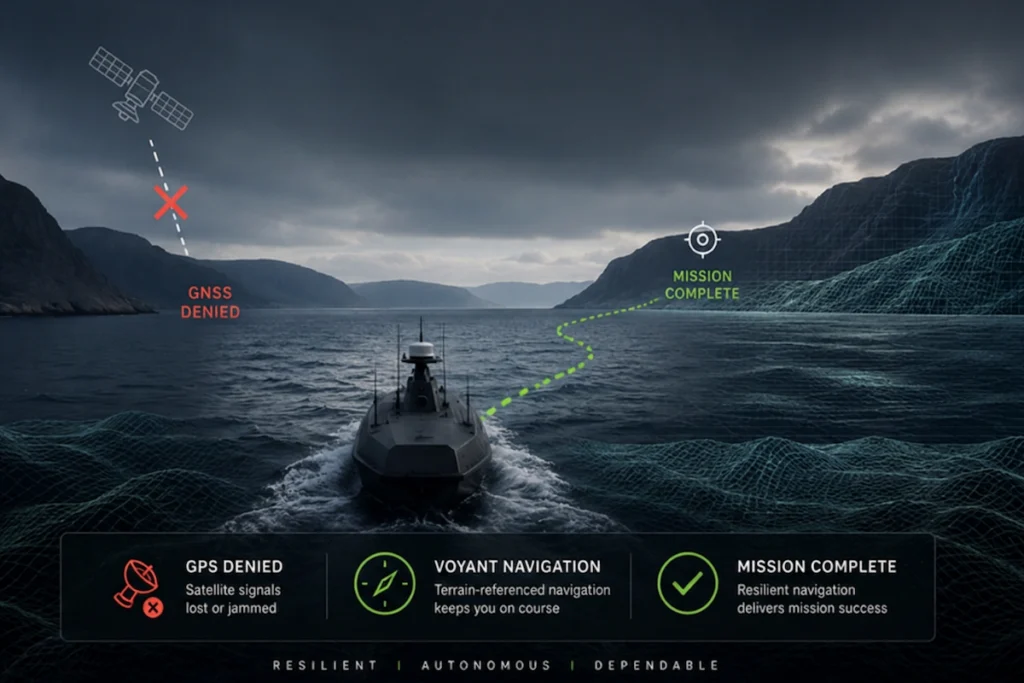
Voyant has demonstrated its advanced navigation software to the UK Ministry of Defence, marking a key step in developing resilient Position, Navigation and Timing capabilities for autonomous maritime platforms in contested environments.
The demonstration took place aboard a Kraken K3 Scout autonomous surface vessel in the demanding littoral waters of the Solent. Operating in real time, Voyant’s software ran advanced particle filter algorithms to compare live radar imagery against pre-existing terrain reference maps, enabling the vessel to determine its precise position without relying on Global Navigation Satellite Systems (GNSS).
The trial forms part of a wider UK Ministry of Defence initiative exploring resilient technologies capable of supporting military operations in contested and congested GNSS-denied environments. For autonomous systems, this capability ensures vessels can continue navigating when satellite navigation is lost or deliberately denied, supporting mission completion and the safe recovery of valuable assets.
Modern military operations depend heavily on GNSS, including GPS, to supply positioning, navigation, and timing data for ships, aircraft, vehicles, missiles, and autonomous platforms. However, satellite signals are increasingly vulnerable to jamming, spoofing, and disruption. This operational challenge is particularly acute in littoral zones, where coastlines, changing terrain, and dense infrastructure can naturally degrade satellite reception even before adversaries actively seek to deny it.
Voyant’s software addresses these vulnerabilities by fusing radar observations with probabilistic algorithms to estimate a vessel’s position relative to its surroundings, while also calculating the uncertainty attributed to that estimate. Rather than relying on signals from space, the platform continuously matches real-time sensor observations against known geographic features to provide trustworthy, resilient navigation.
“Reliable navigation is fundamental to maritime operations, yet we are entering an era where access to GNSS can no longer be assumed,” said James Norwood, CEO of Voyant. “Working alongside Kraken and the Ministry of Defence, we have demonstrated a practical capability that supports the safe and effective deployment of autonomous maritime systems in challenging operational conditions. The demonstration represents another milestone in the UK’s continued investment in sovereign technologies that strengthen resilience, enhance operational freedom and support the next generation of autonomous defence capabilities.”
As uncrewed and autonomous maritime systems assume greater importance across defence and security applications, deploying alternative navigation technologies that ensure safe and reliable operation in degraded environments will be critical to operational success.