

TTP has detailed how the integration of quantum sensors addresses growing vulnerabilities in critical Positioning, Navigation, and Timing (PNT) infrastructure.
Disruption or denial of Global Navigation Satellite Systems (GNSS) presents severe risks to modern infrastructure, with a 24-hour blackout estimated to cost the UK economy over £1 billion. While legacy fallback systems rely on classical inertial or timing technology, these solutions often lack long-term accuracy when operating in isolation. Quantum-enhanced sensors, such as cold atom interferometers and optical atomic clocks, provide significantly higher precision and extended drift-free operation.
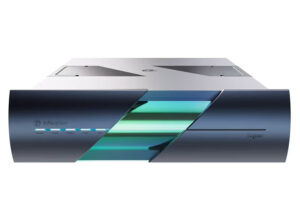
Tiqker, Infleqtion’s Next-Generation Atomic Frequency Reference.
Overcoming Airborne Integration Challenges
Deploying quantum sensors into dynamic environments, such as airborne navigation platforms, introduces complex engineering demands. Integrating systems like Infleqtion’s Tiqker optical atomic clock with a quantum accelerometer creates a high-accuracy, GNSS-independent solution, but real-time validation remains challenging. In dynamic flight conditions, environmental variations and vibration profiles can cause clock outputs to drift subtly, requiring advanced sensor fusion algorithms, pre-emptive calibration, and robust benchmarking.
Managing Quantum Fragility and Probabilistic Output
Because quantum states are inherently delicate, environmental noise poses a constant threat to sensor stability. High-altitude flight introduces fluctuating electromagnetic fields and cabin pressure changes that impact quantum coherence. System designers mitigate these risks using magnetic shielding, active thermal regulation, and vibration isolation—such as mounting a quantum accelerometer on a damped platform within a mu-metal shield.
Furthermore, because quantum systems function probabilistically, performance assurance requires sophisticated stochastic modelling and simulation frameworks to account for edge cases like turbulence.
Context-Specific Deployment and System Redundancy
Quantum sensor integration depends heavily on operational context, as constraints such as Size, Weight, Power, and Cost (SWaP-C) differ vastly between maritime vessels, airborne units, and land-based platforms. Moreover, failure modes in quantum systems differ from classical counterparts, requiring indirect state monitoring and classical feedback loops to maintain system health without constant recalibration.
Industry Approaches to Quantum Readiness

Infleqtion successfully completes commercial flight trials of its un-jammable quantum navigation technology.
To transition these systems from laboratory settings to field applications, Infleqtion utilizes a modular, application-driven architecture.
Ryan Hanley, Head of Research and Development, UK at Infleqtion, said, “Infleqtion is advancing quantum PNT sensors from the laboratory to real-world deployment by pairing world-class cold atom expertise with a system-level approach to integration. We design our quantum systems around real-world constraints—such as SWaP-C, environmental robustness, and mission-specific requirements—building modular, application-driven platforms that complement classical systems and enable seamless integration.
“Each product is engineered with the end-use case in mind, from airborne to maritime platforms, allowing us to tailor interface specifications for GNSS-denied PNT operations and ensure performance in diverse conditions.
“Infleqtion leads in developing deployable quantum technologies. Our work includes deploying cold atom PNT systems on airborne and maritime platforms, delivering a world-leading neutral atom quantum computer for the UK, and contributing to the production of Bose-Einstein condensates aboard the International Space Station. Field trials, together with deep collaboration with partners like QinetiQ and BAE Systems, have enabled us to validate performance, understand integration challenges such as failure modes, performance limits, and environmental constraints, and mature our technology stack for mission-critical use in defence and commercial markets.”
TTP works alongside system integrators to bridge the gap between emerging quantum technologies and practical, deployable platforms, ensuring architectures capitalize on quantum capabilities without operational disruption.
Read Navigating uncertainty – integrating quantum sensors for reliable PNT for more information.