Showcase your capabilities
If you design, build or supply Military USVs, create a profile to showcase your capabilities and connect with visitors who have an active requirement for your solutions.




Source military USV platforms from leading manufacturers and suppliers developing unmanned surface vehicles for naval operations, maritime security, and critical infrastructure protection. Military USVs combine autonomous navigation, advanced sensors such as radar, sonar, lidar, GNSS, and INS, and robust propulsion systems to support intelligence surveillance and reconnaissance, border patrol, port protection, and offshore asset protection.
Read the Technology Overview


Advanced Mission Systems for Defense Forces Across the Land, Air, Naval & Space Domains

Naval Vessels, Submarines & Autonomous Maritime Systems for Modern Defense Forces

Crewed & Uncrewed Vessels for Naval Defense, Coast Guard & Humanitarian Missions

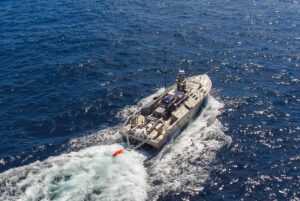
Cutting-Edge Defense Technologies Empowering The Warfighter On The Modern Battlefield

If you design, build or supply Military USVs, create a profile to showcase your capabilities and connect with visitors who have an active requirement for your solutions.

Military USVs, also known as unmanned surface vehicles or naval drone boats, are autonomous, semi-autonomous, or remotely operated vessels designed to operate without onboard crew. They support missions such as intelligence, surveillance, and reconnaissance, anti-submarine warfare, mine countermeasures, and maritime patrol. Equipped with navigation technologies including GNSS, inertial measurement units, and autonomous control systems, these platforms can conduct long-duration operations with minimal operator input.
Modern military USV platforms integrate sensors such as radar, sonar, infrared cameras, and signals intelligence payloads to support maritime surveillance, target tracking, and communications relay. Modular payload bays enable rapid mission reconfiguration, while autonomous control systems allow coordinated swarm operations and distributed maritime security missions.
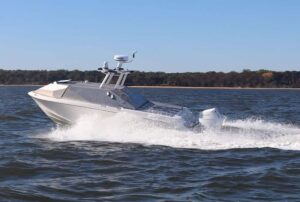
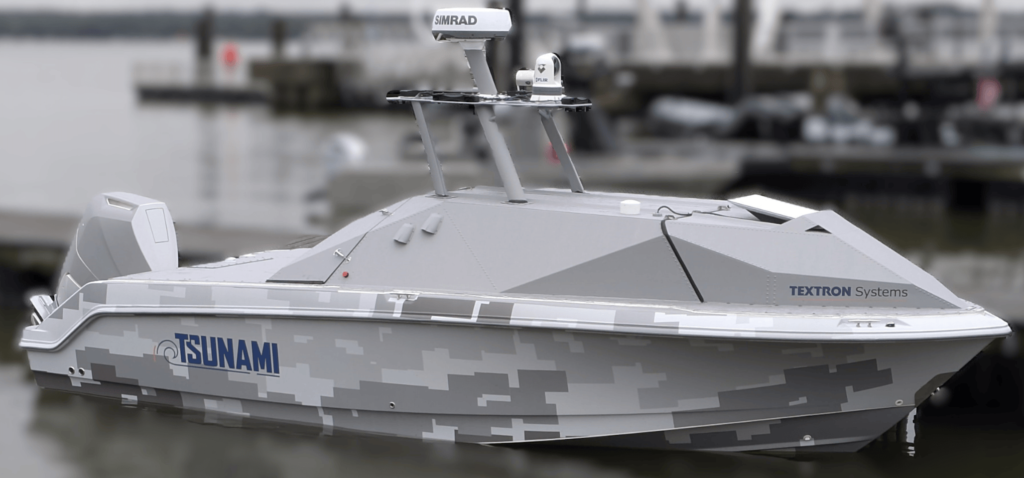
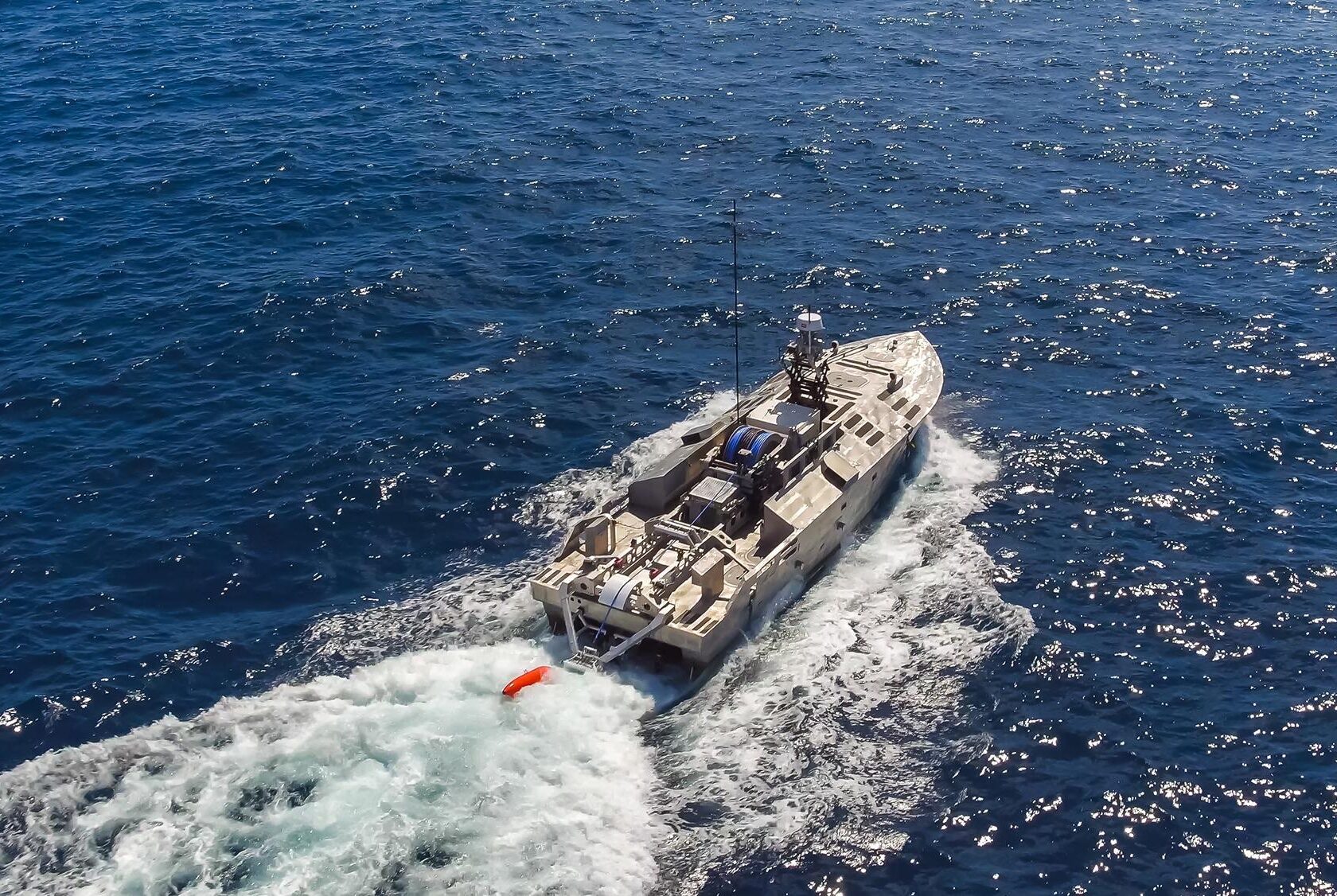
TSUNAMI™ naval USV by Textron Systems.
Military USVs equipped with radar, EO sensors, infrared cameras, and signals intelligence systems provide persistent ISR capabilities for naval forces. These platforms monitor maritime activity and support intelligence-gathering across coastal and open-water environments.
ASW USV platforms integrate sonar and acoustic sensors to detect and track underwater threats. They support anti-submarine operations by extending the detection range of naval fleets while reducing risk to crewed vessels.
Unmanned surface vehicles are widely used for mine detection, mine hunting, and mine sweeping missions. These systems can tow sensors or deploy autonomous underwater vehicles to identify and neutralize naval mines in contested waters.
USV military platforms support border security and coastal surveillance by conducting autonomous maritime patrol operations. Equipped with radar and communications systems, they detect suspicious vessels and support maritime interdiction.
Small USVs and surveillance platforms monitor harbor environments and critical infrastructure. These systems enhance port security and force protection by detecting unauthorized vessels and providing continuous harbor monitoring.
USVs are used for hydrographic mapping and bathymetry survey missions in support of naval navigation and offshore operations. Autonomous survey vessels collect high-resolution seabed data using sonar and bathymetric sensors.
Small unmanned surface vehicles are compact platforms designed for coastal surveillance, harbor monitoring, and reconnaissance missions. Their portability and rapid deployment make them ideal for maritime security operations.
MUSV platforms provide greater endurance and payload capacity than small USVs. They are commonly used for ISR missions, communications relay, and maritime surveillance over extended operational areas.
Fleet-class USVs are larger autonomous surface vessels capable of operating alongside naval ships on long-duration missions. Fleet-class and large USV platforms may support electronic warfare, intelligence, surveillance, and reconnaissance, as well as distributed maritime operations.
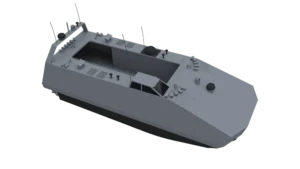
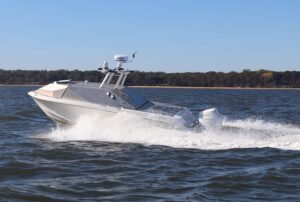
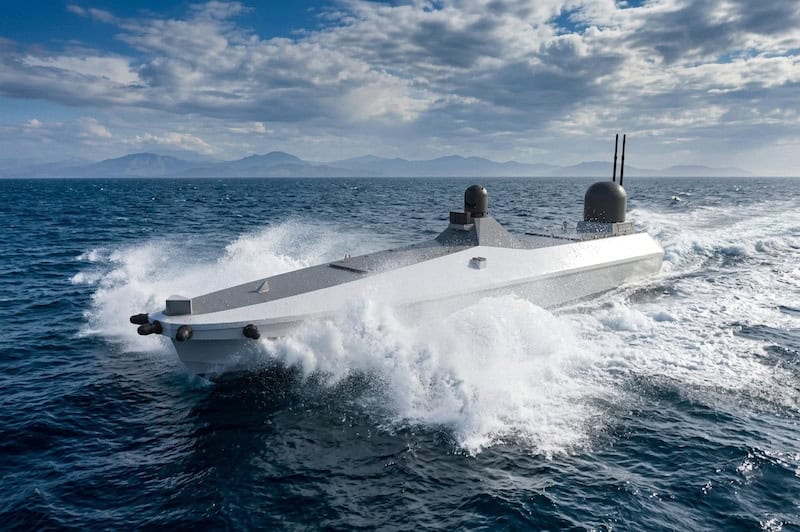
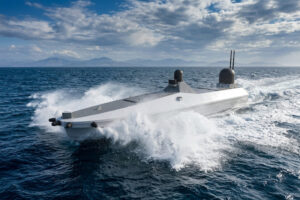
AIRCAT Panther autonomous military USV by Eureka Naval Craft.
Armed USVs integrate weapon mounts or remote weapon systems for defensive or offensive missions. These combat USV platforms support escort operations, anti-surface warfare, and maritime force protection.
Key technologies enabling unmanned surface vehicle military platforms include navigation systems, sensor payloads, propulsion systems, and autonomous control architectures.
Navigation systems typically integrate GNSS receivers, inertial navigation systems, and IMUs to provide precise positioning and autonomous navigation. These technologies allow USVs to operate reliably in complex maritime environments.
Sensor payloads include radar, lidar, sonar, EO/IR sensors, and electronic support measures, enabling maritime monitoring, target tracking, and intelligence gathering. Signals intelligence and electronic warfare payloads allow USVs to detect and analyze electromagnetic emissions from adversary systems.
Propulsion systems may include diesel engines, electric motors, or hybrid propulsion systems optimized for endurance and efficiency. Power management systems and battery systems ensure the reliable operation of onboard sensors and mission computers.
Control systems typically consist of an onboard mission computer, remote control stations, and satellite communication links. SATCOM and secure communication systems allow operators to monitor and control USV platforms during long-range maritime missions.
Military USV platforms are often designed to comply with relevant defense standards and interoperability frameworks. These include NATO STANAG standards for maritime interoperability and communication protocols used across allied naval forces.
Environmental and ruggedization requirements are frequently aligned with MIL STD specifications covering shock, vibration, temperature tolerance, and electromagnetic compatibility. Compliance with these standards ensures reliable operation in harsh maritime environments and compatibility with naval command-and-control systems.
Integration with naval C4ISR architectures is also critical for operational deployment. USVs must support secure data links, sensor integration, and interoperability with existing naval platforms to enable coordinated maritime surveillance and distributed naval operations.


 Searching Companies & Products