Showcase your capabilities
If you design, build or supply Fast Interceptor USVs, create a profile to showcase your capabilities and connect with visitors who have an active requirement for your solutions.


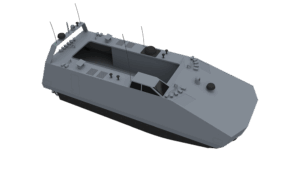
Select uncrewed fast interceptor boats from leading manufacturers and suppliers engineered for high-speed pursuit, maritime interdiction, and force protection in contested environments. Unmanned high-speed USVs integrate marine radar, camera gimbal systems, GNSS, inertial navigation systems, and satellite communication to support ISR operations, perimeter security, and maritime domain awareness across diverse deployment scenarios.
Read the Technology Overview
Crewed & Uncrewed Vessels for Naval Defense, Coast Guard & Humanitarian Missions

Cutting-Edge Defense Technologies Empowering The Warfighter On The Modern Battlefield

If you design, build or supply Fast Interceptor USVs, create a profile to showcase your capabilities and connect with visitors who have an active requirement for your solutions.

Uncrewed fast interceptor boats are high-speed USVs designed for rapid response in demanding operational environments. Engineered for maritime interdiction, border patrol, and critical infrastructure protection, they combine high-performance propulsion with advanced navigation and communication systems. These platforms support ISR operations, intelligence gathering, and high-speed pursuit in contested environments while reducing risk to personnel and extending operational reach.
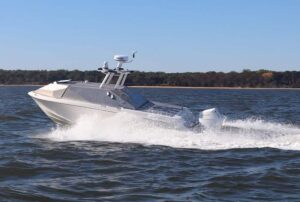
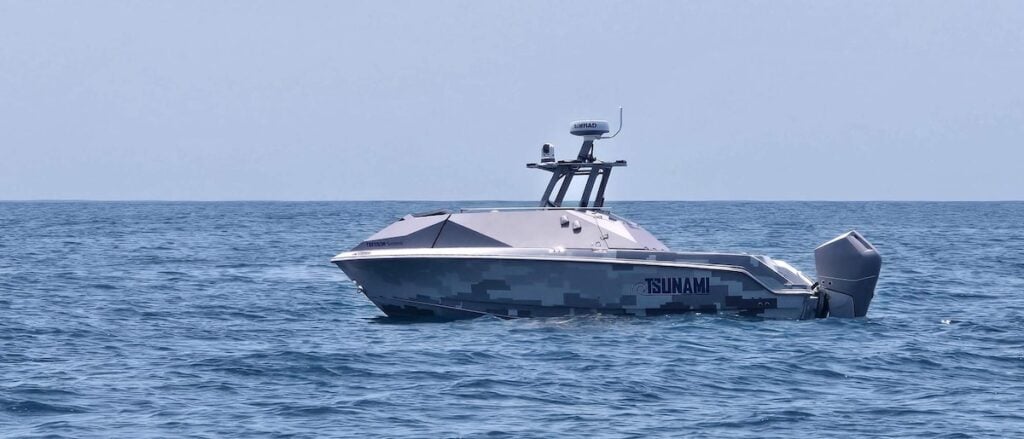
TSUNAMI™, a rapidly deployable and attritable USV, from Textron Systems
Fast interceptor USVs support border patrol and maritime law enforcement by conducting high-speed pursuits and intercepting suspect vessels. They enable a persistent presence without risking crew in contested environments. Integration with ISR systems enhances intelligence collection and interdiction effectiveness.
These platforms provide force protection for ports, offshore assets, and coastal infrastructure. Autonomous patrol patterns and sensor fusion enable rapid threat response and perimeter security enforcement. They operate effectively in complex harbor security environments.
Unmanned fast interceptor boats are deployed for anti-piracy operations and offshore security missions. Their speed and autonomy enable rapid deployment to emerging threats. Satellite communication ensures continuous control in remote maritime environments.
Fast interceptor USVs function as agile ISR platforms for intelligence gathering and maritime surveillance. Sensor suites, including marine radar, camera gimbal, and thermal imaging camera, support real-time target tracking. Data links enable seamless integration into broader ISR operations.
Remote-operated systems rely on ground control stations and remote control unit architectures for human-in-the-loop control. They prioritize secure communication systems and low-latency data link performance. Suitable for precise interdiction in complex operational environments.
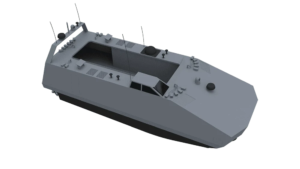
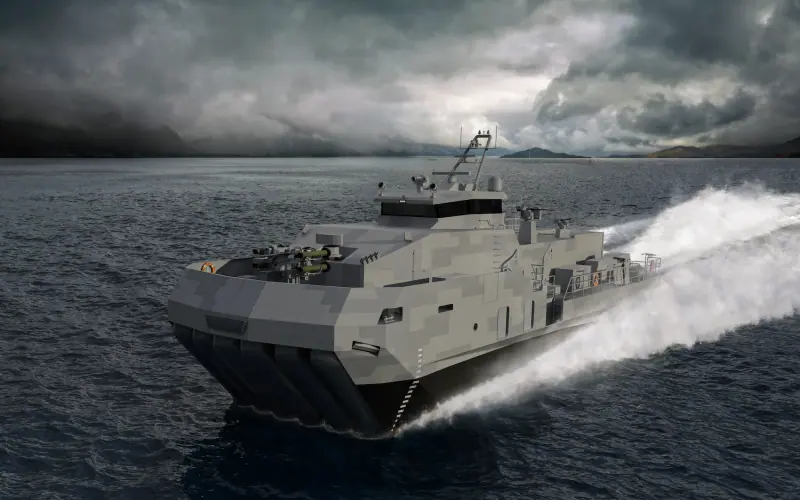
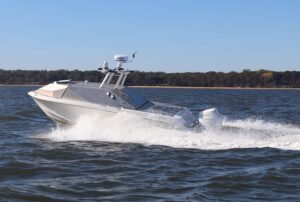
AIRCAT Panther, a fast autonomous surface vessel, from Eureka Naval Craft
Autonomous surface vessel configurations incorporate onboard computers and AI processor capabilities for navigation and threat response. They enable reduced operator workload and scalable deployment scenarios. Collision avoidance system integration supports safe autonomous maneuvering.
Hybrid control systems combine autonomous operation with operator override via communication systems. They offer flexibility across mission requirements and operational environments. These platforms are optimized for dynamic ISR operations and multi-role deployment.
Fast interceptor boat USVs are typically categorized into small, medium, and large USVs based on displacement, payload capacity, and endurance, with each class aligned to specific operational environments and mission requirements.
Small USVs are optimized for harbor and perimeter security, as well as rapid deployment scenarios. Their low SWaP footprint supports high-speed interception in constrained environments. They are typically used for force protection and short-duration ISR operations.
Medium USVs balance speed, payload capacity, and endurance for maritime interdiction and border patrol missions. They support integrated sensor suites including marine radar, camera gimbal, and satcom systems. These platforms are commonly deployed in coastal patrol and high-speed pursuit operations.
Large USVs provide extended endurance and increased payload capacity for offshore security and persistent ISR operations. They support advanced communication systems, multi-sensor integration, and long-range deployment scenarios. These platforms are suited for sustained maritime domain awareness in contested environments.
System integration enables modular payload bays to support camera gimbal systems, electro-optical camera and infrared camera payloads, marine radar, AIS receiver, and lidar sensors. These subsystems provide target tracking, anomaly detection, and maritime surveillance capabilities across diverse operational environments. Sensor fusion enhances ISR operations and real-time intelligence collection.
Navigation and positioning rely on the Global Navigation Satellite System (GNSS) and inertial navigation systems (INS) to maintain accuracy in degraded or contested environments. These systems ensure reliable guidance during high-speed pursuit and interception missions. Integration with collision avoidance system technologies supports safe maneuvering in congested waters.
Propulsion system configurations include water-jet propulsion, jet drive, and hybrid propulsion architectures optimized for acceleration and maneuverability. These systems support shallow-water access and rapid deployment scenarios. Power systems and energy storage system design must balance endurance with SWaP constraints.
Secure data link, satcom, and radio link technologies enable command-and-control via ground-control-station infrastructure. These communication systems support beyond-line-of-sight operations and real-time telemetry. Integration with C4ISR frameworks ensures coordinated ISR operations, maritime domain awareness, and force protection.
The successful deployment of fast interceptor USVs depends on robust system integration among propulsion, control, sensor, and communication systems. Compatibility with existing ground control station infrastructure and C4ISR architectures is critical for operational effectiveness.
SWaP constraints must be carefully managed when integrating payloads such as camera gimbal, marine radar, and satellite communication modules. Modular design enables rapid reconfiguration to meet different mission requirements, from maritime interdiction to intelligence, surveillance, and reconnaissance.
Deployment scenarios include coastal patrol, harbor security, offshore security, and distributed ISR operations. These platforms are increasingly used in swarm missions and coordinated fleet protection strategies, enhancing force protection and maritime domain awareness in contested environments.
Compared with manned fast interceptor boats, unmanned fast interceptor USVs eliminate the risk of onboard crew during high-speed pursuit and interdiction missions. They provide extended endurance through optimized power systems and reduced life support requirements. Integration into networked C4ISR architectures enhances coordination across distributed maritime assets.
However, manned platforms may offer greater on-scene decision-making flexibility in complex boarding scenarios. USVs compensate through advanced autonomy, sensor fusion, and real-time communication systems. The selection depends on mission requirements, rules of engagement, and operational constraints.
Fast interceptor USVs are developed in alignment with relevant military and maritime standards to ensure interoperability and reliability. STANAG frameworks support communication systems and data link compatibility across allied forces. MIL-STD requirements govern environmental resilience, electromagnetic compatibility, and system durability in harsh operational environments.
Navigation and positioning systems align with GNSS standards, ensuring interoperability with GNSS infrastructure. Collision avoidance system implementation may follow COLREGs compliance frameworks adapted for autonomous surface vessel operations. Cybersecurity considerations are increasingly aligned with defense-grade communication and control system standards.


 Searching Companies & Products