Showcase your capabilities
If you design, build or supply EW & SIGINT USVs, create a profile to showcase your capabilities and connect with visitors who have an active requirement for your solutions.




Select USVs for electronic warfare and SIGINT operations from leading manufacturers and suppliers. These platforms integrate advanced sensors, spectrum analyzers, and communications intelligence payloads for contested environments. Built for persistent deployment, they support intelligence gathering, force protection, and maritime situational awareness for defense, emergency services, and public safety organizations.
Read the Technology Overview
Crewed & Uncrewed Vessels for Naval Defense, Coast Guard & Humanitarian Missions

If you design, build or supply EW & SIGINT USVs, create a profile to showcase your capabilities and connect with visitors who have an active requirement for your solutions.

Electronic warfare USVs are unmanned surface vessels engineered to support signals intelligence, electronic surveillance, and electronic warfare operations in complex operational environments. These platforms extend ISR operations by providing persistent, low-signature presence for intelligence gathering, communications monitoring, and emissions detection without exposing crewed assets.
Configured with modular subsystems, electronic warfare USVs integrate SIGINT, ELINT, and COMINT systems alongside navigation and positioning technologies such as inertial navigation systems and GPS modules. This enables precise geolocation, signal analysis, and real-time data dissemination across mission systems and C4ISR networks.
Electronic warfare USVs are deployed to meet evolving mission requirements across contested environments, where traditional platforms face increased risk. Their unmanned nature supports:
These platforms support naval intelligence and maritime reconnaissance while contributing to force protection and fleet protection strategies. Their ability to operate autonomously or semi-autonomously enables scalable deployment across distributed maritime operations.
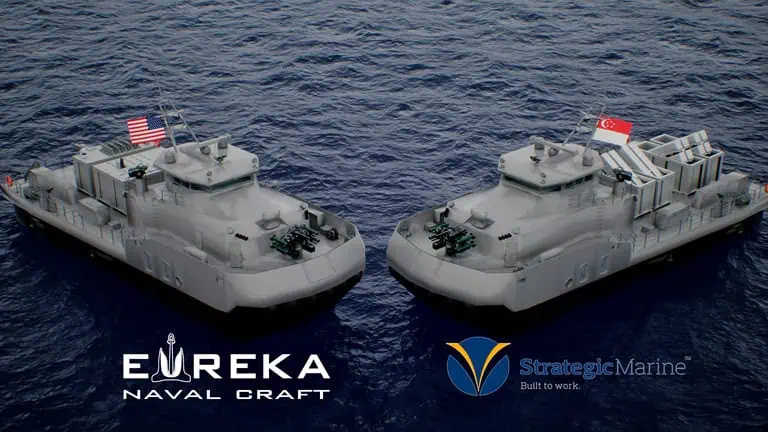
AIRCAT Panther multi-mission USV with electronic warfare capability by Eureka Naval Craft.
Electronic warfare USVs support ISR operations by delivering persistent signals intelligence and electronic surveillance across wide maritime areas. They enhance situational awareness through continuous data acquisition and real-time intelligence dissemination. Integration with ISR mission systems ensures interoperability across joint operations.
These platforms enable continuous coastal monitoring and maritime border security by detecting emissions, monitoring communications, and tracking vessels of interest. Their low-profile deployment supports discreet intelligence gathering in sensitive regions. They are increasingly used by public safety organizations for maritime domain awareness.
Electronic warfare USVs conduct electronic intelligence and signals intelligence collection using advanced ESM systems and signal processors. They identify, classify, and geolocate emitters across the electromagnetic spectrum. This supports threat analysis and operational planning in dynamic environments.
Equipped with COMINT systems and spectrum analyzers, USVs enable monitoring and interception of communications across multiple frequency bands. They support law enforcement and emergency services in tracking unauthorized or suspicious transmissions. This capability is critical for both military and civilian security operations.
These platforms are designed for flexible payload integration, enabling rapid reconfiguration of SIGINT systems, sensors, and antennas. They support evolving mission requirements and enable cost-effective upgrades. Modular architectures simplify system integration across multiple deployment scenarios.
Long-endurance electronic warfare USVs prioritize extended mission duration through optimized propulsion systems and power supply systems. They support persistent ISR operations over large maritime areas. These platforms are ideal for continuous surveillance and intelligence gathering missions.
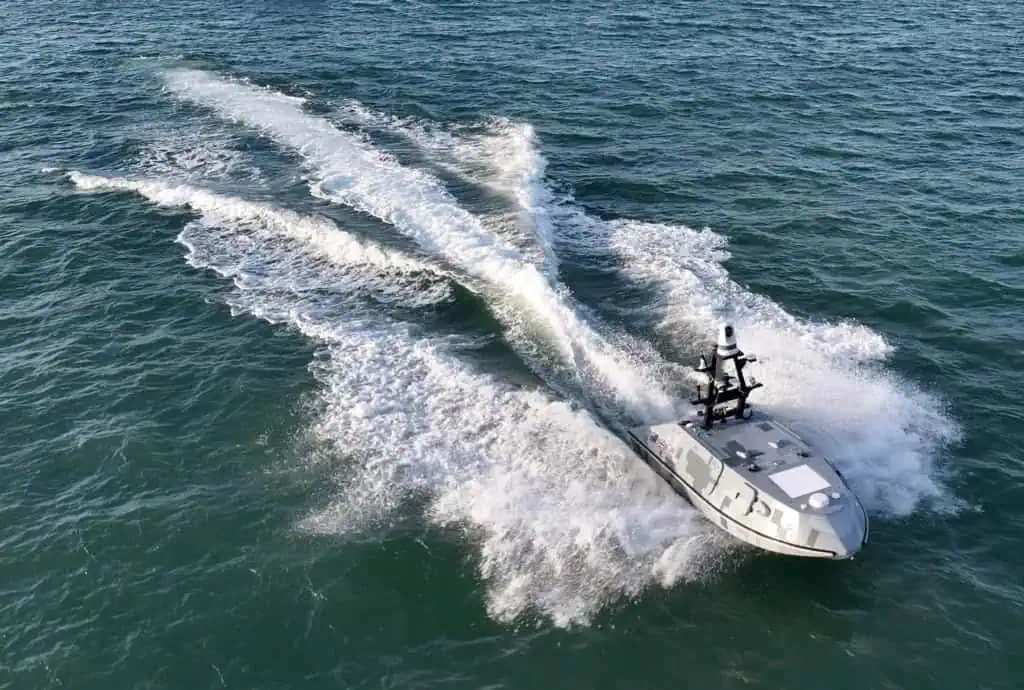
High-speed variants are designed for rapid deployment and responsive operations in dynamic environments. They support time-sensitive ISR missions and electronic warfare operations near contested zones. Their agility enhances survivability and mission flexibility.
Electronic warfare USVs are built around mission-driven system integration, combining payloads, control systems, and communications subsystems into a unified operational platform. Key components include:
These subsystems must operate within strict SWaP constraints while maintaining reliability in harsh maritime conditions. Integration with radar, infrared, and camera systems enables multi-domain ISR missions and enhances maritime surveillance capabilities.
Compared to crewed vessels, electronic warfare USVs reduce operational risk while enabling persistent presence in contested environments. They offer lower operational costs and can be deployed in greater numbers to support distributed ISR operations.
Compared with unmanned aerial systems, USVs offer longer endurance and greater payload capacity for SIGINT, radar, and data storage systems. While UAVs offer broader coverage, USVs provide sustained proximity to targets and improved signal-collection fidelity.
Unmanned underwater vehicles provide covert capabilities but are limited in communications and real-time data transmission. Electronic warfare USVs bridge this gap by enabling continuous connectivity via satellite communications and data links.
Electronic warfare USVs are developed in alignment with defense and maritime standards to ensure interoperability and mission readiness. Relevant frameworks include:
Compliance with these standards ensures that electronic warfare USVs can be integrated into existing mission systems and deployed across joint and coalition operations.
Electronic warfare USVs are designed to integrate seamlessly with broader C4ISR architectures, enabling real-time data exchange and coordinated operations. Their compatibility with satellite communications, data link systems, and mission computers supports network-centric warfare and intelligence sharing.
Advanced signal processing units and data storage modules enable onboard analysis and post-mission exploitation. This reduces latency in intelligence workflows and enhances decision-making in time-critical scenarios.
As electronic warfare and signals intelligence requirements continue to evolve, electronic warfare USVs provide a scalable, adaptable platform for maritime intelligence, surveillance, and reconnaissance operations across defense, emergency response, and public safety domains.


 Searching Companies & Products