Showcase your capabilities
If you design, build or supply Remotely Operated USVs, create a profile to showcase your capabilities and connect with visitors who have an active requirement for your solutions.




Select remotely operated USV manufacturers and suppliers delivering configurable platforms with advanced sensor payloads, secure data links, and ISR-ready control systems for defense operations.
Read the Technology Overview
Naval Vessels, Submarines & Autonomous Maritime Systems for Modern Defense Forces

Cutting-Edge Defense Technologies Empowering The Warfighter On The Modern Battlefield

Autonomous Systems, Subsea Sensing & Underwater Technologies for Maritime Defense

If you design, build or supply Remotely Operated USVs, create a profile to showcase your capabilities and connect with visitors who have an active requirement for your solutions.

Remotely operated USVs provide deployable, networked capabilities for ISR operations, threat detection, and maritime interdiction across complex operational environments. These platforms extend naval reach while reducing risk to personnel, supporting mission requirements across coastal, littoral, and open-ocean deployment scenarios.
These platforms are designed to support multi-domain integration within C4ISR architectures, enabling coordination with aerial, subsurface, and manned assets. Their flexibility supports rapid deployment, scalable force protection, and persistent surveillance across a wide range of maritime security applications.
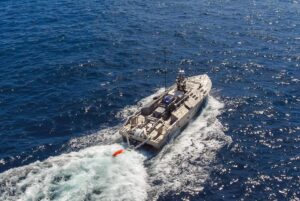
CUSV, a rapidly-reconfigurable USV, from Textron Systems
Remotely operated USVs support intelligence, surveillance, and reconnaissance operations through persistent sensor deployment and real-time data relay. They enable extended coverage without exposing crewed vessels in contested environments.
USVs equipped with sonar and mine-detection payloads conduct mine countermeasures and mine-clearance operations. These platforms reduce risk during route clearance and harbor access operations.
These systems provide continuous maritime surveillance for border, port, and perimeter security. Their deployment supports threat detection and tracking across critical infrastructure zones.
Remotely operated USVs can deploy sonar payloads and support anti-submarine warfare operations. They act as distributed sensor nodes within broader naval task groups.
USVs enhance search-and-rescue operations and disaster response by enabling access to hazardous environments. Remote operation enables rapid deployment without risk to human operators.
These platforms support force protection and convoy protection by monitoring and intercepting threats. They are used in escort missions and maritime interdiction scenarios.
Small USVs are optimized for rapid deployment and nearshore operations. They are used for harbor security, infrastructure inspection, and short-range ISR missions.
Medium USVs balance endurance and payload capacity for extended ISR operations and maritime patrol. They are commonly deployed for multi-mission roles, including surveillance and interdiction.
Large USVs support long-duration missions with expanded payload integration, including electronic warfare systems and remote weapon systems. These platforms operate in open-ocean environments and complex deployment scenarios.
Armed USVs integrate remote weapon systems to support force protection and combat USV roles. They are deployed in high-threat environments that require rapid response and engagement capabilities.
Remotely operated USVs rely on tightly integrated subsystems to meet mission requirements in complex deployment scenarios.
GNSS, inertial navigation systems, and sensor fusion enable precise navigation and positioning in degraded or contested environments. These systems ensure reliable waypoint tracking, station keeping, and route execution during ISR missions and maritime patrol operations.
Radar, lidar, sonar, and electro-optical systems provide multi-layered threat detection and target tracking capabilities. These payloads support maritime surveillance, mine detection, and anti-submarine warfare operations under varying environmental conditions.
Satellite communication and secure data link architectures enable beyond-line-of-sight control and real-time data transmission. These systems are critical for ISR operations and coordinated deployment scenarios across distributed naval forces.
Advanced control systems and autopilot technologies stabilize vessel behavior and support semi-autonomous functions. Operators maintain direct command authority while leveraging automation for collision avoidance and mission-execution efficiency.
Power management systems optimize endurance and payload operation under SWaP constraints. Efficient propulsion enables long-duration missions, including coastal surveillance and persistent ISR operations.
Remotely operated USVs differ from autonomous surface vessels in command architecture and operational control. Remote systems maintain continuous operator oversight, enabling real-time adaptation to mission requirements and evolving threats.
Autonomous surface vessels rely on pre-programmed behaviors and onboard decision-making, which may be constrained in contested environments with electronic warfare interference. Remotely operated platforms provide greater control in ISR missions, electronic warfare operations, and maritime interdiction where human judgment is critical.
Hybrid approaches combining remote operation with autonomous functions are increasingly deployed to balance control and endurance.
Remotely operated USVs are developed in alignment with defense and maritime standards to ensure interoperability and operational reliability.
Relevant frameworks include MIL-STD requirements for environmental and electromagnetic performance, STANAG protocols for interoperability across allied forces, and ISO standards governing maritime safety and system integration. Compliance ensures compatibility within C4ISR ecosystems and supports deployment across joint and coalition operations.
System integration is critical for ensuring remotely operated USVs meet mission requirements across diverse operational environments. Integration with mission systems, ISR networks, and electronic warfare systems enables coordinated deployment and data sharing.
Key considerations include SWaP constraints, payload compatibility, communication resilience, and navigation system redundancy. Deployment scenarios range from coastal surveillance and harbor security to open-ocean ISR operations and anti-submarine warfare.
Remotely operated USVs provide a scalable, adaptable solution for modern naval forces, supporting persistent presence and mission flexibility across contested environments.


 Searching Companies & Products