
Showcase your capabilities
If you design, build or supply Loitering Munitions, create a profile to showcase your capabilities and connect with visitors who have an active requirement for your solutions.




Select loitering munitions and kamikaze drones from trusted manufacturers and suppliers for precision strike, target acquisition, and modern tactical operations. These one-way attack drone systems support defense programs seeking expendable unmanned aerial vehicle platforms with integrated seeker, autopilot, data link, and warhead technologies. From short-range tactical drone requirements to long-range loitering munition capabilities, the market spans systems optimized for survivability, flexible launch methods, and rapid target engagement.
Read the Technology Overview

Cutting-Edge Defense Technologies Empowering The Warfighter On The Modern Battlefield

If you design, build or supply Loitering Munitions, create a profile to showcase your capabilities and connect with visitors who have an active requirement for your solutions.

Loitering munitions combine unmanned aerial system persistence with precision guided munition effects, enabling operators to loiter over a target area, conduct ISR and target confirmation, and strike at the optimal moment. Typical systems integrate airframes, propulsion, flight control systems, inertial navigation systems with GNSS guidance, data links, and mission computers, alongside payloads such as fragmentation, thermobaric, or anti-radiation warheads. Their flexibility supports precision strike against mobile or time-sensitive targets, suppression of enemy air defenses, and distributed operations without requiring larger manned platforms.
A loitering munition differs from a traditional missile because it is designed to search, observe, and wait before impact. A missile usually follows a direct flight profile toward a predesignated point, whereas a loitering munition can adjust its trajectory during flight based on updated sensor data, target acquisition, or operator input.
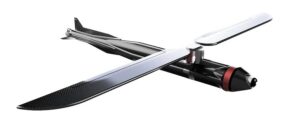
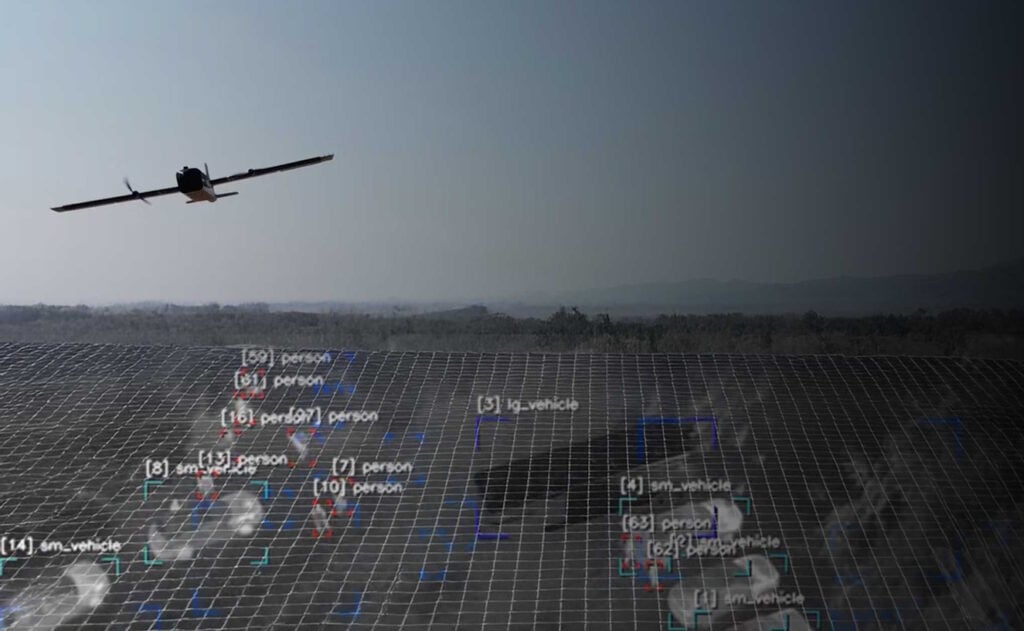
Peregrine Loitering UAS by Arctic Horizons
It also differs from a recoverable UAV or tactical drone. A standard unmanned aerial vehicle is generally intended for ISR, communications relay, or reusable strike missions, whereas a disposable loitering munition is the weapon itself. That distinction affects airframe design, payload integration, launch system requirements, and procurement priorities.
Compared with larger strike drones, loitering munitions are usually smaller, faster to deploy, and easier to integrate at platoon, vehicle, ship, or expeditionary level. Their tradeoff is lower endurance, smaller payloads, and reduced multirole capability compared with reusable military drones.
Loitering munitions are used for precision strike against high-value, mobile, or briefly exposed targets. Their onboard seeker and guidance system helps reduce wasted effects and improve engagement timing.
Anti-radiation loitering munition concepts support SEAD missions by homing on radar emissions or targeting air defense nodes. This role is important in contested environments where quick reaction and stand-in attack are required.
Some concepts support counter-UAS or rapid battlefield response by intercepting or striking emerging threats near frontline formations. Their low launch signature and distributed deployment make them useful in dynamic operating areas.
Maritime-launched and ship-launched configurations extend strike options against small surface threats or coastal targets. Compact launch systems are especially relevant where deck space and integration margins are limited.
Swarm-capable and AI-coordinated loitering systems can overwhelm defenses, increase search coverage, and distribute targeting across multiple platforms. These approaches are becoming more relevant as network-centric operations expand.
Tube-launched systems are valued for portability, fast setup, and compatibility with dismounted or vehicle-launched operations. They are commonly used for short-range missions and expeditionary deployment.
Catapult launchers support larger airframes that need more launch energy without a runway. This type can improve payload capacity and endurance for tactical units.
Air-launched loitering munition designs extend standoff reach and allow rapid employment from aircraft or larger unmanned platforms. They are often considered where operational tempo and reach are critical.
Long-range loitering munition systems emphasize endurance, communication systems, and navigation resilience. They are suited to deep strike, persistent surveillance, and high-value targeting.
These variants use radar seeker or RF-homing approaches to engage emitters and support air defense suppression. Their mission profile prioritizes seeker sensitivity, target reacquisition, and rapid terminal attack.
Navigation performance is central to mission success. Most systems combine inertial navigation systems with GNSS inputs, and some add anti-jam or degraded-navigation modes to preserve guidance in contested electromagnetic environments. For procurement teams, the balance between INS, GNSS resilience, and mission computer sophistication often determines effectiveness in real-world operations.
Seeker selection also drives operational fit. Electro-optical (EO) sensors, IR sensor packages, imaging seeker options, and anti-radiation seeker configurations each support different target sets and weather or visibility conditions. Programs should assess seeker performance alongside data links, operator workload, and latency through the GCS.
Propulsion choices shape endurance, signature, and sustainment. Battery-powered electric motor designs can reduce noise and simplify logistics, while internal combustion engines may support longer-range missions and heavier payloads. Airframe efficiency, wing design, and fuel system integration all influence total loitering capability.
Launch and control architecture matter as much as the air vehicle. Hand-launched, tube launcher, catapult-launched, vehicle-launched, and maritime-launched configurations affect deployment speed and footprint. Ground control station design, communication system hardening, and RF link reliability all influence mission assurance.
Defense buyers often evaluate loitering munitions against broader integration and interoperability requirements rather than a single dedicated standard. Relevant considerations may include MIL-STD-810 for environmental engineering and ruggedization, MIL-STD-461 for electromagnetic compatibility, and MIL-STD-882 for system safety processes. In NATO-aligned programs, STANAG requirements related to UAV interoperability, data exchange, identification, and communications can also shape procurement and integration decisions.
Programs should also assess compatibility with existing C4ISR architectures, launch-system interfaces, target-engagement workflows, and counter-UAS doctrines. As loitering drone use expands across joint and coalition operations, open interfaces and secure communication systems are becoming increasingly important.
Selection depends on mission profile, target set, launch constraints, and command concept. Some users prioritize lightweight, man-portable systems for tactical units, while others need long-range loitering munitions with advanced seekers, larger warheads, and networked data links. The most effective sourcing approach is to compare loitering munition manufacturers and suppliers by endurance, seeker type, launch method, control architecture, warhead options, and integration readiness.


 Searching Companies & Products