Showcase your capabilities
If you design, build or supply Military AI Drones, create a profile to showcase your capabilities and connect with visitors who have an active requirement for your solutions.




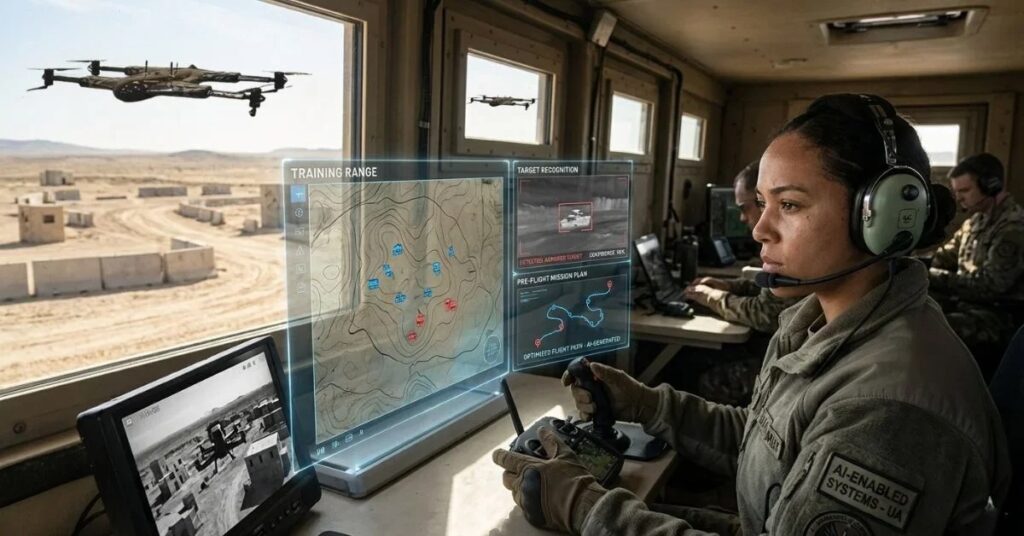
Military AI Drones are Uncrewed Aerial Systems (UAS) that integrate onboard Artificial Intelligence to support sensing, decision-support, and mission execution with reduced operator input. Using machine learning, computer vision, and autonomous reasoning, these platforms process EO/IR, radar, and SIGINT data at the edge to operate effectively in contested, communications-degraded environments.
This guide showcases AI-powered military drone suppliers for ISR, strike support, and swarm operations, enabling faster reaction cycles and scalable deployment.
Read the Technology Overview
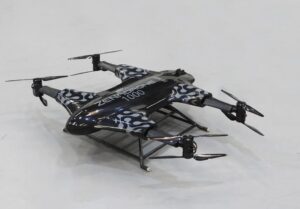
Autonomous UAV Platforms & Drone Services for Military, Government, Security & Emergency Response

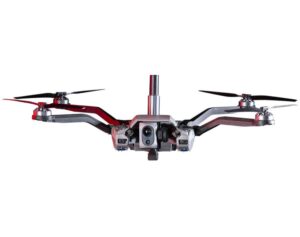
Advanced American-Made Drone Technologies for Aerial ISR (Intelligence, Surveillance & Reconnaissance)

If you design, build or supply Military AI Drones, create a profile to showcase your capabilities and connect with visitors who have an active requirement for your solutions.

Military AI drones are advanced Uncrewed Aerial Systems (UAS) that integrate sophisticated Artificial Intelligence directly into sensing, decision-support, and mission execution functions. Unlike traditional remotely piloted vehicles that rely on continuous human teleoperation, these AI-powered military drones utilize onboard Machine Learning (ML), computer vision, and autonomous reasoning. This enables them to interpret complex environments, prioritize actions, and execute mission tasks with minimal operator input.
The adoption of AI in military drones is a defining factor in future air and maritime warfare as it directly addresses the scale, speed, and complexity of modern conflict. Modern threat environments are increasingly saturated with targets, sensors, and electronic interference. Human operators simply cannot process this immense volume of real-time data or react fast enough to dynamic threats. AI, however, allows these systems to:
In maritime and expeditionary contexts, AI enables persistent coverage over vast areas, effectively multiplying the reach and endurance of manned assets that are often scarce or operationally constrained.
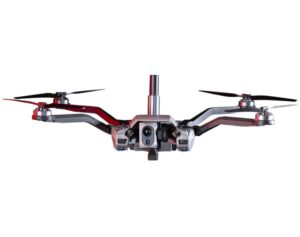
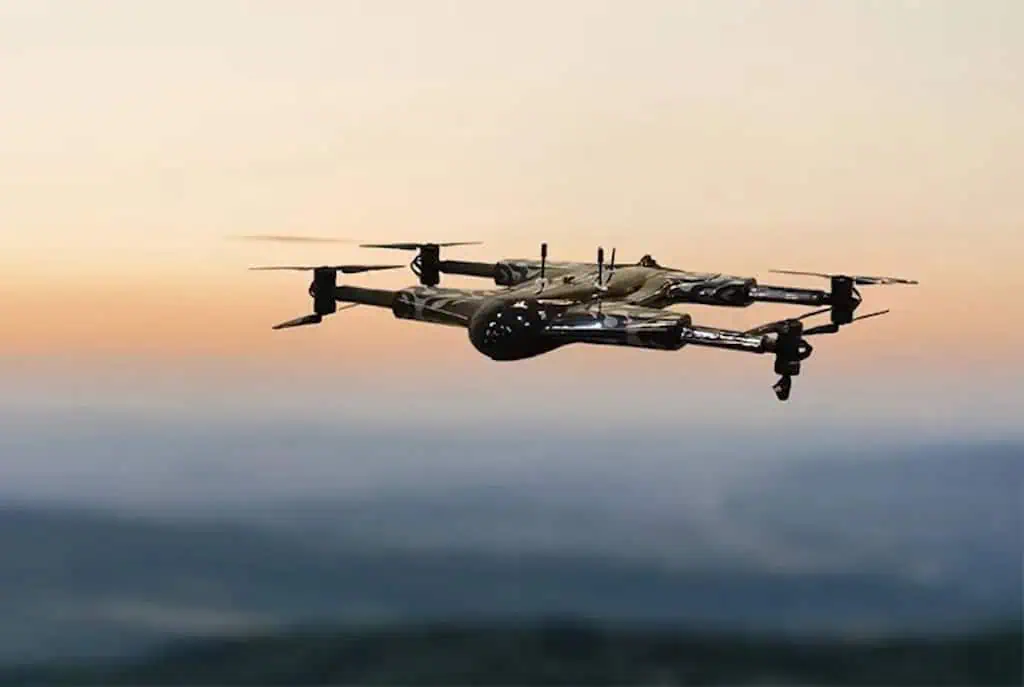
Black Widow™ small military AI drone by Red Cat Holdings.
The capabilities of AI military drones are rapidly segmenting into mission-specific roles, from direct engagement to persistent surveillance.
AI attack drones apply machine intelligence to the most time-critical phases of the kill chain: target detection, classification, prioritization, and engagement support. Onboard AI processes fused sensor inputs, typically Electro-Optical/Infrared (EO/IR), Radar, and Signal Intelligence (SIGINT), to identify valid targets and support engagement decisions. While human authorization often remains a requirement for weapon release, AI dramatically compresses the sensor-to-shooter timeline.
Combining persistent surveillance with Autonomous Target Recognition (ATR), AI-powered autonomous drone systems can patrol an area, detect pre-defined target signatures, and execute precision strikes with minimal external guidance. Their impact lies in their high responsiveness, making them well-suited for contested and dynamic battlefields.
AI combat drones extend beyond single-mission strike roles into multi-mission air combat applications. The central concept driving procurement and development is the Collaborative Combat Aircraft (CCA), often referred to as the “loyal wingman.” In this model, the AI manages complex tasks such as formation keeping, threat detection, sensor fusion, and mission execution, freeing the human pilot in the crewed fighter aircraft to focus on command-level decisions rather than platform control.
AI fighter drones in this category are also being developed for independent roles, including air-to-air engagements, Suppression of Enemy Air Defenses (SEAD), and escort missions. AI allows these platforms to conduct rapid, high-G maneuvering, sophisticated threat reaction, and complex cooperative tactics that far exceed human reaction times.
ISR is perhaps one of the most operationally valuable domains for AI-enabled UAS. Stealth AI drones combine low-observable airframes with intelligent onboard processing to penetrate defended airspace and maintain persistent surveillance. The AI-driven analytics enable real-time interpretation of vast sensor data, significantly reducing reliance on high-bandwidth datalinks and enabling robust operations under strict Emissions Control (EMCON).
AI supports automated detection, classification, and tracking of objects and activities across wide areas. Advanced systems perform pattern-of-life analysis, allowing them to identify anomalies and emerging threats without constant human oversight. This capability is particularly critical for long-endurance missions where the sheer volume of data would otherwise overwhelm ground station operators.
AI drone swarms represent an essential shift in operational thinking, moving from platform-centric to system-centric command. Instead of controlling each drone individually, operators task the swarm as a cohesive whole, while the system’s distributed AI manages formation, dynamic task allocation, navigation, and resilience. This distributed intelligence allows each asset to make necessary local decisions while contributing to a unified mission objective.
Attritable drone swarms are designed for mass deployment, where individual losses are a planned and acceptable risk in exchange for overwhelming an adversary’s layered defenses. AI enables these systems to dynamically reconfigure in response to losses, threats, or mission changes. This approach dramatically complicates enemy targeting, saturates defenses, and introduces new operational dilemmas across air and maritime domains.
Naval forces are increasingly leveraging AI-powered drones to extend situational awareness and defensive reach far beyond the horizon. Navy AI drones support ISR, strike coordination, and sophisticated force protection for Carrier Strike Groups, amphibious task forces, and surface combatants. AI is crucial for enabling these systems to operate autonomously over vast maritime areas where communications are intermittent, delayed, or subject to degradation.
Navy AI drone swarms are highly relevant in littoral and deep-sea environments, enabling coordinated surveillance of choke points and high-value assets. Tight integration with naval combat management systems ensures AI drones contribute their fused sensor data directly into the fleet’s common operational picture, supporting faster threat assessment and coordinated responses across air, surface, and subsurface domains.
The performance capabilities of military AI drones are fundamentally dependent on the sophisticated hardware and software at the platform’s core.
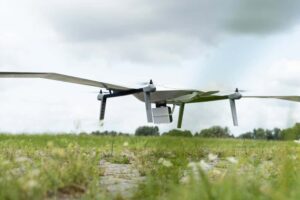
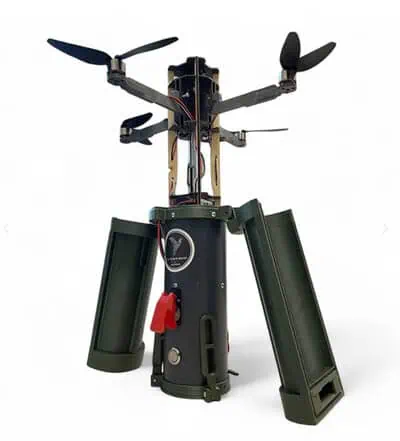
Sentinel airborne AI-powered counter-UAS system by Alpine Eagle.
As drone systems become more complex and autonomous, survivability is intrinsically linked to the intelligence of their software.
The increased networking and autonomy of modern drones makes cybersecurity a paramount concern for mission assurance. AI is increasingly deployed to monitor onboard systems and communications for anomalous behavior indicative of a cyber intrusion. Machine learning models can detect deviations from normal system operation in real time, enabling rapid isolation or mitigation before mission integrity or confidentiality is compromised.
Ensuring secure autonomy requires that AI decision-making remains predictable, verifiable, and strictly aligned with mission intent. The implementation often leverages the Zero Trust Architecture (ZTA) security model. Trusted AI architectures combine secure boot, cryptographic validation, and partitioned software environments to ensure that core autonomy functions cannot be altered, corrupted, or spoofed. These measures are essential for maintaining command trust in AI-driven systems, particularly in weaponized platforms.
AI in drone warfare significantly enhances resilience against advanced electronic warfare (EW) by enabling adaptive responses to jamming, GNSS denial, and sophisticated sensor spoofing. By fusing multiple sensor inputs and learning normal operating patterns, AI can rapidly identify degraded data sources and reweight or discard compromised inputs. This critical capability allows drones to continue operating effectively even when traditional navigation or communications systems are severely disrupted.
The trajectory of development points toward systems with increasing autonomy and cross-domain utility.


 Searching Companies & Products