



Showcase your capabilities
If you design, build or supply Rugged Routers, create a profile to showcase your capabilities and connect with visitors who have an active requirement for your solutions.




In military operations, where communication is critical and conditions are unforgiving, having a reliable, high-performance network is non-negotiable. A rugged router designed specifically for military applications offers the durability and advanced features necessary to maintain secure and stable connections in even the harshest environments. From robust WiFi routers to cellular-enabled systems, these ruggedized devices ensure uninterrupted military communications, whether in extreme weather or challenging terrains. Engineered with high durability in mind, rugged routers are the backbone of mission-critical connectivity, delivering reliable performance where it's needed most.
Read the Technology Overview


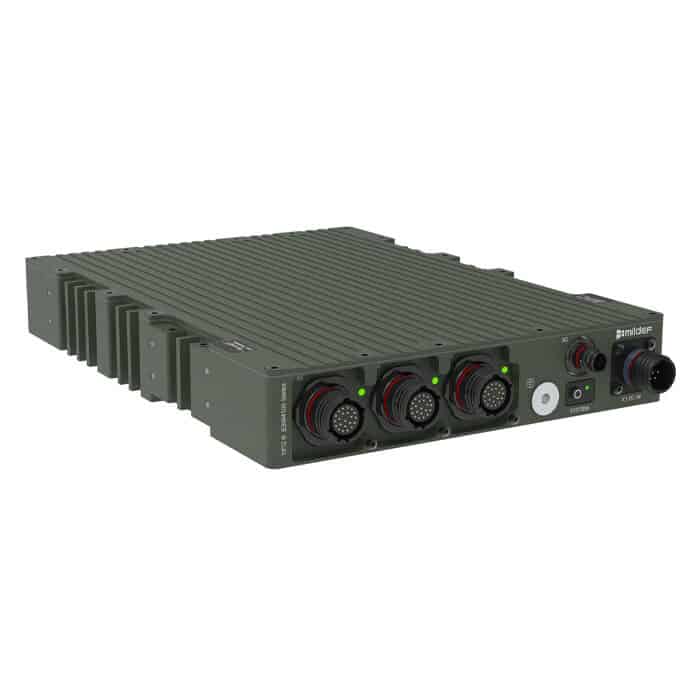
Cutting-Edge Encryption Solutions for Military & Government: Protection Against The Most Sophisticated Modern Cyber Threats

WE ARMOR IT. MilSpec Electronics & Rugged IT Equipment for Military, Government & Critical Infrastructure

Data Transmission & Network Connectivity Hardware for OEMs of Mission-Critical Drones & Robotics

If you design, build or supply Rugged Routers, create a profile to showcase your capabilities and connect with visitors who have an active requirement for your solutions.

Rugged routers enabling reliable, secure, and high-performance networking across contested, remote, and highly dynamic environments. They link sensors, mission computers, radios, and digital payloads into a cohesive tactical network, allowing warfighters and autonomous systems to exchange data with low latency and deterministic performance.
Military routers translate the diverse data requirements of modern warfare into actionable network traffic. Whether supporting armored vehicle mission systems, airborne Intelligence, Surveillance, and Reconnaissance (ISR) platforms, or expeditionary command posts, these systems ensure that mission-critical network traffic continues to flow even when exposed to severe vibration, shock, temperature extremes, or electronic interference.
These devices function as the tactical IP gateway, dynamically managing the complex routing decisions required to stitch together disparate communications systems (like SATCOM, MANET, and 5G) into one secure operating picture. They execute sophisticated Quality of Service (QoS) policies to guarantee bandwidth and low jitter for critical flows such as fire control data or real-time video feeds. As forces move toward fully networked multi-domain operations, the requirement for hardened routing equipment that can manage high-bandwidth traffic securely and with uninterrupted mobility becomes fundamentally necessary for mission success.
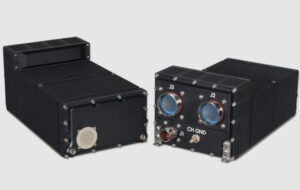
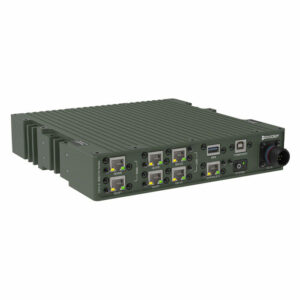
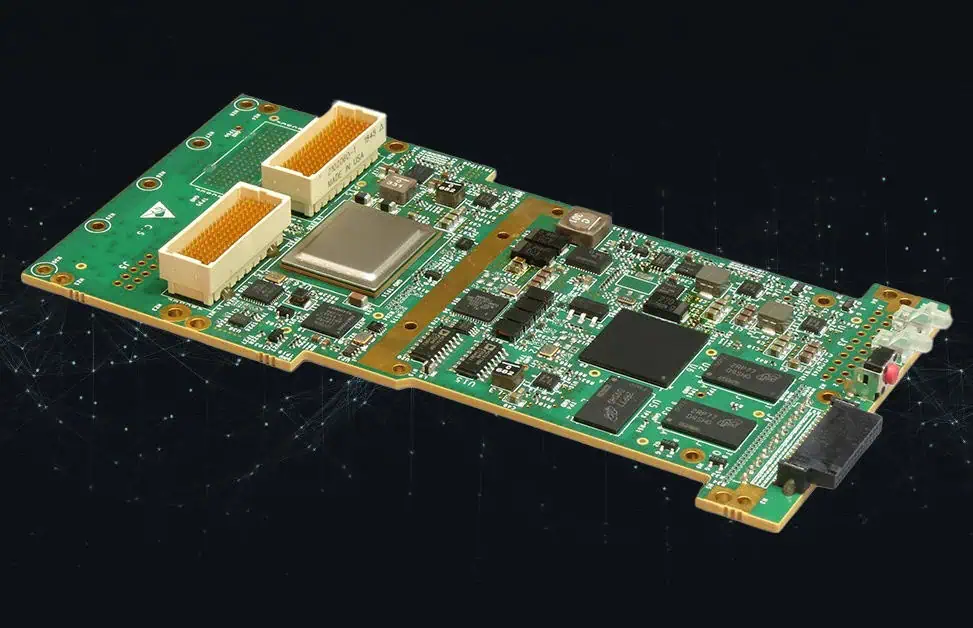
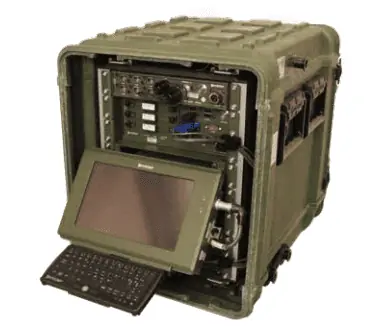
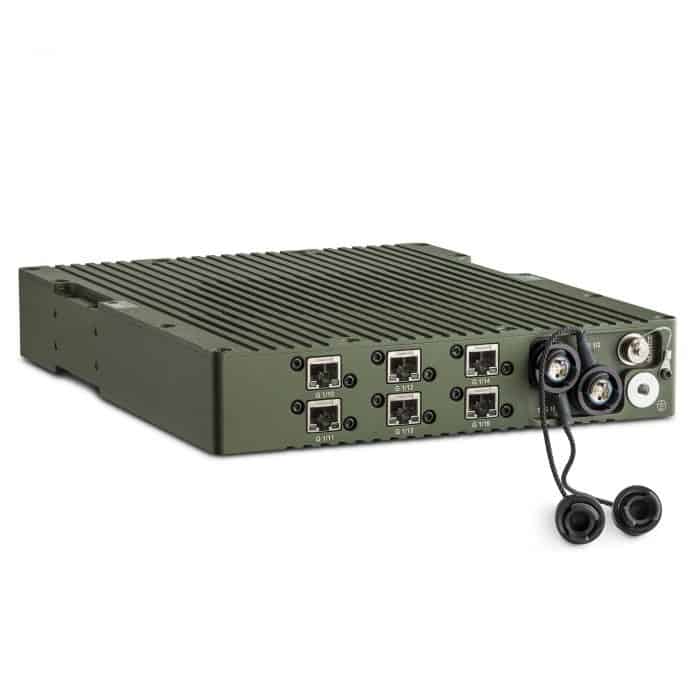
XPand6211 rugged SFF switch & router by X-ES.
Unlike commercial routers, which typically operate in benign, climate-controlled IT racks, defense-oriented routers must maintain performance across conditions that would quickly overwhelm conventional networking equipment. They are expected to handle sustained shock loads in armored vehicles, pressure variations in high-altitude aircraft, conductive and airborne dust on ground platforms, and salt-laden atmospheres aboard maritime craft. Connectivity cannot degrade even as platforms move at high speed, rotate directional antennas, or switch between multiple radios and SATCOM links.
This places unique demands on packet handling, routing convergence, and QoS enforcement. Tactical routers also support increasingly heterogeneous transport layers, including MANET, 5G, SATCOM, Ethernet, and fiber, requiring sophisticated link monitoring and automatic failover to preserve mission continuity.
Defense-grade routers differ from commercial systems in almost every engineering dimension. They incorporate hardened enclosures, electromagnetic interference/electromagnetic compatibility (EMI/EMC) shielding, sealed connectors, and conduction-based thermal designs instead of fan-based cooling. Their hardware accelerators, crypto modules, and isolation mechanisms meet rigorous military security requirements, supporting classified domain separation, MACsec encryption, secure boot, and authenticated firmware loading. Note that for classified applications, these systems may integrate into or host Type-1 encryption devices, which are NSA-certified for high-assurance data protection.
Beyond physical ruggedness, these routers are designed for predictable behavior under stress: deterministic packet processing, low-latency control paths, and rapid failover are mandatory when platforms rely on precision timing for targeting, navigation, and ISR dissemination. Long-term lifecycle support and alignment with open standards such as SOSA (Sensor Open Systems Architecture) and CMOSS (C4ISR/EW Modular Open Suite of Standards) further distinguish military-grade routers from commercial equipment.
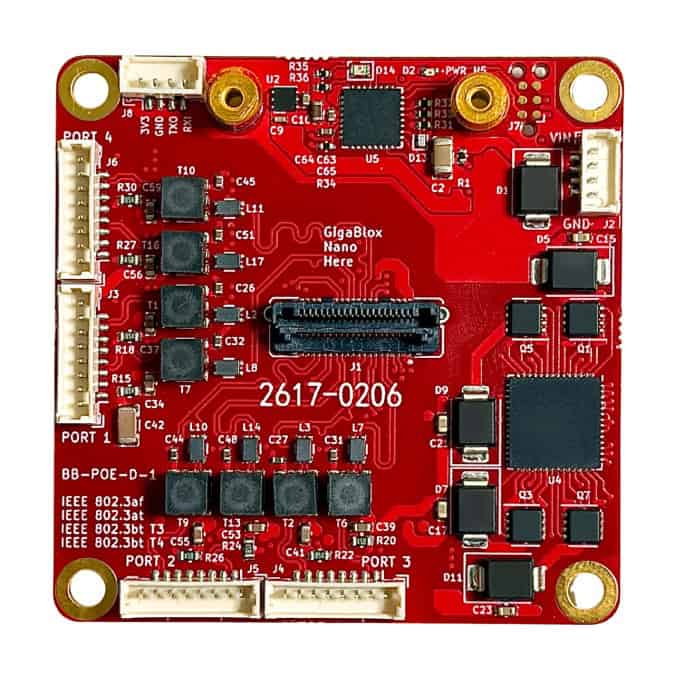
Embedded board-level routers offer high-performance network processing in a compact form factor for integration directly into mission computers, avionics trays, or C4ISR payloads. Open standards such as VPX, COM Express, and XMC provide modularity and allow router functions to share backplane resources with other mission-critical subsystems. The trend is toward SOSA-aligned VPX router modules, which enable high-speed data fabrics (like PCIe and 10/40GbE) and promote interoperability and reusability across programs. These embedded solutions often include multi-core network processors and FPGA-based packet routing logic engineered to operate within tightly managed thermal envelopes. They are widely used in UAV and UGV platforms where Size, Weight, and Power (SWaP) constraints dictate minimal cabling and where routing functions must coexist with onboard computers, navigation units, and sensor processors.
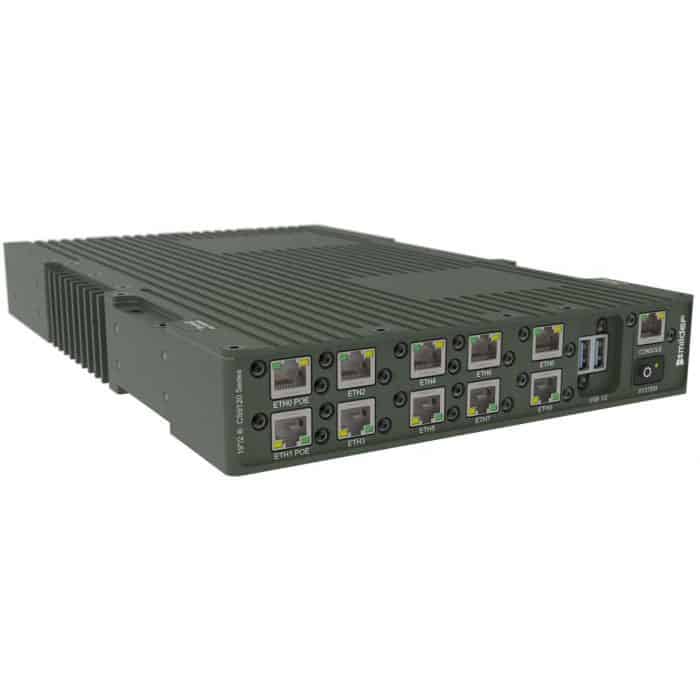
Standalone tactical routers are engineered for field deployment, offering superior environmental sealing, power conditioning, and secure interfaces for installation across land, sea, and air platforms.

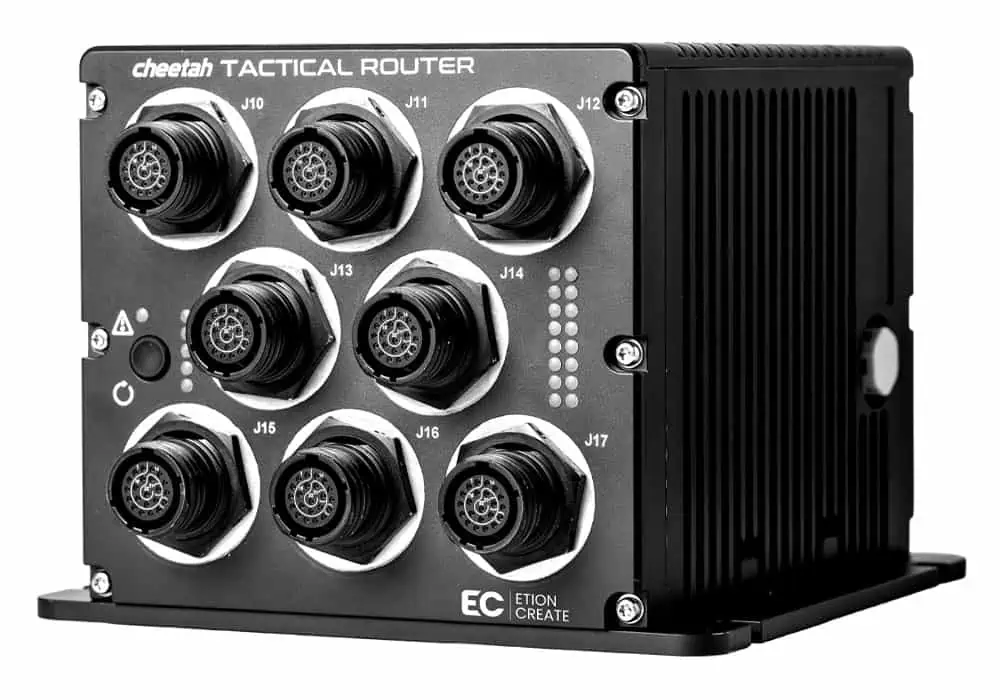
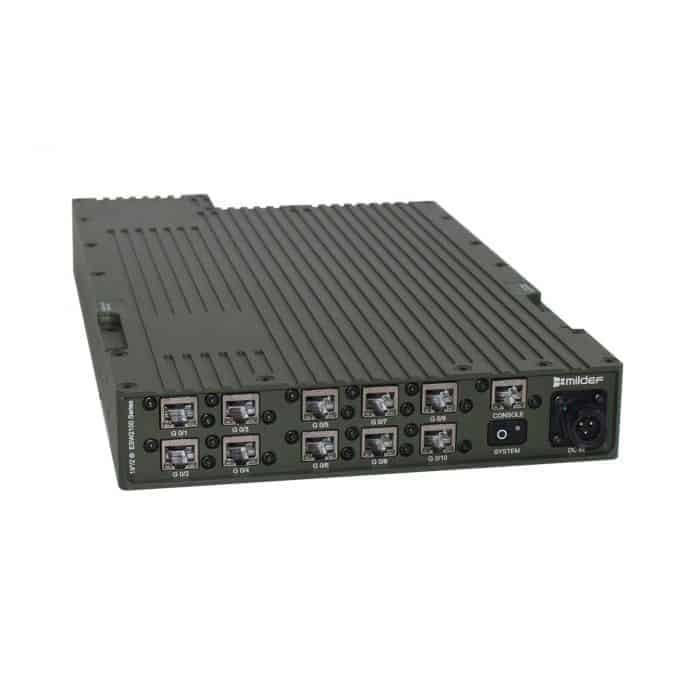
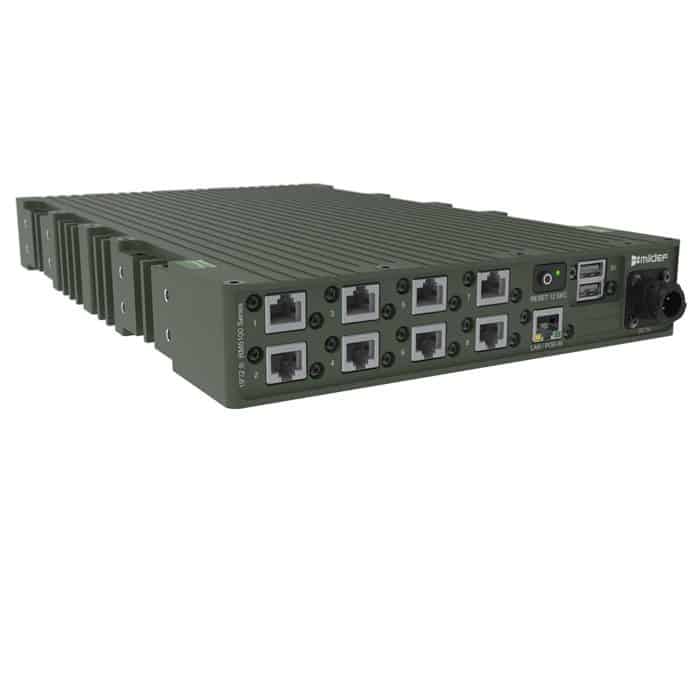
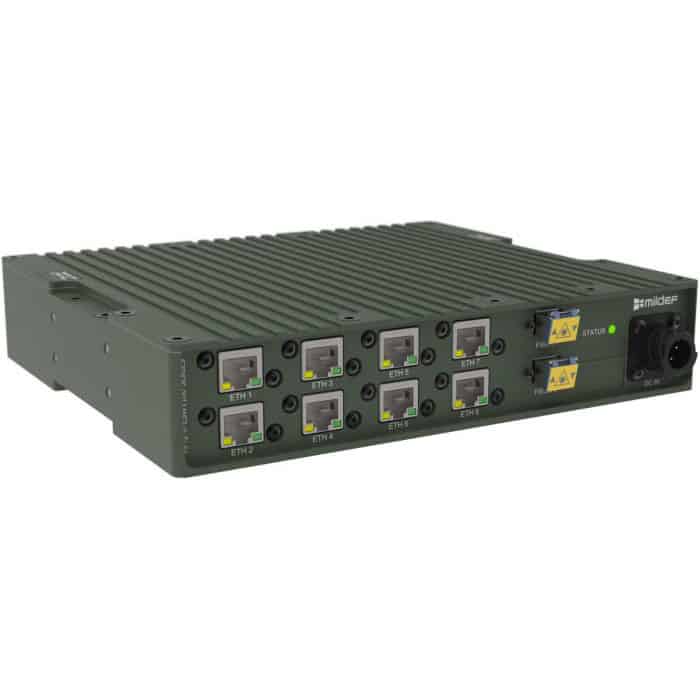
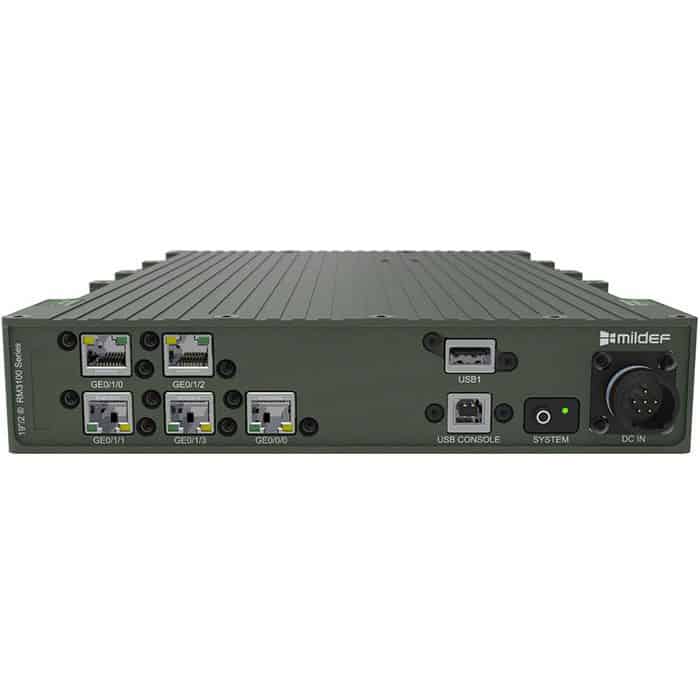
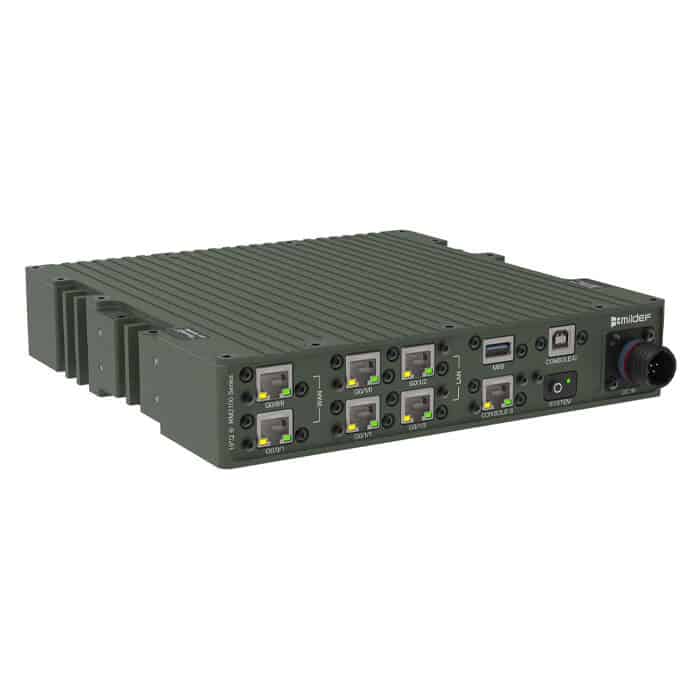
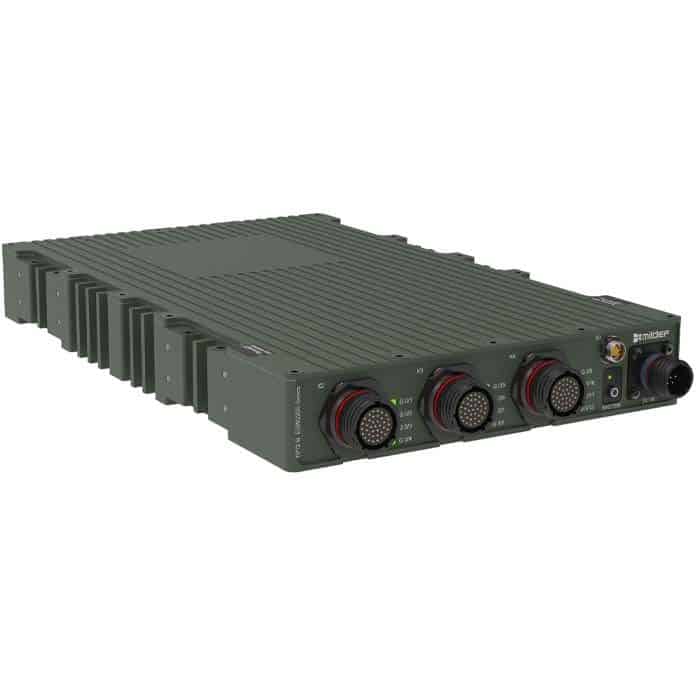
RM2100 Series military router by MilDef.
Military routers handle both local switching and high-performance routing, balancing traffic between multiple networks with predictable latency. To support ISR and real-time mission data, they often incorporate hardware packet processing, queue shaping, and WAN optimization to compress, deduplicate, or prioritize essential data under constrained bandwidth conditions.
Modern routers interoperate with a broad spectrum of tactical radios, including MANET waveforms such as TSM and WNW, along with LTE/5G modems and SATCOM terminals. They translate between IP and radio-native protocols, manage bearer selection, and dynamically adjust routing priority based on link quality or mission policy.
Defense routers often integrate inline encryption engines supporting IPsec or MACsec secure encapsulation. Many platforms are designed to be part of a Commercial Solutions for Classified (CSfC) architecture or to accept Type-1 classified crypto modules. Hardware root-of-trust and tamper-resistant storage ensure secure handling of key material and classified configurations.
Routers continuously evaluate link performance across Ethernet, fiber, Wi-Fi, 5G, or SATCOM channels. Multi-bearer algorithms provide automatic failover, load balancing, and prioritization based on mission type, ensuring resilient connectivity even under jamming, obstruction, or platform mobility. This is critical for reliable communication with a military wifi router or military grade wifi router in the field.
ISR feeds, targeting data, and command links require deterministic latency. Defense routers enforce strict QoS to guarantee bandwidth and minimal jitter for priority flows. Traffic shaping, queue weighting, and application-aware classification maintain network performance under heavy load.
For moving platforms or dynamic formations, rugged routers enable automatically forming and maintaining mesh networks. They support mobility protocols, rapidly reestablishing routes as nodes move, divide, or converge. Auto-healing ensures continuity despite link loss or platform failure.

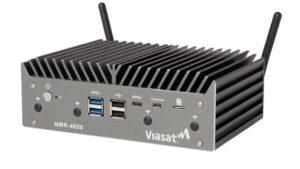
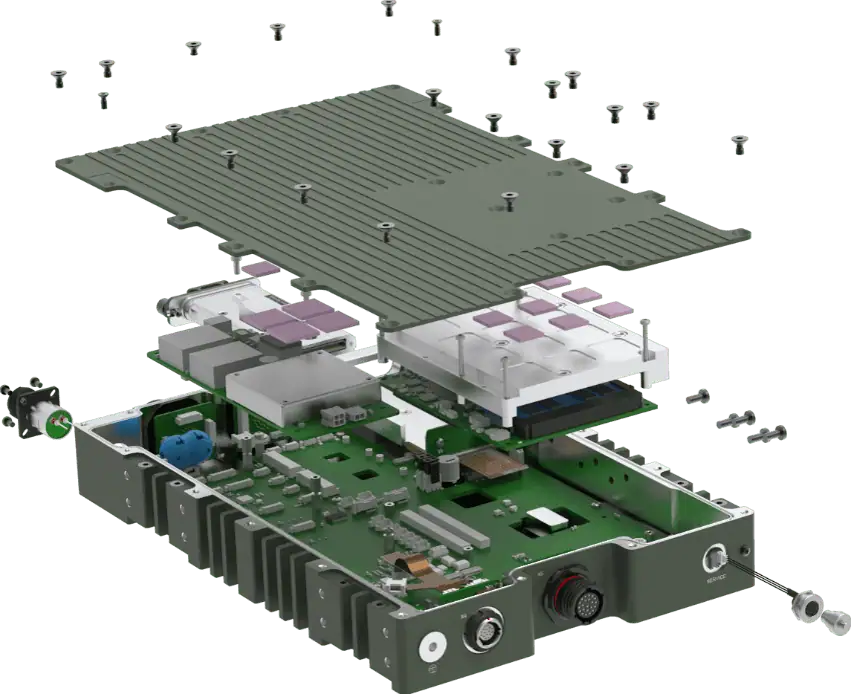
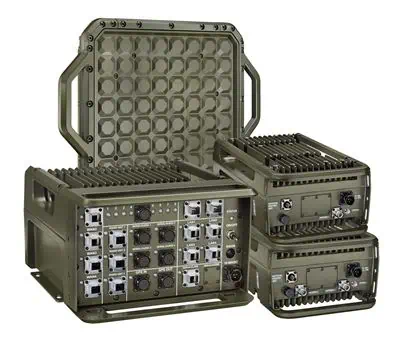
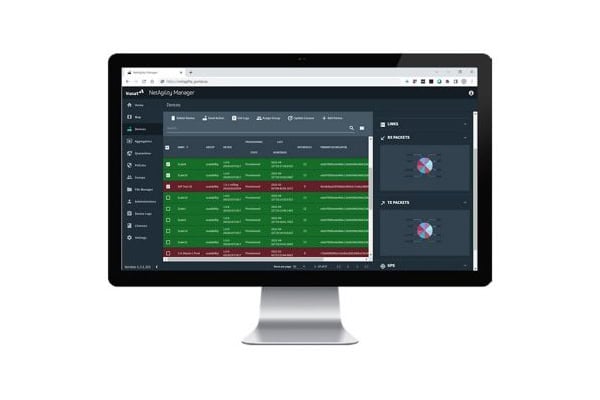
NMR-2410 mobile military-grade router by Viasat.
Mechanical integrity is a defining characteristic of military routers. Enclosures are typically machined from aluminium or magnesium alloys to balance weight, corrosion resistance, and thermal conductivity. Gasketed seams, EMI shielding, and sealed connector plates maintain protection against dust, moisture, and electromagnetic intrusion. Compliance with MIL-STD-810 (for environmental engineering) and DEF STAN 00-35 ensures routers remain functional after exposure to severe shock events, extended vibration profiles, high humidity, and airborne contaminants.
Routers must validate firmware integrity at power-on using cryptographic signatures and a secure identity module, which acts as the Hardware Root of Trust. This component securely stores keys, enables tamper detection, and ensures unauthorized firmware cannot execute, which is crucial in hostile or compromised environments.
Many military platforms rely on routers to enforce segmentation between networks of different classification levels. This may involve onboard Multi-Level Security (MLS) architectures, secure partitions, or external guards. Routers must ensure that data cannot traverse between domains unless explicitly allowed by security policy, and they must maintain verifiable audit trails.
Major defense integrators develop military routers as part of broader tactical communication suites, focusing on large-scale programs requiring multi-domain interoperability and compliance with stringent security frameworks. A second tier of vendors specializes exclusively in hardened networking equipment, offering board-level routers and ultra-rugged standalone units optimized for SWaP and quick deployment in emerging applications like 5G tactical networking and SOSA-aligned systems. Leading specialized vendors of rugged routing equipment are featured at the top of this page – click here to view.


 Searching Companies & Products