
Showcase your capabilities
If you design, build or supply Power Amplifiers, create a profile to showcase your capabilities and connect with visitors who have an active requirement for your solutions.





RF Power amplifiers are essential for military communication, electronic warfare, and radar systems, ensuring reliable signal transmission and reception in demanding operational environments. From RF power amplifiers to tactical radio solutions, these advanced technologies deliver enhanced performance, durability, and efficiency across a wide range of defense applications.
Read the Technology Overview
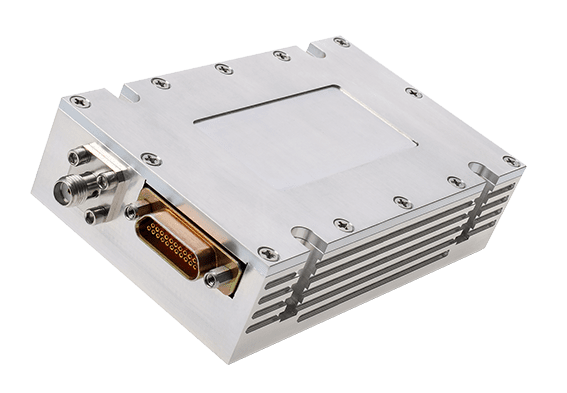

Integrated Radio MIMO Systems, RF Power Amplifiers for C-UAS, Electronic Warfare & ISR Data Links

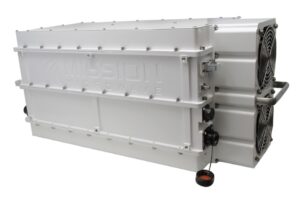
High-Powered Microwave & RF Solutions for Mission-Critical Military & Defense Applications

If you design, build or supply Power Amplifiers, create a profile to showcase your capabilities and connect with visitors who have an active requirement for your solutions.

RF power amplifiers (RFPAs) are fundamental building blocks within every radio-frequency transmission chain used across modern defense platforms. They provide the necessary gain and output power required for radar pulses, sophisticated electronic attack waveforms, secure military communications, and missile telemetry links. In essence, the RFPA is the component that allows a signal – generated at milliwatt levels by a synthesizer or exciter – to be elevated to tens, hundreds, or thousands of watts while precisely preserving the fidelity and spectral characteristics needed for defense-grade performance.
Across multi-domain operations, the RFPA is central to achieving long-range detection, high-duty cycle jamming, resilient SATCOM links, and high-data-rate tactical communications in congested or contested environments. Whether embedded within an airborne AESA radar, a ground vehicle EW suite, or a naval ship’s deck, the amplifier ultimately determines both the reach and effectiveness of the entire system.
Key RFPA parameters govern how effectively systems transmit high-integrity signals under operational constraints:
Achieving the optimal balance between these attributes is central to defense RF power amplifier design, especially in high-duty cycle and broadband military applications.
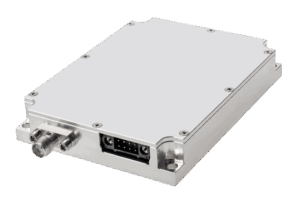
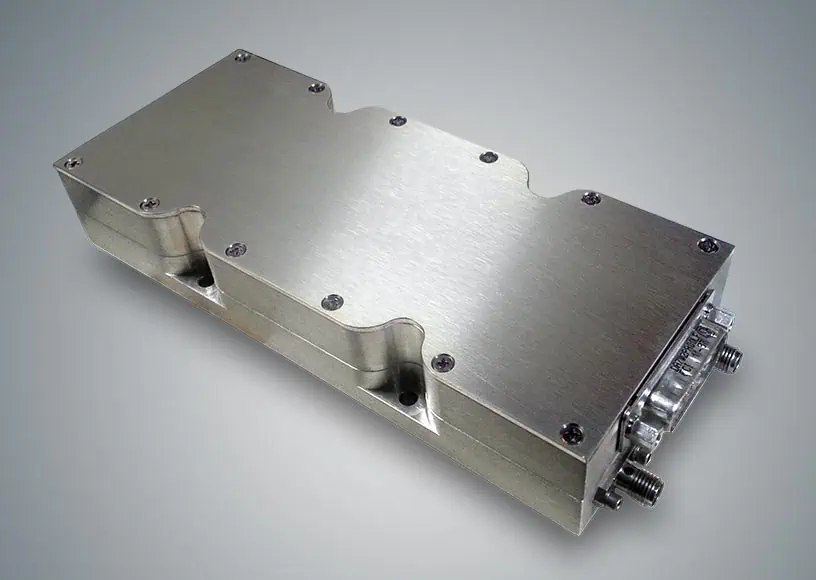
TTRM1210 30-2700MHz 8W Bi-Directional Military RF Amplifier by Triad RF Systems.
Solid-state power amplifiers (SSPAs) have become the dominant architecture across most defense platforms due to their inherent reliability, ruggedness, and the rapid advances in wide-bandgap semiconductors.
Gallium Nitride (GaN on SiC) stands as the leading technology, specifically for high-power, wideband, and high-voltage military RF amplifier applications. Its superior characteristics, including high breakdown voltage, excellent power density, and outstanding thermal conductivity, make GaN the ideal choice for Active Electronically Scanned Array (AESA) radars, high-power jamming, and critical tactical communications systems.
Gallium Arsenide (GaAs) maintains its importance for applications demanding low-noise, high-linearity performance in microwave and millimeter-wave bands.
LDMOS (Laterally Diffused Metal-Oxide Semiconductor) continues to be utilized in VHF/UHF and lower microwave bands, frequently appearing in high-reliability ground and naval systems. However, its poor power density and performance degradation at higher microwave frequencies mean it is being rapidly superseded by GaN in critical broadband, high-power defense systems.
Finally, Silicon Germanium (SiGe) processes support specialized high-frequency and low-noise applications in compact form factors, commonly finding use in sophisticated receivers and low-power transmission stages.
Despite the profound advances in solid-state devices, vacuum electron technologies remain indispensable for the most extreme high-power and extremely high-frequency defense RF amplifier applications.
Traveling-Wave Tubes (TWTs), though historically dominant, are now primarily reserved for highly specialized roles. They are utilized in extreme-power, long-range ground-based radar, advanced Electronic Warfare (EW) systems, and space-based SATCOM uplinks that demand multi-kilowatt output or operation at high millimeter-wave frequencies where Solid-State Power Amplifiers (SSPAs) still face performance challenges. It is critical to note that GaN SSPAs are actively displacing TWTs across the majority of modern airborne and tactical applications due to size and efficiency benefits.
Klystrons maintain their importance in high-power ground-based radar and strategic communication nodes, particularly where achieving maximum peak power output is the primary design priority. Finally, Magnetrons are now largely confined to legacy systems or specific applications that require simple, robust, and high-power microwave generation.
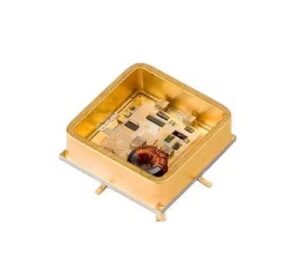
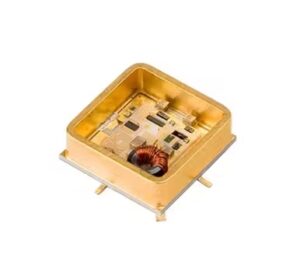
Rugged, connectorized & low noise defense RF power amplifiers by Spectrum Control.
Amplifier class selection is closely tied to the required waveform characteristics:
For fixed-frequency radars or single-band radios, narrowband amplifiers are well-suited as they provide peak power and efficiency around a specific operating frequency. By contrast, broadband amplifiers support multi-mission capability across wide spectral ranges, essential for electronic attack, EW threat response, SIGINT, and advanced tactical radio amplifier systems.
RFPAs used in the defense sector must adhere to rigorous standards to ensure operational reliability, longevity, and platform compatibility:
RFPAs must withstand extreme thermal cycling, shock loads from weapon releases, vehicle vibration profiles, altitude, humidity, and blowing sand/dust.
Amplifiers must both resist external electromagnetic interference and strictly limit their own emissions to avoid interfering with co-located systems—critical on aircraft avionics bays and electronics-dense ground vehicles.
Amplifiers must tolerate voltage transients, ripple, spikes, and generator-based noise on both airborne (704) and ground/naval (1275) platforms, ensuring stability regardless of power source quality.
High reliability RF amplifiers for aerospace and defense platforms rigorously prioritize compact, efficient, rugged solutions. This focus on SWaP-C (Size, Weight, Power, and Cost) is critical for tactical deployment.
Size and Weight constraints profoundly influence mechanical design, thermal materials, and device selection – an especially critical factor in UAVs, missiles, and soldier-worn systems. Power efficiency directly reduces heat load and battery demand, thereby extending mission time and reducing the burden on cooling systems. Cost considerations favor commercial off-the-shelf (COTS) modules for radios and smaller UAVs, while defense RF amplifier supplier specialized systems (e.g., high-power EW) require custom, high-end development.
RFPAs are fundamental to achieving mission success across the entire spectrum of military platforms:
In radar, RFPAs determine pulse power and duty cycle. Modern AESA radars embed thousands of GaN-based transmit/receive modules, each containing miniature RFPAs delivering high power density, fast switching, and graceful degradation.
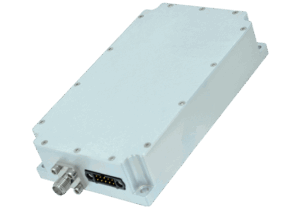
TA1056 20-1000 MHz 40 W high power RF amplifier system by Triad RF Systems.
The RF amplifier for electronic warfare demands wideband, high-linearity amplifiers capable of sustaining long duty cycles and rapidly varying power levels. GaN SSPAs are now widely used due to their ruggedness and high instantaneous bandwidth necessary for effective jamming and denial operations.
Military communications require both linearity and efficiency to support secure, high-data-rate transmission. RFPAs enable frequency-hopping waveforms, multi-carrier operations, and power-efficient SATCOM uplinks for dependable connectivity.
These platforms require ultra-compact, thermally efficient amplifiers for use in seekers, telemetry systems, radar homing, and high-speed data links necessary for autonomous operation.
The defense RFPA ecosystem is driven by major primes and highly specialized semiconductor manufacturers. The market is shaped by high demand for GaN-based amplifiers, modernization of radar and EW systems, and rapid expansion of multi-mission RF front-end architectures aligned with MOSA (Modular Open Systems Approach) and open-system requirements.
Key contributors to this ecosystem include: defense electronics firms producing integrated subsystems, GaN and GaAs semiconductor foundries delivering high-power devices, and specialist amplifier manufacturers offering custom modules for airborne, naval, and terrestrial platforms.


 Searching Companies & Products