Showcase your capabilities
If you design, build or supply Circular Connectors, create a profile to showcase your capabilities and connect with visitors who have an active requirement for your solutions.




Mil-spec circular connectors are ruggedized electrical connectors that meet military standards for reliability, electromagnetic shielding, and environmental durability. These connectors ensure secure, long-lasting electrical performance in mission-critical defense and aerospace systems where failure is not an option.
Read the Technology Overview

State-Of-The-Art Passive Fiber Optics Technologies for the Military, Defense & Security Industries

MIL-Spec Connectors for Military & Army Applications - MIL-STD Electrical Connectors

If you design, build or supply Circular Connectors, create a profile to showcase your capabilities and connect with visitors who have an active requirement for your solutions.

Mil-spec circular connectors provide secure, high-density electrical interfaces across platforms ranging from ground vehicles and combat aircraft to shipboard systems and soldier-worn devices. These connectors are governed by strict Department of Defense (DoD) and international standards, including MIL-DTL-38999, MIL-DTL-5015, MIL-DTL-26482, and MIL-DTL-83723.
They are selected not only for their technical characteristics, such as mechanical robustness, EMI/RFI shielding, and environmental sealing, but also for their lifecycle supportability, compliance with procurement regulations, and compatibility with platform modernization initiatives.
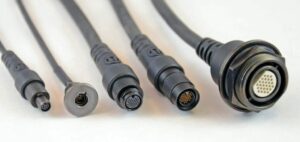
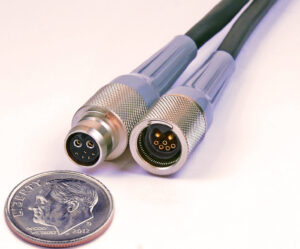
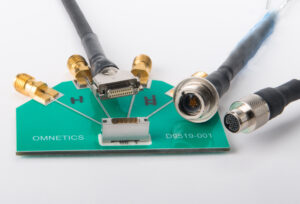
Mil spec circular connectors, Nano, from Omnetics.
In defense platforms, electrical interconnects are subject to harsh conditions, including extreme temperatures, vibration, electromagnetic interference, and exposure to contaminants such as fuel, oil, and salt water. Circular connectors are preferred over rectangular or modular types in many defense applications because they offer:
For program managers and acquisition personnel, standardized connectors reduce integration risk, facilitate multi-source procurement, and align with MIL-STD and NATO STANAG requirements for interoperability.
In main battle tanks, infantry fighting vehicles, and tactical wheeled vehicles, circular connectors interface with power distribution networks, navigation systems, digital communications gear, C4ISR systems, and turret-mounted sensors. Vibration, dust ingress, and moisture resistance are critical considerations.
Onboard aircraft, including fighter jets, helicopters, and unmanned aerial systems (UAS), circular connectors are used in flight control systems, airborne radar modules, avionics data buses, and weapons carriage systems. MIL-DTL-38999 connectors are particularly prevalent due to their resistance to thermal cycling, EMI, and vibration.
Naval applications include sonar arrays, command consoles, propulsion control, and weapons systems. Connectors must comply with corrosion resistance standards and support IP68 or hermetically sealed configurations.
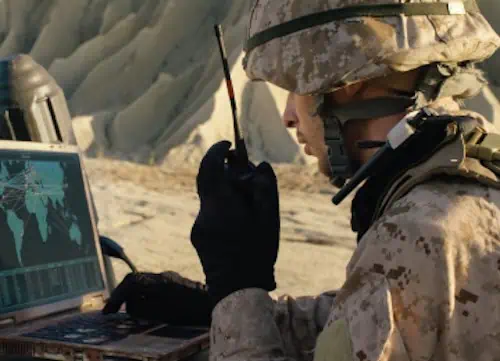
Wearable systems such as night vision devices, tactical manpack radios, and battery-powered electronics use miniature circular connectors. These connectors must be compact, lightweight, easily connected under stress, and sealed against environmental ingress.
Circular connectors adapted for space use must meet NASA outgassing standards, radiation resistance thresholds, and thermal stress performance criteria. Custom MIL-DTL-38999 derivatives are often used in satellite and missile guidance systems.
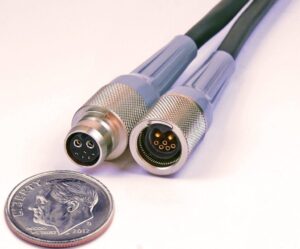
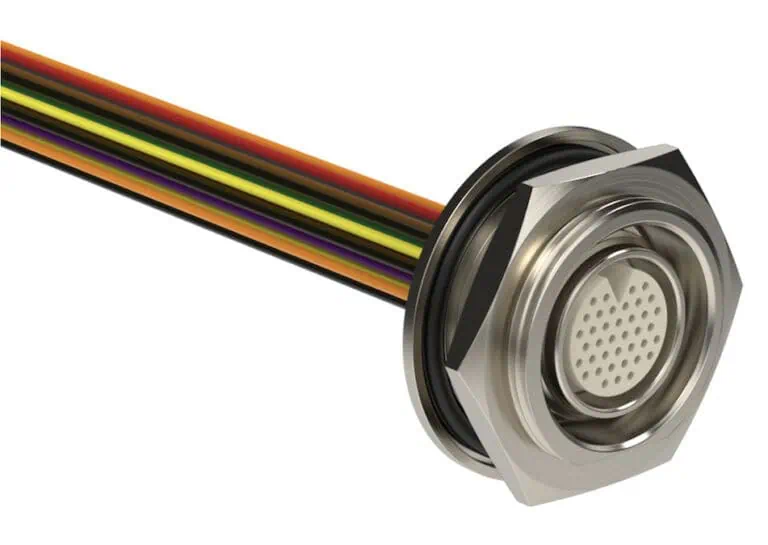
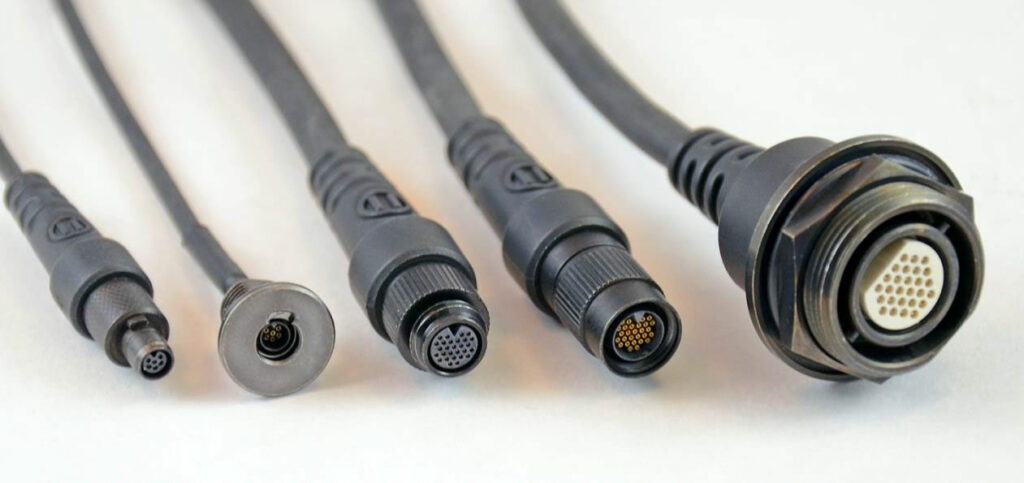
Circular mil spec connector by Omnetics, the Micro Circular range.
This is the most widely used connector family in aerospace and high-performance defense applications. It includes:
Series I: Bayonet coupling, aluminum shell
Series II: Low-profile bayonet for high-density applications
Series III: Threaded coupling with high vibration resistance and EMI shielding
Series IV: Push-pull coupling for rapid disconnect
MIL-DTL-38999 connectors support over 100 insert arrangements, contact types (signal, power, coaxial, fiber optic), and shell configurations. They are rated for up to 200°C operation and 500–1,500 mating cycles.
MIL-DTL-5015 connectors are rugged, threaded connectors typically used in legacy platforms and power distribution systems. They support high current, up to 150A in some configurations, and are known for their reliability in heavy-duty applications. While bulkier than newer types, they are valued for their backward compatibility and durability.
Featuring bayonet-style coupling, this specification is commonly used in compact systems where moderate contact density is required. Its Series I and II versions include environmental sealing for field-deployed applications, including wearable technologies and portable electronics.
This hybrid specification offers the environmental sealing and performance of MIL-DTL-38999 with size and cost advantages. It supports bayonet and threaded coupling mechanisms and is often used in rotary-wing aircraft, airframes, and shipboard control systems.
Mil-spec circular connectors are constructed from corrosion-resistant metals such as aluminum alloy, stainless steel, or composite materials. Shell finishes may include:
Connectors may include:
Environmental ratings typically include:
Procurement officials must account for connector mating styles and contact types. Bayonet couplings allow fast, tool-less mating, while threaded designs offer maximum resistance to vibration. Quick-disconnect push-pull types are used in field-serviceable systems.
Contact options include:
For defense acquisition personnel, selecting circular connectors involves evaluating:
Preferred vendors are often evaluated based on their DoD sourcing experience, JCP certification, and ability to provide traceability for all supplied parts.
Circular connectors are central to defense modernization and data interoperability efforts, particularly when integrating new electronics into legacy platforms. They enable:
For program offices and OEMs, specifying the right connector upfront reduces integration risk and streamlines testing, certification, and fielding timelines.
Mil-spec connectors must pass rigorous testing per NATO and U.S. military standards:
Testing includes lifecycle performance (mating cycles), mechanical endurance, insertion/extraction force, EMI shielding effectiveness, and fluid exposure resistance.
The next generation of circular connectors is evolving with the needs of high-speed digital battlefield environments:
These advances are critical for integrating edge computing, artificial intelligence, and secure communications into future force structures.


 Searching Companies & Products