Showcase your capabilities
If you design, build or supply Tracking Antennas, create a profile to showcase your capabilities and connect with visitors who have an active requirement for your solutions.


Tracking antenna systems use directional antennas and mechanical or electronic steering to maintain alignment with moving targets, platforms, or satellites. In military applications, tracking antennas support tactical data links, radio telemetry, command and control, surveillance, reconnaissance, electronic warfare, and mobile ad-hoc networks.
This page features tracking antenna suppliers and solutions for defense applications where reliable directional communications, target tracking, and sustained connectivity are required.
Read the Technology Overview
IP Mesh and COFDM MANET Technology: Mission-Critical Tactical Communications for Unmatched Operational Superiority

Anti-Jam GPS-GNSS Devices, Tactical Data Links, Telemetry Systems, Electronic Warfare Equipment & Flight Termination Systems


Mission-Critical Antenna, Tracking, & Video Solutions for Defense, Law Enforcement & Security Applications

If you design, build or supply Tracking Antennas, create a profile to showcase your capabilities and connect with visitors who have an active requirement for your solutions.

Tracking antenna systems maintain directional radio-frequency links with moving airborne, terrestrial, maritime, and space-based platforms. They are used wherever a narrow antenna beam must remain aligned with a target despite changes in position, range, bearing, elevation, or platform attitude.
Tracking antenna systems can be classified according to aperture design, steering method, installation, or operating environment. Common types include:
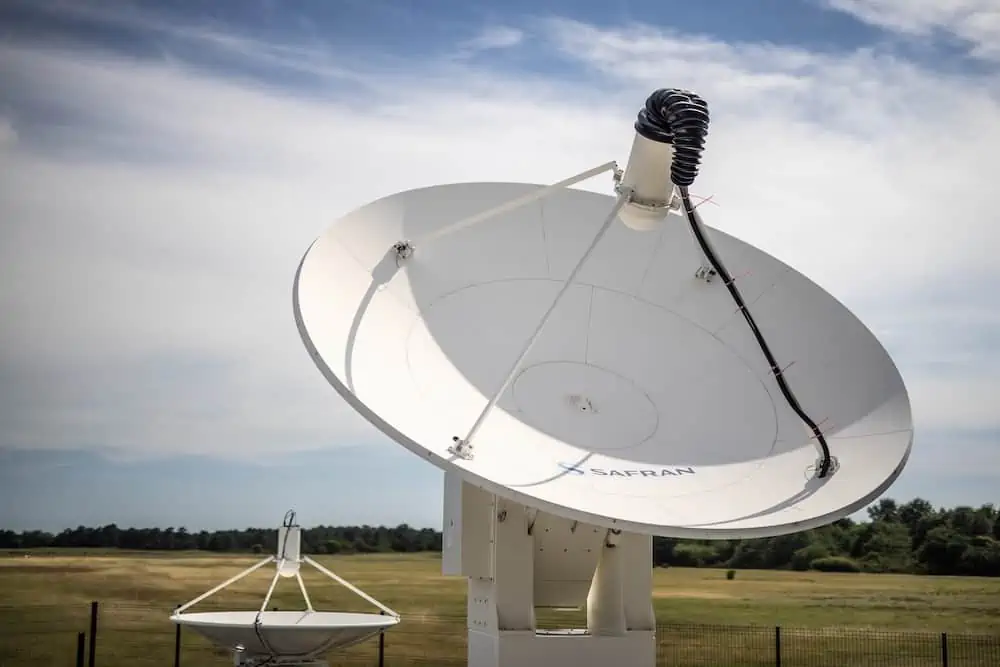
Parabolic Reflector Tracking Antennas – Parabolic reflectors provide high directional gain and narrow beamwidth, making them well suited to long-range telemetry, satellite tracking, and high-data-rate RF links where precise pointing can be maintained.
Mechanically Steered Tracking Antennas – Mechanically steered systems use motorized azimuth and elevation axes or similar positioners to orient the complete antenna assembly toward a moving target.
Phased Array and Electronically Steered Antennas – Phased arrays steer one or more beams by controlling multiple radiating elements electronically, enabling rapid pointing without rotating the complete antenna aperture.
Hybrid Mechanical and Electronic Steering – Hybrid systems combine broad mechanical positioning with faster electronic beam steering to extend field of regard while providing responsive fine tracking.
Fixed-Site Tracking Antenna Systems – Fixed installations support permanent test ranges, ground stations, airfields, and communications facilities where stable foundations and carefully calibrated pointing can be maintained.
Transportable and Expeditionary Tracking Antennas – Transportable tracking antennas are designed for temporary deployment and emphasize manageable logistics, repeatable setup, rapid alignment, and integration with field communications or telemetry infrastructure.
Mobile and Stabilized Tracking Antenna Systems – Mobile systems compensate for vehicle or vessel motion using stabilized gimbals, inertial references, GNSS data, or electronic steering to maintain the required line of sight.
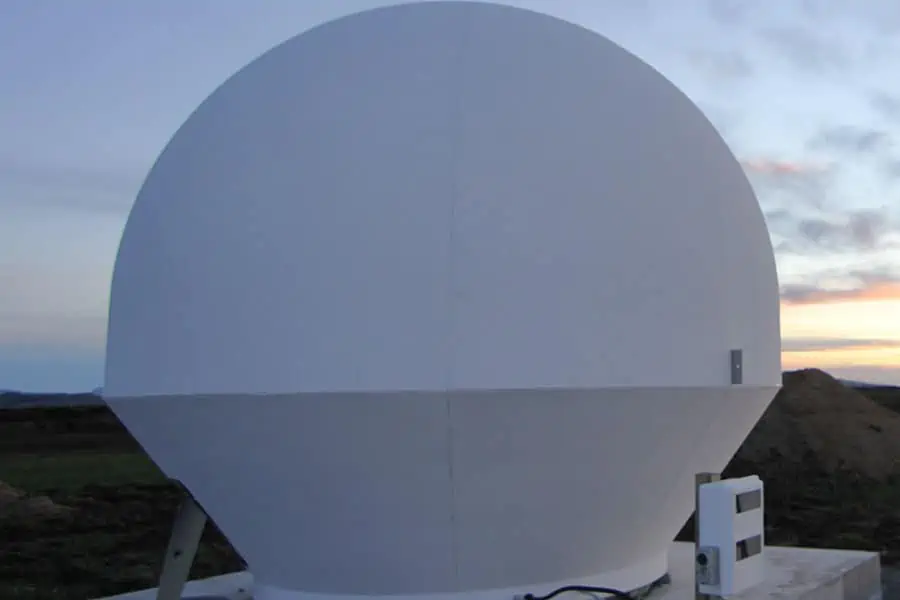
Radome-Protected Tracking Antennas – Radomes shield precision antenna assemblies from wind, rain, ice, dust, salt spray, and other environmental exposure while being designed to minimize RF attenuation and beam distortion.
Frequency selection is highly dependent upon the use case, and affects antenna dimensions, beamwidth, propagation characteristics, available bandwidth, feed architecture, pointing requirements, and overall link performance. Defense tracking applications may operate across several RF bands depending on the platform or equipment that the system supports.
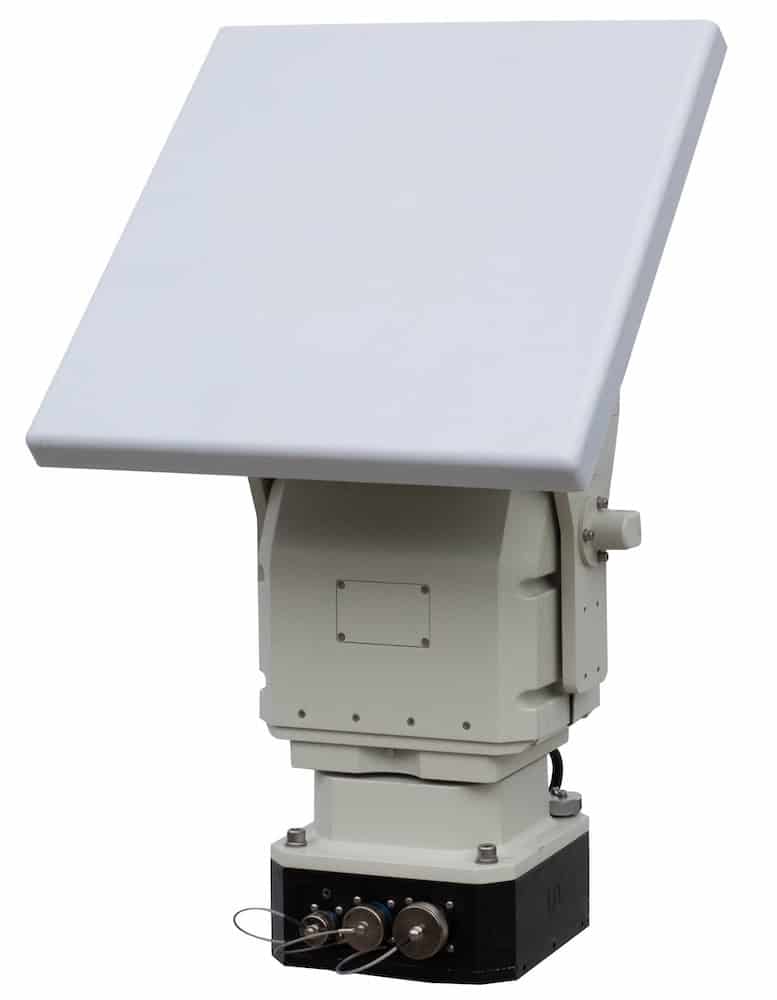
Autotracking Antenna System by TUALCOM
L, S, and C Band Tracking Systems
L, S, and C band systems support a range of telemetry and communications functions and can offer relatively forgiving propagation and pointing characteristics compared with higher-frequency links.
X Band Tracking Antennas
X band antennas provide relatively high directional gain for a given aperture and are used in defense, space, telemetry, and satellite communications applications where accurate pointing can be maintained.
Ku and Ka Band Tracking Systems
Ku and Ka band systems can support high-capacity communications and narrow beams from comparatively compact apertures, although they require tighter pointing control and greater consideration of atmospheric attenuation.
Dual-Band and Multi-Band Antenna Configurations
Multi-band systems allow one antenna installation to support several RF channels or missions through shared reflectors, multiple feeds, broadband components, or frequency-selective architectures.
Military tracking antenna systems support a wide range of applications including communications, telemetry, instrumentation, and data transfer across air, land, maritime, missile, and space domains.
Flight-test programs use telemetry tracking antennas to receive engineering and instrumentation data from aircraft, rotorcraft, missiles, and unmanned systems. The antenna must maintain the link as range, altitude, and target geometry change during the test.
Tracking antennas can strengthen command-and-control links with unmanned aircraft by concentrating RF energy toward the platform. Position data, signal tracking, or both may be used to maintain alignment throughout the mission.
A tactical ISR tracking antenna can support the transfer of imagery, radar, and other sensor data from UAV payloads. Directional gain helps maintain higher-capacity links over extended ranges and during changing flight profiles.
Missile and weapon tests can produce high angular rates and rapid changes in target position. Tracking antennas must provide sufficient slew speed, acceleration, and pointing accuracy to maintain telemetry reception throughout the trajectory.
Tracking systems for Military SATCOM maintain communications links with satellites from fixed, transportable, maritime, or mobile terminals. Non-geostationary networks require continuous tracking and may also require rapid handover between spacecraft.
Defense test ranges integrate tracking antennas with telemetry receivers, recorders, timing systems, radar, and range-control infrastructure. This enables collected RF data to be correlated with other measurements during real-time monitoring and post-test analysis.
Shipboard tracking antennas must compensate for vessel motion while maintaining accurate directional links. Stabilized pedestals, inertial references, GNSS data, or electronic steering can be used to counter roll, pitch, yaw, and vibration.
Vehicle-mounted tracking antenna systems support UAV operations, tactical SATCOM, ISR dissemination, and temporary communications networks. A drone tracking antenna for tactical use must combine accurate pointing with rugged construction, manageable power demand, and rapid deployment.
Tracking antenna qualification requirements vary according to platform, acquisition program, environment, frequency, and intended military use. Common standards include:
Tracking antenna development is increasingly focused on electronically steered arrays, hybrid pointing architectures, digital beamforming, software-defined control, and more automated ground infrastructure. These technologies can support faster beam positioning, lower mechanical wear, and more flexible use of antenna resources.
The growth of unmanned platforms and proliferated non-geostationary satellite constellations is also changing the operational requirements placed on antenna tracking systems. Future military ground and tactical terminals may need to perform frequent satellite handovers, manage several simultaneous links, operate remotely, and share antenna resources across distributed networks. Manufacturers and suppliers are consequently developing tracking architectures that emphasize automation, networked control, multi-band operation, reduced deployment burden, and faster adaptation to changing mission geometry.


 Searching Companies & Products