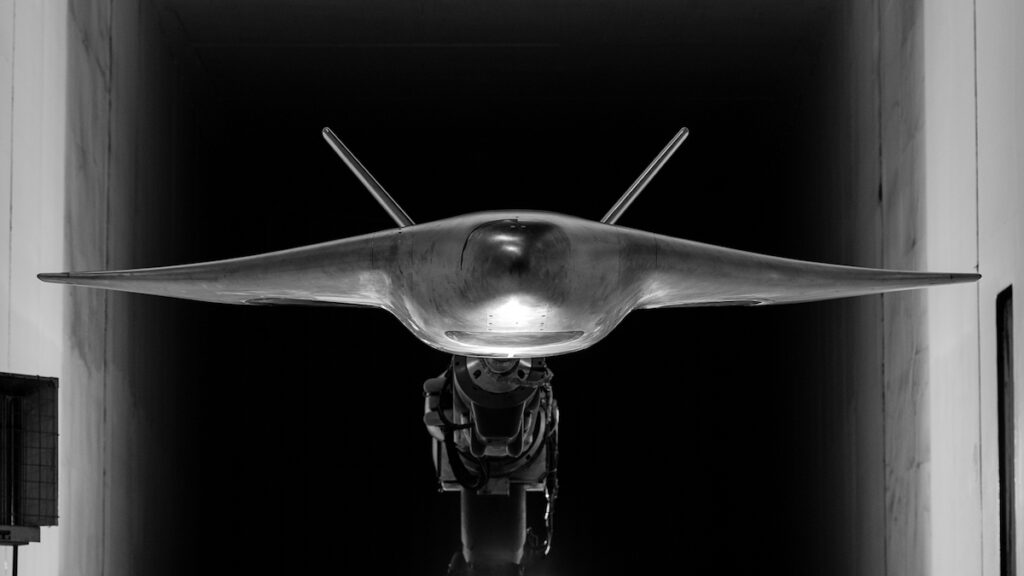





Aurora Flight Sciences has supported customers in the development of next-generation vertical flight systems through a progressive, risk-reducing approach to integrated test and evaluation.
The company has established a foundation in vertical takeoff and landing (VTOL) innovation, spanning rotorcraft research, technology demonstrators, and advanced small unmanned aircraft systems (sUAS). This legacy has informed a development structure where early testing is conducted in controlled environments, followed by phases of increasing complexity as systems demonstrate readiness.
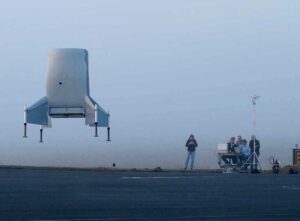
Aurora’s first unmanned vertical‑lift aircraft, the GE-100 prototype, completed its first flight in 2003.
Historical VTOL Development
The GoldenEye family of ducted fan VTOL aircraft has served as a primary vehicle for early innovation. The GE-100 first flew in 2003, providing a foundation for the GE-50, which explored patented free-wing technology and fully autonomous flight. In 2007, the GE-50 received three experimental airworthiness certificates from the FAA. Subsequently, the GE-80 became the first ducted fan UAV to operate using a heavy fuel engine, expanding propulsion options for compact systems.
Urban Air Mobility and Cargo Systems
In 2019, the electric VTOL Passenger Air Vehicle (PAV) achieved its first flight, contributing to autonomous urban air mobility efforts. The PAV has integrated intelligent flight-management capabilities for all phases of flight. Additionally, the Autonomous Aerial Cargo Utility System (AACUS) has demonstrated how autonomy can support cargo resupply. This vehicle-agnostic system has combined radar, LiDAR, and autonomy algorithms to convert conventional helicopters into pilotless platforms. Aurora Flight Sciences has tested AACUS on the Boeing unmanned H-6U Little Bird, a Bell 206, and a modified UH-1 Huey known as AEH-1.
Simulation and High-Fidelity Testing
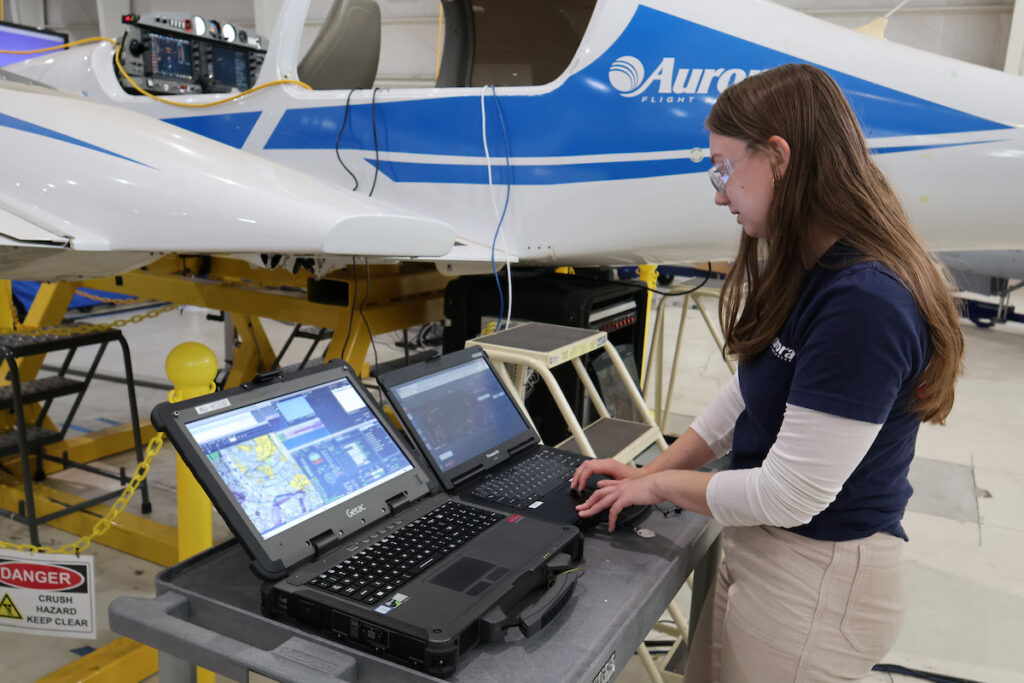
The company has utilized a Hardware-in-the-Loop Simulator (HILSIM) to evaluate flight-critical software and hardware in high-fidelity environments before flight testing. Furthermore, a flight simulation lab in Cambridge, MA, has supported applied research, including the Pilot Cognitive Inference project. This facility features a reconfigurable environment for autonomy testing and human-machine integration, allowing engineers to rapidly prototype and refine new aircraft technologies.
By applying a consistent approach across simulation and surrogate aircraft, Aurora Flight Sciences has provided the technical expertise and comprehensive environment required for system maturation.