Showcase your capabilities
If you design, build or supply Laser Spot Trackers, create a profile to showcase your capabilities and connect with visitors who have an active requirement for your solutions.




Laser Spot Trackers (LST) are passive electro-optical sensors that detect and precisely track coded laser energy reflected from externally illuminated targets, enabling accurate angular guidance without emitting signals. Operating typically around 1064 nm, these systems support cooperative targeting across air, land, and maritime platforms, including combat aircraft, UAVs, armored vehicles, naval vessels, and man-portable units.
This category showcases manufacturers of laser spot trackers designed to meet MIL-STD and NATO requirements, providing low-latency interfaces and SWaP-optimized integration for precision-guided munitions and fire-control systems in GPS-contested operations.
Read the Technology Overview

Rugged Image Processing & Mission-Critical Electronics for Defense Systems

Laser Electronics for Mission-Critical Rangefinding, Targeting, & Directed Energy Systems

If you design, build or supply Laser Spot Trackers, create a profile to showcase your capabilities and connect with visitors who have an active requirement for your solutions.

A Laser Spot Tracker (LST) is a passive electro-optical sensor designed to detect, identify, and precisely track laser energy reflected from a target illuminated by a compatible coded laser designator. Typically operating in the near-infrared spectrum, most commonly around 1064 nm, an LST enables a platform to home in on a designated laser spot without emitting energy itself.
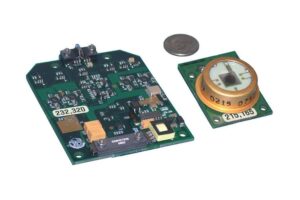
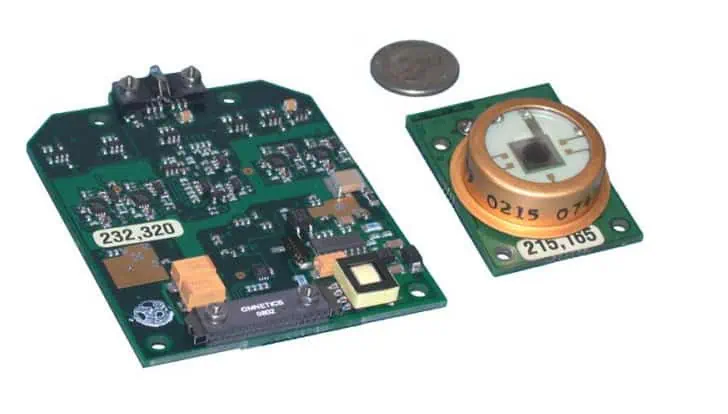
Laser Spot Tracking Modules from Analog Modules Inc.
In modern precision-guided warfare, LSTs enable distributed and cooperative targeting architectures. One platform may designate a target while another conducts the engagement, increasing survivability and tactical flexibility. Because the tracker operates passively and relies on coded pulse recognition, it supports operations in GPS-contested environments and enhances terminal guidance accuracy for laser-guided munitions, UAVs, and advanced fire-control systems.
Effective laser spot tracking relies on the seamless integration of high-sensitivity optical hardware and high-speed digital processing to isolate specific pulse signatures from environmental noise.
The optical subsystem governs photon collection efficiency and background rejection performance. A precision aperture and lens assembly focus reflected laser energy onto the detector plane while narrowband filters suppress out-of-band radiation, particularly solar energy in the near-IR band. Optical coatings and alignment tolerances directly influence transmission efficiency and tracking precision, particularly at long stand-off ranges. Aperture size must be carefully balanced against SWaP constraints, especially for UAV and man-portable applications.
Detector selection defines sensitivity, response speed, and noise characteristics. Avalanche Photodiodes (APDs) provide internal gain, improving long-range detection performance. PIN photodiodes offer robustness and cost efficiency but with reduced amplification. CMOS-based focal plane arrays enable compact digital integration, while InGaAs detectors are widely used due to strong responsivity at 1064 nm. Quadrant detectors and small arrays support angular error measurement and centroid tracking, forming the basis of precise line-of-sight determination.
Embedded processors or FPGA-based architectures handle pulse detection, PRF decoding, signal validation, and centroid calculation in real time. Algorithms apply temporal gating, signal-to-noise analysis, and false alarm suppression to ensure robust tracking in cluttered environments. Deterministic low-latency performance is critical for integration into closed-loop weapon guidance and fire-control systems.
Airborne and mobile LST tracker installations are typically mounted within stabilized gimbals to compensate for vibration, maneuver loads, and platform motion. High-precision inertial stabilization maintains accurate line-of-sight tracking during aggressive aircraft maneuvers or vehicle movement. For fixed systems, mechanical isolation and rigid alignment preserve angular accuracy.
Laser spot trackers output angular deviation data, PRF confirmation, and line-of-sight vectors to mission computers and weapon control systems. Interfaces commonly include MIL-STD-1553, deterministic Ethernet, CAN bus, and serial links. Low-latency digital communication ensures seamless integration into broader combat system architectures.
The versatility of laser spot tracking allows for its deployment across a diverse range of military assets, providing a standardized method for precision engagement in multi-domain operations.
In combat aircraft and ISR platforms, LSTs are integrated into electro-optical targeting pods to acquire externally designated targets during cooperative engagements. This enables strike aircraft to engage threats illuminated by forward air controllers or other aircraft, enhancing survivability by allowing stand-off positioning while maintaining precision terminal guidance.
During Close Air Support operations, ground teams frequently designate targets for airborne assets. UAVs and loitering munitions equipped with LST capability can autonomously acquire and track coded laser spots, enabling precise engagements with reduced sensor payload complexity. This distributed targeting model improves responsiveness and minimizes collateral effects.
Armored vehicles and mobile artillery platforms incorporate a military laser spot tracker into fire-control systems to support cooperative targeting and accurate munition guidance. A laser spot tracking thermal sight provides angular corrections and spot confirmation, improving engagement precision in dynamic battlefield conditions where direct line-of-sight designation may not be feasible from the firing platform.
Naval vessels deploy stabilized LST systems to support precision engagement of surface and littoral targets. Ship motion compensation and robust environmental protection allow reliable tracking in challenging sea states. In maritime operations, cooperative designation supports distributed targeting across ships, helicopters, and shore-based units.
Dismounted forces use compact, ruggedized army laser spot tracker modules to confirm laser designation and monitor target illumination during joint fires missions. Lightweight construction, low power consumption, and environmental hardening are critical to ensuring reliability in austere and rapidly changing operational environments.
Buddy lasing allows one asset to illuminate a target while another platform executes the strike. Laser spot tracking ensures that the engaging system locks onto the correct PRF-coded laser return, reducing the risk of misidentification in multi-asset engagements and enabling safe, coordinated fires across joint forces.
In dense urban environments, precise laser spot tracking supports highly controlled engagements where positive target identification and minimized collateral damage are essential. LST-guided munitions allow accurate terminal correction even in GPS-degraded areas, increasing confidence in target discrimination.
Laser spot tracking concepts are being adapted for counter-UAS architectures, where designated aerial threats can be illuminated for precision-guided intercept. This approach offers a controlled engagement method against small unmanned systems while maintaining flexibility across layered defense strategies.
While often integrated into the same sensor suite, trackers, rangefinders, and designators serve distinct functional roles within the laser-guided engagement cycle.
| System Type | Operational Mode | Primary Function | Technical Mechanism |
| Laser Rangefinder (LRF) | Active | Distance Measurement | Emits a pulse to calculate distance via time-of-flight measurement. |
| Laser Target Designator (LTD) | Active | Target Illumination | Marks a target with a coded laser beam for guided munitions. |
| Laser Spot Tracker (LST) | Passive | Angular Tracking | Detects and follows reflected coded laser energy from an external source. |
Modern integrated targeting modules often combine all three into a single SWaP-optimized package, ensuring perfect boresight alignment between the seeker and the rangefinder.
Adherence to rigorous military standards is mandatory to ensure that laser spot tracking hardware remains interoperable across allied forces and resilient in harsh theater conditions.
Robust signal processing is required to maintain a positive lock on the intended target while filtering out natural interference and intentional adversary countermeasures:
Advancements in processing architectures and artificial intelligence are enhancing discrimination performance in cluttered operational environments. Machine learning techniques are being introduced to improve false alarm rejection and refine spot validation under complex background conditions. At the hardware level, multi-spectral detection approaches are being explored to increase resilience against environmental interference and countermeasures.
Future systems increasingly combine EO/IR imaging and laser spot tracking within tightly integrated sensor suites, enabling simultaneous visual confirmation and automated tracking. As autonomous platforms and swarming concepts mature, LST capability will support cooperative engagement models in which one asset designates while multiple networked effectors coordinate precision strike actions with minimal human intervention.


 Searching Companies & Products