Capacitor Charging Power Supplies (CCPS) are high voltage power conversion systems designed to rapidly and precisely charge capacitor banks to a defined energy level for pulsed power applications. In defense platforms, these systems regulate controlled energy transfer, high voltage step-up conversion, precision charge termination, and repetition rate management.
This page showcases leading capacitor charging power supply manufacturers, supporting directed energy, HPM, radar modulators, and electromagnetic launch systems.
If you design, build or supply Capacitor Charging Power Supplies, create a profile to showcase your capabilities and connect with visitors who have an active requirement for your solutions.
The Complete Guide to Capacitor Charging Power Supplies
Overview by
William Mackenzie
Updated:
Introduction to Capacitor Charging Power Supplies
A Capacitor Charging Power Supply (CCPS) is a specialized high-voltage power conversion system engineered to rapidly and precisely charge capacitors to a defined energy level. Unlike conventional DC power supplies that provide continuous output, or a CCPS is optimized to deliver controlled energy into an energy storage element, which then releases that energy in a short-duration, high-power pulse.
In modern defense systems, this capability is foundational. Many high-energy military technologies rely on stored electrical energy that can be discharged in microseconds. The CCPS is a mission-critical subsystem that directly influences pulse fidelity, repetition rate, thermal stability, and overall system reliability.
Core Functions of a Capacitor Charging Power Supply
A professional-grade CCPS manages complex electrical transitions that would damage a standard laboratory supply. Five technical functions define these units:
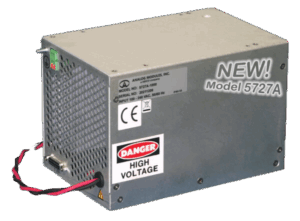
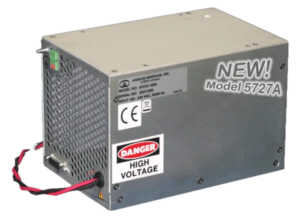
Capacitor Charging Power Supplies from Analog Modules Inc.
Controlled Energy Transfer: Regulates energy flow to the capacitor bank using constant-current or constant-power charging to optimize recharge time while limiting stress on capacitors and upstream systems.
High-Voltage Step-Up Conversion: Converts standard bus input to hundreds or thousands of volts using high-frequency stages and isolation transformers, maintaining precise regulation and galvanic isolation.
Charge Termination and Precision Regulation: Uses digital control loops and high-resolution voltage feedback to prevent overcharge, extend capacitor life, and maintain tight voltage tolerance.
Repetition Rate Management: Manages recharge timing to support required pulse rates without exceeding input or thermal limits through current limiting and adaptive power control.
Protection and Fault Handling: Incorporates overvoltage, overcurrent, arc detection, short-circuit protection, and controlled discharge circuits to safely manage high-energy fault conditions.
Applications of Capacitor Charging Power Supplies in Defense
As warfare shifts toward electronic and directed-energy platforms, demand for specialized capacitor charging power supplies has increased across all operational domains where pulsed electrical energy is required.
Directed Energy Systems and Laser Pumping
Directed-energy platforms, particularly solid-state and fiber laser systems, depend on precision capacitor charging and specialized laser power supplies for flashlamp pumping or power-conditioning stages. Pulsed laser systems using flashlamp excitation demand repeatable high-current discharges. The CCPS must recharge quickly while maintaining voltage precision to ensure consistent optical output and beam quality.
High-Power Microwave (HPM) Systems
HPM emitters rely on pulsed high-voltage inputs to drive microwave tubes or solid-state devices. In these systems, rise-time control and pulse consistency are critical for spectral control and overall system effectiveness against electronic targets.
Railguns and Electromagnetic Launch Systems
Electromagnetic launch systems require extremely high stored energy and rapid discharge capability. These architectures typically employ modular, distributed charging units that manage segmented or staged capacitor banks at the megajoule scale. The charging system must ensure uniform voltage distribution, controlled ramp rates, and minimal imbalance across the storage network to maintain system efficiency and structural integrity.
Radar and Electronic Warfare Systems
Many pulsed radar transmitters use capacitor-based modulators to achieve the necessary peak power. Charging supplies must maintain stable voltage levels to ensure consistent pulse width and amplitude, which directly influence detection range, signal clarity, and the performance of electronic countermeasure suites.
Containerized and Skid-Mounted Systems
For fixed-site defense installations and test ranges, containerized pulsed power systems integrate large capacitor banks with high-power CCPS modules. These deployments prioritize scalability, maintainability, and modular redundancy to support long-term testing or base defense.
Explosive Forming and Initiation Systems
In controlled detonation and explosive-forming applications, capacitor charging systems provide the energy source for precision initiation circuits. Reliability and safe discharge design are paramount to ensure these high-energy systems function exactly when commanded.
Design Architectures & SWaP Optimization
The evolution of CCPS architecture is defined by the pursuit of reduced Size, Weight, and Power consumption without compromising high-voltage integrity.
Switch-Mode and Resonant Topologies
Modern defense systems favor switch-mode architectures for efficiency and compactness. High-frequency inverter designs reduce transformer size and improve regulation bandwidth. Resonant and quasi-resonant converters are frequently employed to enhance efficiency and minimize switching losses by enabling zero-voltage switching.
Semiconductor Advancements
Power semiconductor selection significantly influences efficiency and power density. While silicon IGBTs remain common in high-energy systems, silicon carbide (SiC) and gallium nitride (GaN) devices enable higher switching frequencies, reduced losses, and smaller magnetic components.
Digital Control and FPGA Integration
Modern CCPS platforms integrate digital signal controllers or FPGA-based systems to manage feedback loops, fault detection, and adaptive charge algorithms. Digital architectures enable firmware updates and system-level integration within networked defense platforms.
Military Compliance & Ruggedization Requirements
A capacitor charger must be built to survive extreme environments. Technical specifications often require compliance with several key standards:
MIL-STD-810: Survival against vibration, mechanical shock, and temperature extremes.
MIL-STD-461: Ensures high-frequency switching does not interfere with sensitive communications or sensor systems.
MIL-STD-704 and MIL-STD-1275: Define the power interface constraints for aircraft and ground vehicles, requiring the CCPS to tolerate voltage transients and surges.
Export controls: High-voltage pulsed-power systems frequently fall under ITAR or other export-control regimes due to their relevance to advanced weapons technologies.
Emerging Trends in Capacitor Chargers
The industry is moving toward higher energy-density capacitor technologies, such as advanced film capacitors and hybrid chemistries, which increase stored energy per unit volume. This shift influences CCPS design parameters and necessitates more sophisticated charge-control strategies.
Advanced digital diagnostics and embedded health monitoring are increasingly integrated into high-value or large-scale pulsed-power systems. In some research and test-range environments, predictive analytics techniques are being evaluated to support condition-based maintenance and reduce downtime in mission-critical deployments.
The latest defense technology news, straight to your inbox.
Get our weekly roundup of technology developments, new products and industry news.
THANK YOU FOR SIGNING UP
Thanks for joining us. Check your inbox.
We've sent you an email. Click the confirmation link to complete your subscription to the weekly eBrief. In the meantime, explore the latest news, suppliers and technologies on DA.
Advancing Defense Capability Through Strategic Collaboration
Defense Advancement works with major OEMs to foster collaboration and increase engagement with SMEs, to accelerate innovation and drive defense capabilities forward.