Showcase your capabilities
If you design, build or supply Pockels Cell Drivers, create a profile to showcase your capabilities and connect with visitors who have an active requirement for your solutions.




Pockels cell drivers are precision high-voltage electronic subsystems that control the electro-optic state of a Pockels cell with nanosecond timing accuracy. In defense laser architectures, they enable high-speed optical switching for Q-switching, pulse picking, regenerative amplification, and beam modulation.
This page features global manufacturers of Pockels cell drivers for integration into laser rangefinders, LiDAR, ISR payloads, and directed energy systems, generating fast-rise kilovolt pulses with low jitter to preserve range resolution and targeting accuracy.
Read the Technology Overview
Laser Electronics for Mission-Critical Rangefinding, Targeting, & Directed Energy Systems

If you design, build or supply Pockels Cell Drivers, create a profile to showcase your capabilities and connect with visitors who have an active requirement for your solutions.

A Pockels cell driver is a precision high-voltage electronic subsystem engineered to control the electro-optic state of a Pockels cell with nanosecond-level timing accuracy. It serves as the enabling electronics that allow an electro-optic crystal to function as a high-speed optical switch, shutter, pulse selector, or phase modulator by generating well-defined voltage pulses (often in the kilovolt range) with extremely fast rise and fall times. By exploiting the Pockels effect, where the refractive index of a crystal changes proportionally to an applied electric field, the driver determines critical performance metrics such as switching speed, extinction ratio, and timing jitter.
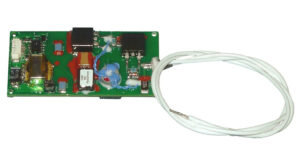
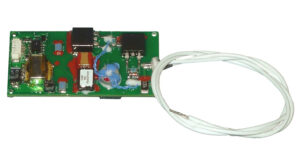
MOSFET Pockels Cell Drivers from Analog Modules Inc.
In a defense context, this function is mission-critical for maintaining the temporal integrity of tactical laser systems. Whether controlling the Pockels cell Q-switch of a laser rangefinder, gating pulses in an ISR payload, or modulating high-energy laser weapons, the driver ensures deterministic timing and electromagnetic resilience. Any instability or jitter in the driver directly translates to degraded range resolution, reduced targeting accuracy, or inefficient energy delivery. These factors make Pockels cell drivers vital for performance in rugged military environments.
In Q-switched architectures, the Pockels cell laser configuration uses the crystal as a rapid optical gate. The driver maintains a high-voltage bias to suppress lasing while energy builds. At the precise switching instant, the driver removes the bias and allows the stored energy to be emitted as a high-peak-power pulse. In Nd:YAG and fiber systems, this nanosecond precision is what ensures shot-to-shot stability and pulse-width consistency.
Mode-locked lasers produce pulse trains at high repetition rates. Selecting a single pulse requires an ultra-fast driver for a high-capacitance Pockels cell capable of sub-nanosecond synchronization. Even small timing errors can cause incomplete pulse selection or degraded extinction ratios.
In regenerative amplifier systems, the Pockels cell traps and releases pulses within an optical cavity to achieve controlled amplification. The driver must coordinate injection and extraction events with high temporal precision. High-voltage pulse fidelity is essential to avoid parasitic oscillations or incomplete switching.
Laser rangefinding and LiDAR systems rely on tightly controlled pulse timing for accurate Time-of-Flight (ToF) measurement. An ultra-fast Pockels cell driver governs pulse gating, receiver protection, and energy shaping. In airborne or ground-based ISR platforms, drivers must maintain stable performance despite vibration, shock, and wide temperature swings.
In High-Energy Laser (HEL) systems, Pockels cells are used for cavity control, pulse shaping, and beam management. The associated drivers must operate at elevated voltage levels and sometimes higher repetition rates while maintaining electromagnetic compatibility with radar, communications, and power subsystems.
Pockels cell drivers are integral to a wide array of mission-critical military platforms where the precision of optical timing directly determines tactical success.
Selecting the appropriate driver architecture depends heavily on the specific crystal material and the optical performance requirements of the laser system.
| Crystal Type | Key Characteristics | Driver Requirements |
| BBO Pockels Cells | High damage threshold, UV suitable. | High-kilovolt switching with fast rise times. |
| DKDP Pockels Cells | High energy, large aperture. | Stable high-voltage operation to manage capacitive loads. |
| KDP Pockels Cells | Standard Q-switching. | Moderate-to-high voltage with moisture-sealed design. |
| PEPC | Extremely large apertures. | Exceptional pulse fidelity across high capacitance. |
| LiNbO3 Pockels Cells | Compact, low half-wave voltage. | Precision timing and low jitter. |
| KTP Pockels Cells | Environmentally robust. | Balanced voltage with high repetition rates. |
| RTP Pockels Cells | Low piezoelectric ringing. | Clean, well-damped transitions. |
| CdTe Pockels Cell | Optimized for Infrared (IR). | Stable operation for specific IR capacitance. |
| LiTaO3 Pockels Cell | High photorefractive resistance. | Precise voltage control for modulation stability. |
Modern high-voltage Pockels cell drivers have moved beyond traditional designs to meet defense requirements.
Deployment in combat environments requires environmental and electromagnetic hardening. Drivers are typically hardened against several critical factors:
The next generation of Pockels cell drivers is moving toward total integration. Wide bandgap semiconductors like GaN enable higher voltage operation and faster edge transitions within compact form factors. Furthermore, advanced pulse generation techniques are pushing switching speeds into the sub-nanosecond domain to support next-generation ultra-fast lasers. Ongoing miniaturization efforts focus on reducing mass for UAV integration, while smart diagnostics and Built-In Test (BIT) functionality support predictive maintenance in mission-critical deployments.


 Searching Companies & Products



