Showcase your capabilities
If you design, build or supply Laser Power Supplies, create a profile to showcase your capabilities and connect with visitors who have an active requirement for your solutions.




Laser power supplies are precision electrical subsystems that convert platform power into tightly regulated current and voltage profiles required to operate military laser systems. Integrated into target designators, rangefinders, fiber lasers, and directed energy weapons, these systems determine beam stability, pulse fidelity, and overall mission reliability.
This page features military laser power supply manufacturers, offering architectures that support both continuous and pulsed operation, with emphasis on ultra-low ripple, fast transient response, and deterministic timing control.
Read the Technology Overview
Laser Electronics for Mission-Critical Rangefinding, Targeting, & Directed Energy Systems

If you design, build or supply Laser Power Supplies, create a profile to showcase your capabilities and connect with visitors who have an active requirement for your solutions.

A laser power supply is a high-precision electrical subsystem designed to convert platform power into the specific current and voltage profiles required to drive a laser medium. In military applications, these units provide the foundational stability needed for target designation, rangefinding, and directed energy. Beyond simple energy conversion, a defense-grade supply must regulate current with extreme accuracy to protect sensitive laser diodes while maintaining deterministic performance under the physical stresses of the battlefield.
The operational effectiveness of a combat system depends on the reliability of this power subsystem. Whether integrated into a man-portable designator or a naval high-energy laser, the power supply determines the beam pulse fidelity and temporal profile.
A CW laser power supply provides high-stability, low-noise output to maintain constant optical energy over extended durations. In fiber lasers used for target designation or continuous illumination, even minor current ripple can translate into beam instability or degraded pointing precision.
A high-performance CW laser diode power supply prioritizes:
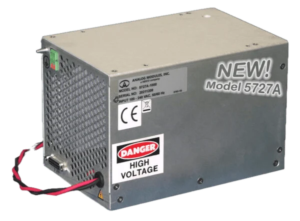
Capacitor Charging Power Supplies from Analog Modules Inc.
Ultra-low output ripple: Necessary to maintain spectral purity and beam quality.
A pulsed laser power supply delivers high peak power over nanosecond or microsecond durations. These architectures typically rely on capacitor discharge topologies where energy is stored in high-voltage banks and released via fast-switching semiconductors like SiC MOSFETs or IGBT arrays.
Key characteristics for a pulsed laser diode power supply include:
USP systems operating in picosecond or femtosecond regimes demand extreme temporal precision. At these scales, electrical noise and parasitic inductance are dominant design hurdles. High-power laser power supply units for these systems typically incorporate ultra-fast switching and deterministic delay control.
For directed energy weapons, these drivers coordinate with beam directors and thermal management subsystems to ensure consistent optical output under dynamic operational loads.
Many military systems rely on diode-pumped architectures. In these configurations, laser diode module power supply units directly determine system reliability and lifetime. Current-controlled designs are standard because laser diodes are inherently current-driven. Precise regulation prevents thermal runaway and wavelength drift.
Modern military laser diode driver power supply modules support:
Power supplies for laser modules are integrated into a broad range of military laser-based subsystems, where electrical precision directly influences optical performance, targeting accuracy, and mission reliability.
In LiDAR and laser rangefinding systems, the power supply must deliver tightly controlled pulsed current with minimal timing jitter to preserve time-of-flight accuracy and range precision. Stable peak current and consistent pulse repetition frequency are essential to ensure repeatable energy per pulse, particularly in airborne ISR and mapping platforms operating under vibration, thermal cycling, and fluctuating bus voltages.
Laser designation systems depend on precise pulse shaping and encoded timing stability to ensure reliable hand-off to guided munitions and cooperative platforms. The laser power supply governs pulse amplitude, width, and repetition rate, maintaining deterministic output across temperature extremes and dynamic operational conditions to prevent degradation in targeting accuracy.
DIRCM applications require rapid current modulation and sustained high-power delivery to counter infrared-guided threats effectively. The laser power supply must support fast transitions, high dynamic range operation, and strict electromagnetic compatibility to prevent interference with onboard avionics while maintaining thermal stability during extended engagements.
In laser communication systems, ultra-low noise current regulation is critical to preserve signal integrity and modulation fidelity. The power supply ensures stable continuous wave or high-speed modulated output, minimizing ripple and long-term drift that could otherwise reduce link margin or introduce optical distortion in high-bandwidth communication channels.
High-energy laser weapons and counter-UAS platforms rely on scalable, high-capacity electrical architectures capable of buffering and delivering substantial power during repeated firing cycles. The power supply must coordinate with platform generation and storage systems, maintaining load stability, transient resilience, and consistent optical output under sustained operational demand.
For both CW and pulsed systems, stability is a defining metric. Excessive ripple introduces optical noise and potential damage to sensitive gain media. A professional-grade laser power supply must manage RMS current ripple and long-term drift while surviving the power transients typical of aircraft and ground vehicles.
In tactical systems, energy per pulse is tightly regulated to ensure targeting precision. Advanced systems utilize digital control loops and pulse-forming networks to maintain repeatability. In systems requiring variable intensity, a variable power supply for laser diode applications allows for output adjustment based on atmospheric conditions or target range.
Certain laser architectures require a high-voltage power supply to achieve the necessary gain. Furthermore, maintaining the detector or switching components often necessitates a secondary high-voltage bias supply to ensure the entire optical train operates at peak sensitivity.
While linear supplies offer low noise, their low efficiency makes them impractical for mobile defense units. Modern laser power supplies utilize high-frequency switched-mode topologies to optimize SWaP and scalability.
Defense programs increasingly utilize modular architectures. A laser diode array power supply can be composed of parallel modules to allow for 100 kW+ output. This modularity simplifies field maintenance and allows for technology updates without replacing the entire power infrastructure.
Power supplies for laser modules must survive rigorous mechanical and electromagnetic stress. Compliance typically includes:
Beyond electrical specifications, laser diode power supply manufacturers adhere to MIL-STD-1472 for human engineering. This covers physical interlocks, discharge circuits, and user interface layouts to ensure operator safety during high-voltage operations.
The adoption of Silicon Carbide and Gallium Nitride has replaced legacy silicon components in high-TRL systems. These wide-bandgap materials allow for higher power density and improved thermal performance.
As defense platforms move toward integrated power architectures, the power supply functions as an intelligent node within the platform energy management network. When identifying laser diode power supply suppliers for ruggedized weapon systems, the focus is on deterministic performance and digital telemetry for real-time health monitoring.


 Searching Companies & Products