

Showcase your capabilities
If you design, build or supply Radio Batteries, create a profile to showcase your capabilities and connect with visitors who have an active requirement for your solutions.




Military radio batteries are mission-critical power systems designed to support secure tactical communications across dismounted, vehicle-mounted, manpack, and fixed-site defense platforms. Engineered to sustain high peak transmission loads and continuous digital networking, these batteries enable modern software-defined radios, wideband waveforms, MANET, and SATCOM operations.
This category features military radio battery suppliers offering handheld, wearable, manpack, and static configurations, meeting stringent MIL-STD requirements for shock, vibration, immersion, and temperature extremes.
Read the Technology Overview
Mission-Critical Power & Lighting Solutions for Sustainable Military Operations

If you design, build or supply Radio Batteries, create a profile to showcase your capabilities and connect with visitors who have an active requirement for your solutions.

Military radio batteries are mission-critical components engineered to power tactical communications across land, sea, air, and fixed-site operations. These power systems must deliver unfailing reliability under extreme environmental stress, sustain high peak transmission loads, and integrate seamlessly with secure, encrypted architectures.
In the defense sector, radio capability is directly tied to battery demand. Modern wideband waveforms, Mobile Ad Hoc Networking (MANET), and SATCOM connectivity consume far more power than legacy narrowband voice systems. As a result, selecting the correct military radio battery supplier is no longer a peripheral logistical consideration but a core element of communications system design that directly influences unit mobility and operational tempo. These systems must support higher processing loads, wider bandwidths, and continuous always-on duty cycles required by digital networking.
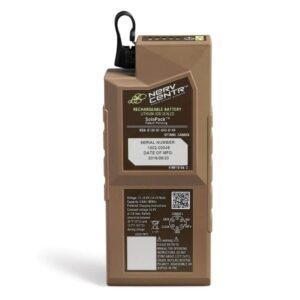
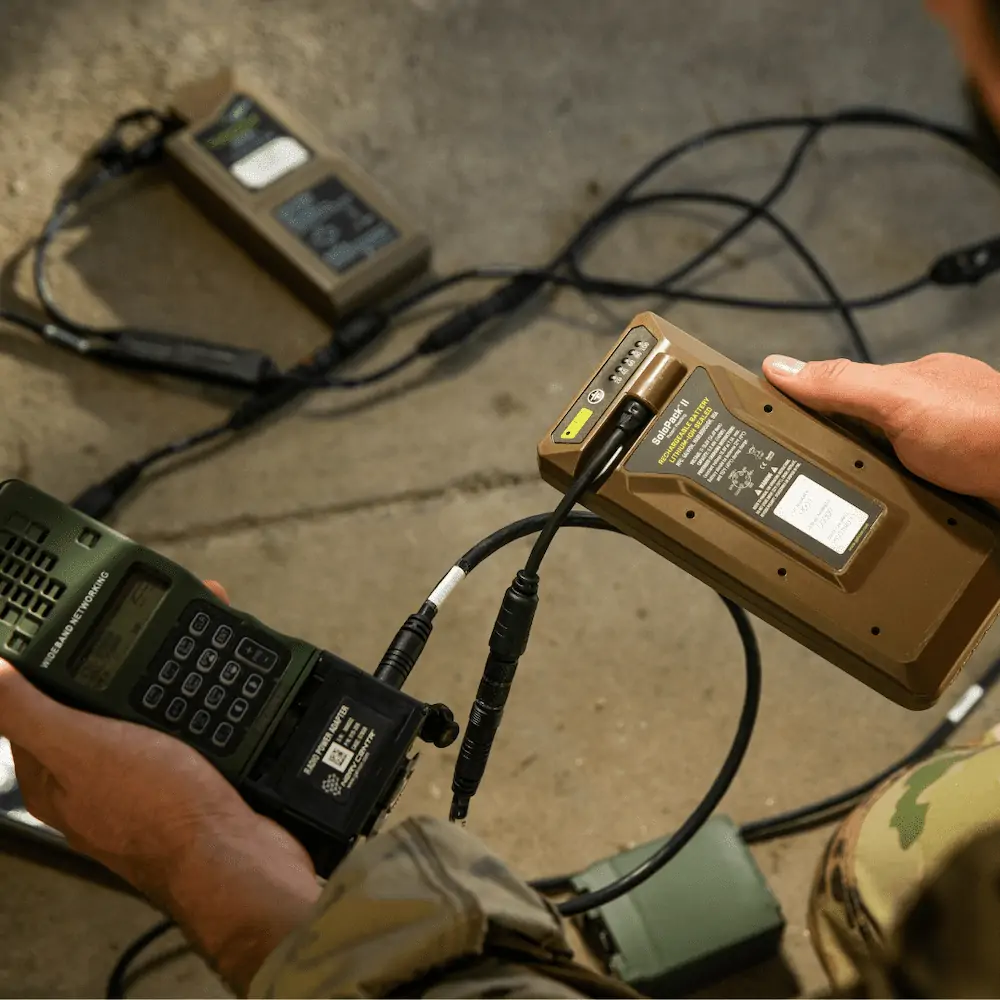
SoloPack Battery, a rugged, rechargeable li-ion battery for charging and powering operational devices on the battlefield, from Galvion
Handheld radio batteries power dismounted soldier communications where Size, Weight, and Power (SWaP) constraints are critical. These batteries support short- to medium-range radios at the squad and section level, requiring a balance between ergonomic design and electrical performance. Their power profile is defined by intermittent high-current transmit bursts, continuous receive modes, and integrated GPS operation.
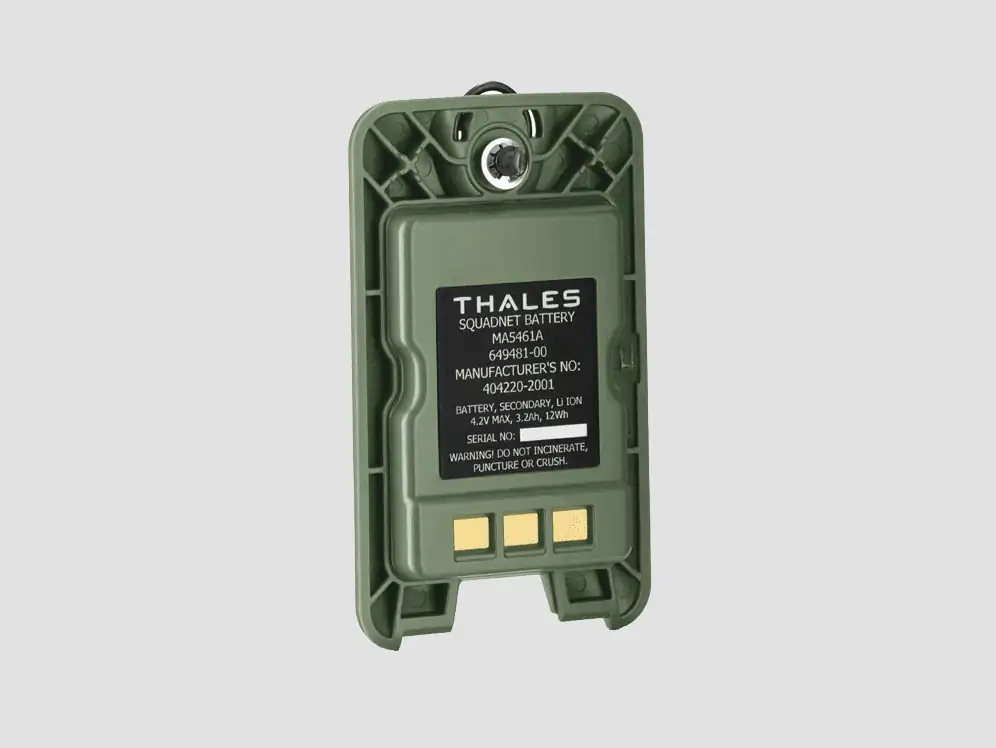
Most modern handheld radios use removable battery packs to enable rapid replacement during sustained operations. Many now incorporate SMBus-enabled smart battery functions, providing real-time state-of-charge (SoC) and state-of-health (SoH) data to reduce the risk of power loss during missions.
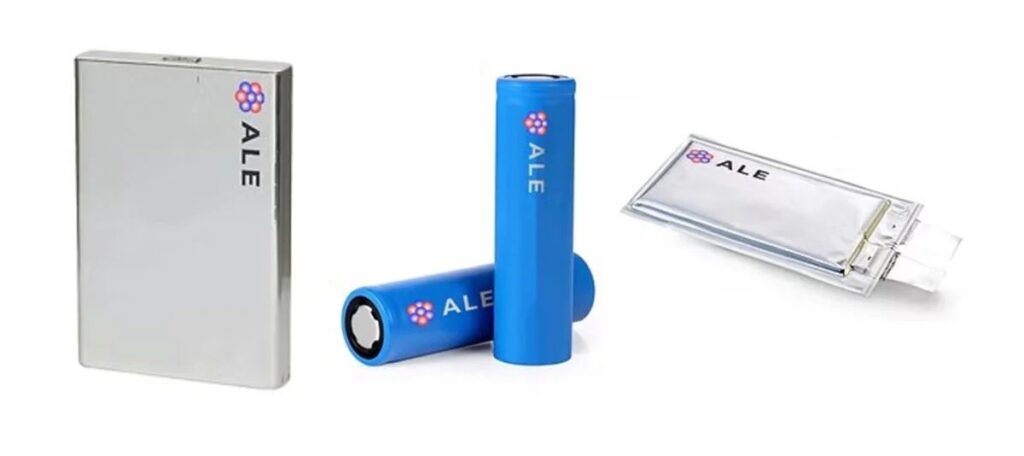
Alongside traditional rigid battery packs, Conformal Wearable Batteries (CWBs) are increasingly deployed. Worn within tactical vests, these thin, flexible batteries distribute weight across the torso while extending mission endurance and reducing profile, supporting longer-duration patrols without increasing carried bulk.
A rugged radio battery in this category typically powers secure voice and data systems used by base security, logistics units, and support elements. While they share some DNA with commercial hardware, these military variants are significantly hardened for environmental resilience and electromagnetic compatibility (EMC).
Unlike frontline tactical radios, the duty cycle for a two-way radio battery is dominated by push-to-talk voice and extended standby monitoring. These systems emphasize long service life and fleet-wide compatibility, simplifying the logistics chain while maintaining high readiness levels for personnel.
Manpack radio batteries support high-power, long-range systems acting as network nodes, relays, or SATCOM terminals. These units typically demand significantly higher energy density than handheld variants.
Because manpack radios often drive data-intensive networking, the load profiles are highly variable, featuring sharp current spikes during high-gain transmissions. To manage this, modular battery packs are often employed, sometimes integrated into rucksack-mounted power distribution systems. This allows a single combat radio battery pack to share energy across mission computers, sensors, and the radio itself, creating a holistic soldier power ecosystem.
For command posts and semi-permanent radio installations, external radio battery systems prioritize massive capacity and longevity. These are often integrated into Uninterruptible Power Supply (UPS) architectures to provide immediate backup during generator transitions. In austere Forward Operating Bases (FOBs), hybrid battery systems are increasingly used to facilitate silent watch capabilities, reducing the acoustic and thermal signatures of the site by minimizing generator runtimes.
At the individual level, the army radio battery is the lifeblood of tactical situational awareness, sustaining the high-bandwidth data links that provide real-time position tracking and sensor integration. For the dismounted soldier, the radio battery must be balanced for maximum energy density to ensure that the primary communication link remains active for the full duration of a mission.
In company and battalion-level command, military radio batteries often sustain the backbone of the distributed network. These batteries power the high-output transceivers required to maintain connectivity across a non-linear battlespace. The battery must provide a flat discharge curve to ensure that signal clarity and transmission power do not degrade as the charge level drops, maintaining the integrity of the command link during maneuvers.
Special operations teams rely on military handheld radio batteries that offer extreme endurance and silent watch capability. In these contexts, the battery must be capable of operating across a vast temperature range without significant capacity loss. Furthermore, these batteries are often designed to be compatible with portable solar blankets or hybrid energy harvesters when the team is operating far from traditional logistics chains.
In mobile command nodes, radio batteries serve as a critical buffer or backup power source. While the vehicle battery provides primary power, external radio batteries ensure that communications remain uninterrupted if the engine is cut for silent observation or if the vehicle suffers a power transient. These batteries are specifically hardened against the high-frequency vibration and electrical noise common in armored vehicle environments.
At forward operating bases, border security sites, and remote surveillance outposts, military radio batteries serve as critical energy storage for persistent communications, monitoring, and rebroadcast infrastructure. In these environments, batteries are typically integrated into hybrid power architectures alongside generators, solar arrays, and power management units.
Their primary role is to provide uninterrupted power to radios, gateways, and networking equipment, maintaining continuous connectivity during generator outages, maintenance cycles, or fuel resupply delays. Battery systems also stabilize power delivery by buffering load fluctuations caused by high-power transmissions and network activity, protecting sensitive radio electronics from voltage transients.
Modern defense units utilize multi-bay charging systems that can interface with AC mains, DC vehicle power, or field generators. These chargers are often housed in ruggedized transit cases, with many systems designed to fast-charge a military radio battery to 80% capacity in under an hour, allowing for a high operational tempo. Intelligent charging algorithms prevent overheating and overcharging, which is vital for preserving the service life of expensive lithium cells.
Energy management has evolved into a shared architecture. Using power hubs and specialized cabling, a single high-capacity army radio battery can share its energy across multiple devices. This reduces the total weight a soldier must carry and allows for a more flexible approach to energy. For example, a manpack battery can be used to emergency-charge a handheld radio or a mission computer via a central hub.
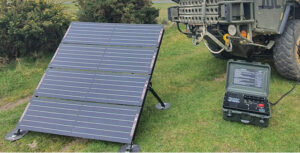
For austere deployments, solar and hybrid solutions are now standard. Portable solar arrays are used to trickle-charge military radio batteries during daylight hours, while hybrid fuel-cell or kinetic energy harvesters provide alternatives in denied environments. These technologies are essential for reducing the logistical burden of transporting thousands of replacement batteries to the front lines.
To survive the rigors of combat, military radio batteries must adhere to stringent MIL-STD specifications:
| Chemistry | Energy Density | Best For | Key Limitation |
| Li-ion | High | Dismounted radios, high-data waveforms | Requires complex protection circuits and thermal runaway management. |
| LiFePO₄ | Moderate | Vehicle-based systems, silent watch | Heavier than standard Li-ion; lower nominal voltage per cell. |
| NiMH | Moderate | Training, legacy hardware, cost-effective backup | Higher self-discharge rate; loses capacity quickly during long-term storage. |
| NiCd | Low | Extreme cold, engine starting, high-abuse environments | Memory effect reduces capacity; contains toxic materials restricted by regulations. |
| Primary Lithium | Very High | Long-term caches, emergency contingency | One-time use only; creates significant logistical waste and high lifecycle cost. |
Future developments from military radio battery manufacturers are set to converge power and intelligence. The industry is seeing a shift toward solid-state chemistries, which promise to eliminate the fire risks associated with liquid electrolytes while further increasing energy density.
Furthermore, digital power management is becoming the norm. Modern radios are becoming energy aware, automatically adjusting their transmission power or data rates based on the remaining capacity of the battery. This creates a smarter, more resilient communications network that can adapt to the logistical realities of the battlefield.


 Searching Companies & Products