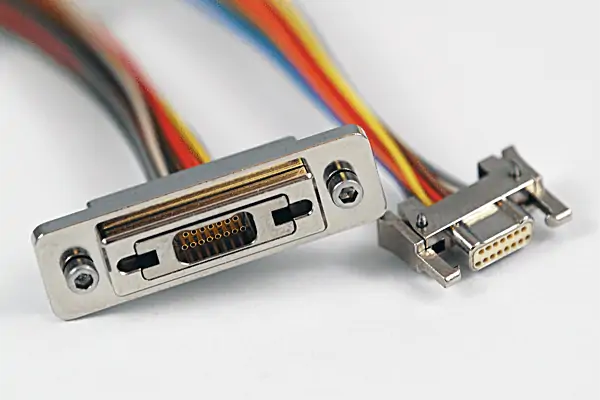
MIL-DTL-32139 connectors are ruggedized, military-grade interconnect solutions engineered for use in harsh defense and aerospace operating environments where reliability, survivability, and long-term performance are essential.
Modern military platforms are increasingly reliant on vast quantities of electrical power, high-speed digital data, sensor traffic, encrypted communications, and distributed computing infrastructure, and thus depend upon secure, dependable interconnectivity.
Understanding the MIL-DTL-32139 Standard
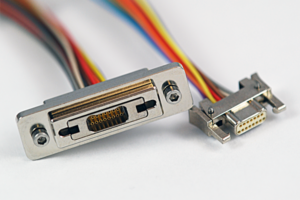
MIL-DTL-32139 Connectors, nanominiature MIL-SPEC connector from Omnetics.
MIL-DTL-32139 establishes rigorous qualification criteria governing connector construction, contact integrity, environmental sealing, vibration resistance, mechanical durability, and electromagnetic performance specifications.
While MIL-DTL-83513 covers micro-miniature connectors with a 0.050-inch contact spacing, MIL-DTL-32139 defines nanominiature interconnects with an incredibly tight 0.025-inch center-to-center contact spacing. Compliance with these requirements ensures that qualified connectors can continue operating reliably under battlefield stresses that would compromise conventional commercial interconnect systems.
A key benefit of military connector standardization is interoperability. Defense programs routinely involve multiple contractors, subsystem suppliers, and long operational lifecycles. Standardized connector architectures simplify system integration, maintenance, field replacement, and long-term sustainment. This is especially important for multinational coalition operations where interoperability between allied systems is critical.
Connector Construction and Design Features
The construction of a military connector directly determines its survivability, durability, and operational reliability. MIL-DTL-32139 connectors are engineered specifically to withstand prolonged exposure to mechanical stress, electromagnetic interference, corrosion, and severe environmental conditions.
Connector shells are typically manufactured from lightweight yet durable aluminum alloys, stainless steel, or titanium. These materials provide structural rigidity while also delivering electromagnetic shielding performance and corrosion resistance. Protective surface finishes such as cadmium-free coatings, electroless nickel plating, zinc-nickel treatments, or passivated finishes improve durability and environmental protection.
Contacts are normally fabricated from high-conductivity copper alloys and plated with gold over a nickel underplate to ensure low contact resistance and stable electrical performance over repeated mating cycles. Contact systems must maintain electrical continuity even under severe vibration and shock loading. Given the 0.025-inch spacing, precision twist-pin or robust receptacle contact designs are utilized to maintain secure electrical interfaces.
Insert arrangements are designed to optimize contact density while maintaining electrical isolation and environmental sealing. Modern defense platforms increasingly require high-density interconnect architectures that support both power distribution and high-speed digital communications within compact connector footprints.
Keying and polarization mechanisms prevent incorrect mating during installation or maintenance. This becomes especially important in battlefield environments where rapid equipment replacement may occur under low-visibility or high-stress conditions.
Environmental sealing technologies are fundamental to military connector survivability. Elastomeric seals, potting compounds, and interfacial sealing systems prevent ingress of moisture, dust, hydraulic fluids, fuels, and contaminants. Many systems are designed to satisfy stringent ingress protection requirements suitable for maritime, airborne, and expeditionary deployments.
EMI and EMC protection are equally critical. Military vehicles and platforms contain dense concentrations of radios, radar systems, electronic warfare equipment, mission computers, and power electronics. Connectors must therefore maintain shielding continuity through grounding fingers and backshell terminations to minimize electromagnetic leakage or susceptibility.
Electrical and Signal Performance
As defense systems become more network-centric and data-intensive, military interconnect systems must support increasingly complex combinations of electrical power distribution, high-speed digital data transfer, RF communications, and sensor connectivity.
Power contacts within MIL-DTL-32139 connectors are designed to support stable, low-current transmission under dynamic operating conditions. Because these are nanominiature connectors, individual contacts are typically rated for approximately 1 ampere. Engineers must manage current de-rating and thermal stability when multiple adjacent contacts are fully loaded to prevent excessive temperature rise when subjected to vibration and fluctuating electrical loads.
High-speed data transmission has become a defining requirement for modern military systems. Advanced battlefield platforms rely heavily on Ethernet-based architectures, mission computers, ISR payloads, EO/IR systems, radar processing, and distributed sensor fusion. Connector systems must therefore preserve signal integrity while minimizing insertion loss, crosstalk, return loss, and electromagnetic susceptibility.
Signal integrity becomes increasingly difficult as data rates rise into multi-gigabit territory. Connector geometry, shielding architecture, contact spacing, and impedance control all influence high-speed transmission performance. Maintaining deterministic data transfer is particularly important for real-time targeting, navigation, weapons control, and autonomous platform operation.
Grounding and shield termination strategies are essential for maintaining electromagnetic compatibility across integrated military systems. Poor grounding design can compromise signal integrity, create unwanted emissions, or increase susceptibility to interference.
Hybrid connector architectures are increasingly common within modern defense systems. These setups combine power and digital signal contacts within a single ruggedized interface, simplifying installation while reducing cabling complexity and SWaP burdens.
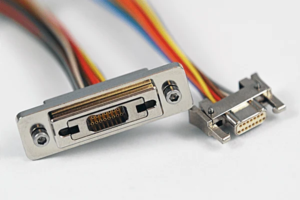
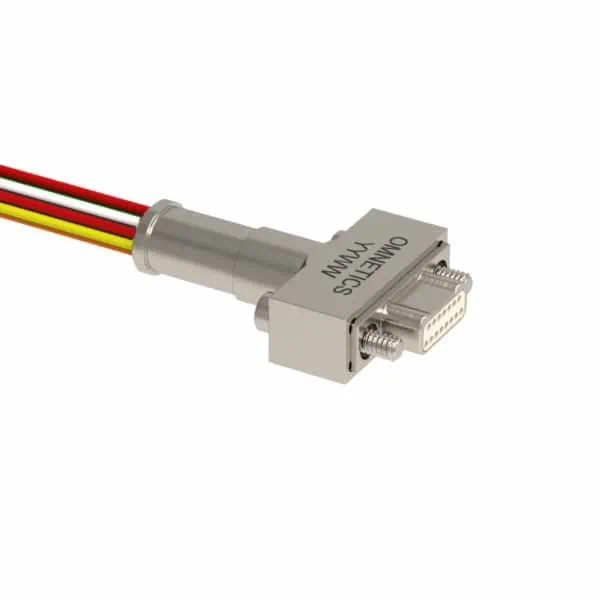
MIL-DTL-32139 Connectors from Omnetics, mil-spec Nano-D rugged connector.
Connector Types and Configurations
MIL-DTL-32139 connector systems are available in a wide range of configurations optimized for different platform requirements, environmental conditions, and installation constraints.
The specification details both single-row (slant-mating) and dual-row configurations, offering a highly flexible variety of form factors:
- Rectangular Styles: These are highly prevalent in the standard, providing massive contact density in ultra-low-profile envelopes. They are ideal for space-constrained printed circuit board (PCB) layouts and line-replaceable units (LRUs).
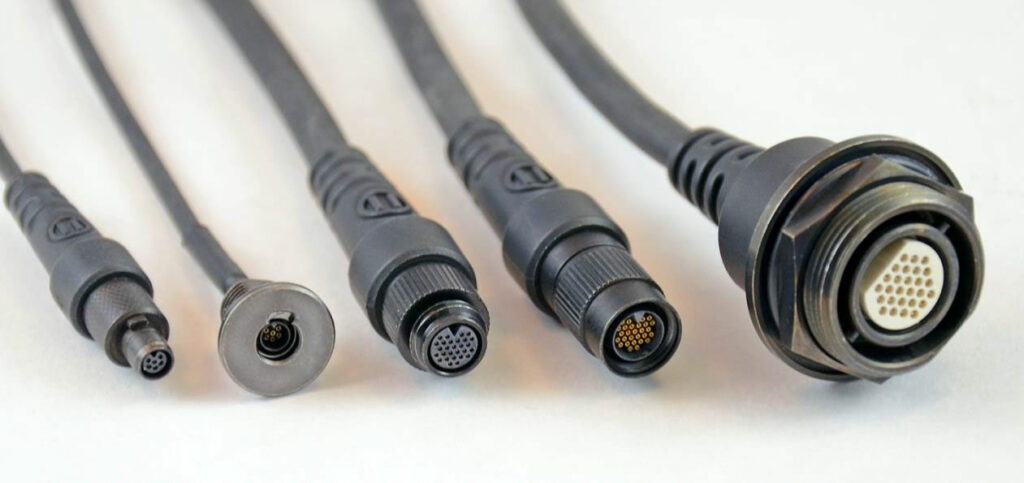
- Circular Styles: Utilized where a traditional circular envelope matches panel cutouts or system geometry, offering excellent mechanical durability and compact footprints.
Mounting and termination options include jam-nut, box-mount, flange-mount, and inline receptacle variants to provide installation flexibility across diverse defense platforms. Mechanical integration requirements vary substantially between airborne, naval, ground, and portable systems.
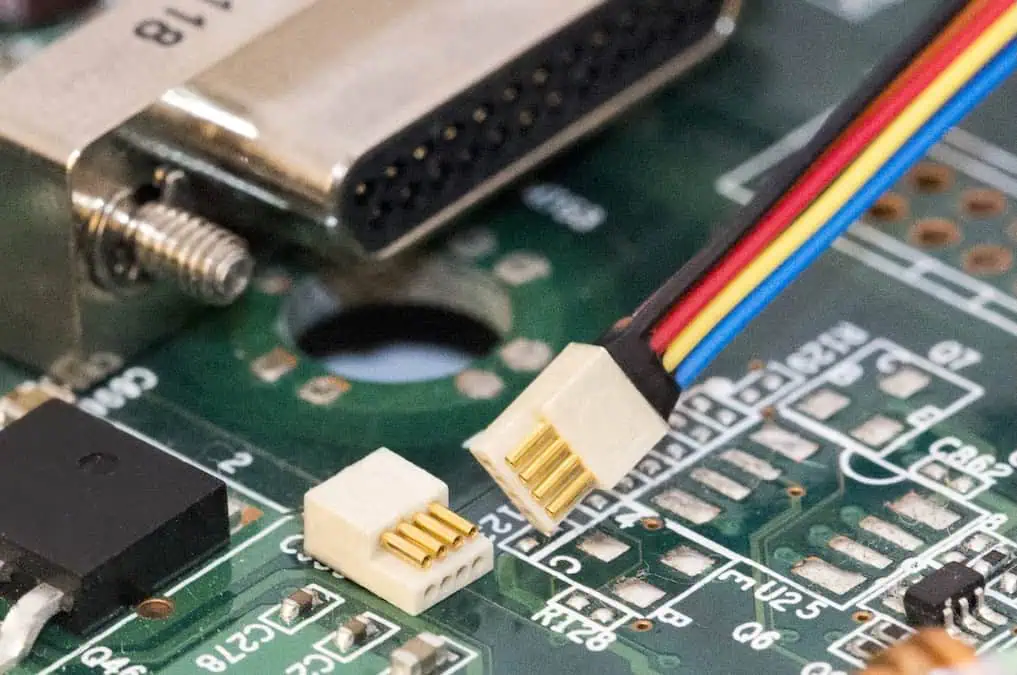
For PCB integration, connectors are available with straight through-hole, right-angle through-hole, and surface-mount tails, alongside pre-wired pigtail options for direct chassis wiring.
Overmolded cable assemblies improve environmental protection and strain relief while reducing assembly complexity. These ruggedized assemblies are frequently used in portable military systems and expeditionary equipment.
Blind-mate and quick-disconnect designs support rapid maintenance and modular platform architectures. These configurations are particularly valuable in systems requiring fast field replacement or modular payload integration.
Defense and Aerospace Applications
Within military aircraft and avionics systems, MIL-DTL-32139 connectors may support flight controls, radar systems, communications equipment, navigation systems, mission computers, weapons systems, and electronic warfare payloads. Aerospace environments place especially demanding requirements on vibration resistance, weight reduction, EMI shielding, and thermal stability.
Naval combat systems rely heavily on ruggedized interconnect infrastructure to support combat management systems, radar arrays, sonar systems, navigation equipment, communications systems, and weapons integration. Shipboard connectors must withstand salt exposure, humidity, shock loading, and electromagnetic congestion.
Armored vehicles and ground combat platforms expose connectors to continuous vibration, mechanical shock, dust, mud, moisture, and wide temperature variations. Ground vehicle connectors must also support rapid maintenance and long operational service life.
Missile and guided weapon systems impose particularly severe requirements due to extreme acceleration, vibration, compact packaging constraints, and long-term storage demands. Connector reliability is critical because failure during launch or flight cannot be corrected.
Radar, ISR, and electronic warfare systems generate especially high data volumes while operating within heavily contested electromagnetic environments. Connectors supporting these systems must preserve shielding effectiveness and signal integrity under severe EMI conditions.
Soldier-worn systems and portable tactical electronics emphasize miniaturization, low weight, ruggedness, and rapid field usability. Connectors used in these applications must survive repeated handling and environmental exposure while remaining simple to operate under combat conditions.
Emerging Trends
Military interconnect technologies continue evolving rapidly in response to changing battlefield requirements, digital transformation initiatives, and increasing demands for platform connectivity.
Miniaturized high-density interconnect systems are becoming increasingly important as defense platforms attempt to maximize capability within constrained physical footprints. Compact connectors supporting high contact density and multi-function integration are particularly valuable within unmanned systems and portable electronics where weight savings translate directly into flight time or mission endurance.
High-speed modular architectures such as VPX and SOSA-aligned (Sensor Open Systems Architecture) systems are reshaping military electronics design. While MIL-DTL-32139 products generally handle peripheral and internal board-to-wire routing rather than the primary heavy backplane slots, their role in linking backplane modules to external arrays and I/O panels is expanding.