Aeron Systems, a developer of Electronic Warfare (EW)-resilient navigation solutions, details the role of Inertial Navigation Systems (INS) in enabling reliable guidance and control for unmanned vehicles operating across aerial, ground, and underwater domains. Read more >>
As autonomous platforms become increasingly important for applications such as surveillance, infrastructure monitoring, search operations, and payload delivery, dependable navigation technologies are essential to ensure that vehicles follow predefined routes and maintain stable operation without direct human control.
The article outlines the limitations of relying solely on Global Navigation Satellite Systems (GNSS). Satellite signals can degrade in environments where reception is obstructed, including urban areas, dense vegetation, or underwater conditions, and may also be affected by adverse weather. In addition, GNSS signals are vulnerable to interference, jamming, and spoofing. Autopilot controllers also require high-frequency vehicle dynamics data, typically sampled at 50 to 100 Hz, while satellite navigation systems generally provide slower update rates that are not suitable for real-time control functions.
To address these challenges, Aeron Systems provides a range of indigenously developed INS designed for autonomous control and navigation tasks. The company’s MEMS-based INS solutions deliver position drift performance as low as 16 meters per minute without external aiding, with accuracy improving when additional inputs such as airspeed sensors, odometers, or GPS are available. With GNSS support, the systems can achieve positional accuracy of 2.5 meters CEP in standalone mode and approximately 1 meter CEP when SBAS is used.
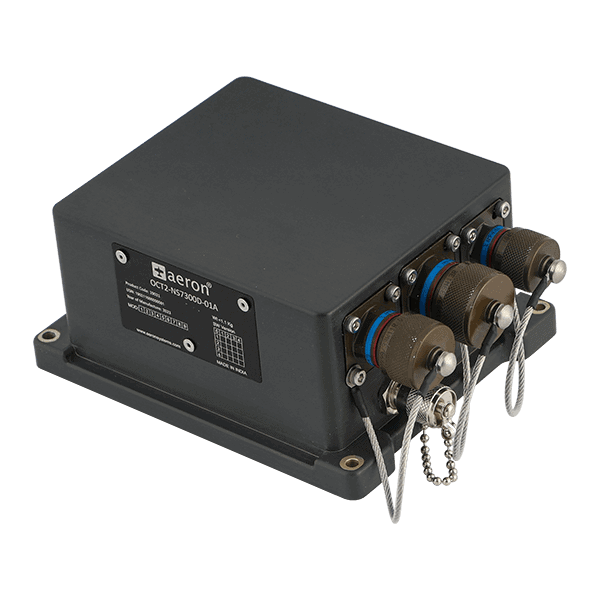
Aeron’s INS portfolio includes systems tailored to the operational requirements of different unmanned platforms. The compact and lightweight Canopus INS is suited to Unmanned Aerial Vehicle (UAV) and Unmanned Underwater Vehicle (UUV) deployments, while the Octantis INS incorporates g-insensitive gyroscopes for ground vehicle applications. Both product families are designed to meet MIL standards, operating across temperatures from -40°C to 85°C and withstanding shock loads of up to 20 g, with higher survivability levels available through custom configurations.
To find out more information, read ‘Inertial Navigation Systems (INS) For Unmanned Vehicles’ here >>