Showcase your capabilities
If you design, build or supply Displacement Sensors, create a profile to showcase your capabilities and connect with visitors who have an active requirement for your solutions.




Displacement sensor manufacturers supply precise measurement of movement, position, and linear or angular shift for control-critical subsystems across defense and aerospace platforms. Typical technologies include LVDTs for wear-free actuator and landing gear feedback, inductive and eddy current sensors for reliable operation in metallic or contaminated environments, capacitive sensors for ultra-precise short-range monitoring, laser and optical displacement sensors for high-speed non-contact tracking, and magnetic and Hall effect sensors for compact, low-power embedded position sensing. Designs are often ruggedized for MIL-STD shock, vibration, and EMI, with options for redundancy, sealing, and diagnostics.
Read the Technology Overview
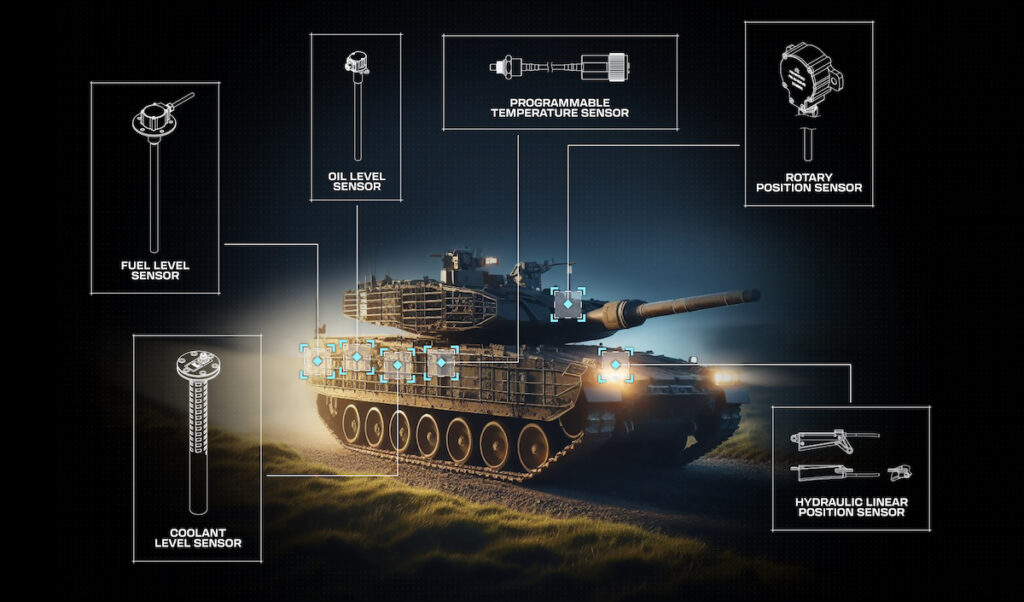
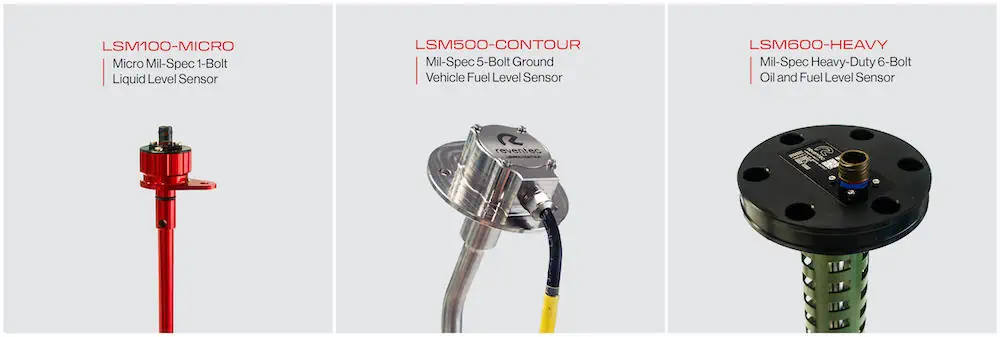
Ruggedized Solid-state Liquid Level, Temperature and Position Sensors for Military Applications

If you design, build or supply Displacement Sensors, create a profile to showcase your capabilities and connect with visitors who have an active requirement for your solutions.

Displacement sensors are utilized in defense and aerospace platforms for precise measurement of movement, position, and linear or angular shift in critical subsystems. Used in armored vehicles, aircraft flight controls, guided missile systems, autonomous platforms and more, these sensors provide real-time feedback that supports dynamic control and improves system reliability.
Displacement sensor manufacturers may utilize one or more of a number of technologies in their solutions. These include:
LVDTs are widely used in defense systems for their non-contact design, which allows for wear-free operation over extended lifecycles. These sensors convert linear displacement into an electrical signal with high accuracy and resolution, making them ideal for monitoring actuator stroke, gear position, or landing gear deployment.
In aerospace platforms, LVDTs are deployed in thrust reverser systems, flight surface monitoring, and brake-by-wire assemblies. They may be found in both fixed-wing and rotary-wing aircraft.
On military ground vehicles, LVDTs provide position feedback for hydraulic systems and suspension controls. Displacement sensors manufacturers often customize LVDT-based sensors to operate in armored environments, incorporating rugged housings, military connectors, and redundant coils for increased fault tolerance.
Inductive displacement sensors are commonly selected for applications requiring high reliability in metallic environments. Using changes in inductance to measure proximity and displacement, these sensors are robust against contaminants such as dust, oil, and moisture. For naval applications and marine-based systems, inductive sensors are favored due to their resistance to corrosion and saltwater ingress.
Eddy current sensors, another type of non-contact inductive technology, are often used for micron-level precision in measuring small displacements, thermal expansion, or shaft positioning. In aerospace and missile systems, they play a key role in monitoring turbine blade movement, rotor alignment, and structural deflection under dynamic loads.
Capacitive sensors provide ultra-precise measurements of short-range displacement and are especially effective in monitoring the position of non-metallic components. Their high sensitivity makes them suitable for applications such as optical stabilization systems, fine control of UAV gimbals, and vibration analysis in electronic payloads.
Defense-grade capacitive displacement sensors are often engineered with multi-channel outputs, electromagnetic shielding, and the ability to operate in high-vacuum or low-pressure environments.
Laser triangulation and time-of-flight sensors offer high-speed, high-accuracy measurements over varying distances and surfaces. These optical sensors are ideal for applications where physical contact is not feasible or where high-speed movement needs to be tracked with sub-millimeter precision.
In guided munitions, optical displacement sensors assist in fin positioning, internal component alignment, and mid-course correction mechanisms. On UAVs and UGVs, they enhance terrain-following capabilities, aid in obstacle detection, and provide surface measurement data for autonomous navigation.
Magnetic displacement sensors, including those based on the Hall effect, provide a robust and contactless method of detecting position and movement in defense and aerospace environments. These sensors operate by detecting changes in magnetic field strength as a target moves relative to the sensor, allowing precise tracking of linear or rotary displacement without mechanical wear.
Hall effect sensors are especially well-suited for embedded applications where compactness, low power consumption, and resistance to environmental contaminants are critical. Common use cases include position monitoring of throttle assemblies, rotor angle sensing in electric motor drives, and gear position detection in remotely operated turrets or weapon mounts.
In military ground vehicles, magnetic displacement sensors are integrated into gearboxes, braking systems, and turret rotation mechanisms to ensure responsive control and real-time feedback. Their immunity to dust, oil, and vibration makes them highly dependable in rugged combat conditions. For aerospace applications, these sensors contribute to flap actuation monitoring, cockpit control feedback, and satellite positioning systems.
Displacement sensors are employed in a wide variety of military and aerospace use cases. These include:
Displacement sensors may feature capabilities that meet defense-specific performance metrics, including:
Advanced models may also incorporate health monitoring, built-in test (BIT) capabilities, and diagnostics interfaces compatible with modern C4ISR systems.


 Searching Companies & Products