



WOLF Advanced Technology’s whitepaper, AI at the Tactical Edge: Rugged GPU + FPGA Solutions for Next-Gen Unmanned Systems, examines how the company integrates NVIDIA’s latest GPU architectures with its proprietary FGX FPGA technology to meet the demands of modern autonomous platforms.
Together, these technologies enable unmanned aerial, ground, surface, and subsea systems to operate independently in high-threat, communication-limited environments where rapid, reliable decision-making is essential.
As autonomous defense platforms evolve from remotely piloted assets into intelligent, self-directed machines, onboard computing has become a decisive factor in mission performance. The ability to process data, interpret sensor input, and execute autonomous decisions in real time, often without reliable communication or GPS access, requires embedded systems that combine high computational throughput with exceptional ruggedness.
Edge Computing for Autonomous Missions
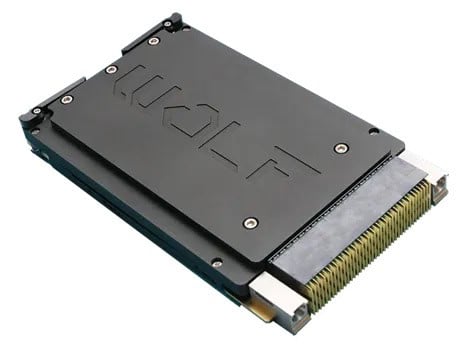
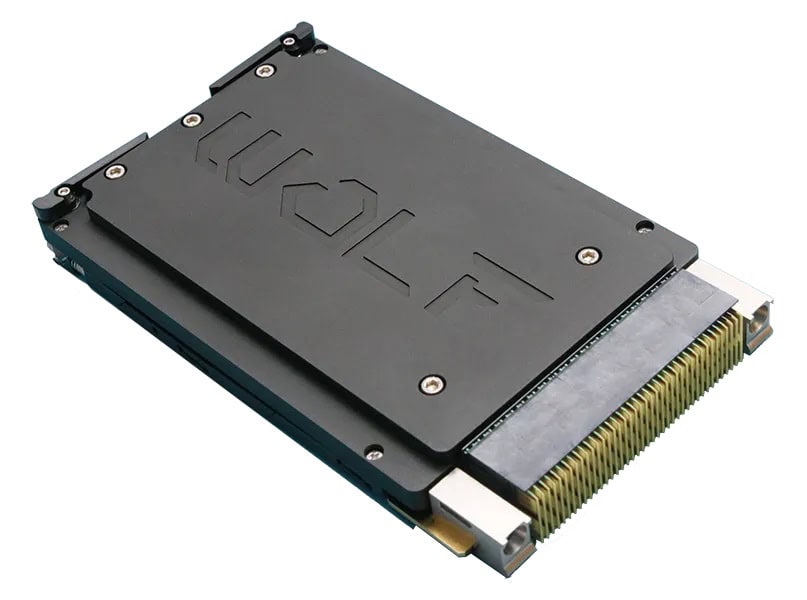
Modern defense systems depend on onboard processors capable of fusing multiple sensor streams and supporting AI inference for navigation, object recognition, and threat response. WOLF designs embedded computing solutions in VPX, VNX+, XMC, and custom small form factor (SFF) configurations to achieve this performance within strict size, weight, and power limits.
Leveraging NVIDIA Jetson AGX Orin and Thor, Ada, and Blackwell architectures, these systems bring high-performance AI computing directly to the tactical edge. The GPUs’ Tensor Core design supports complex inference tasks such as object detection and Simultaneous Localization and Mapping (SLAM), enabling autonomous platforms to interpret their surroundings and act within milliseconds.
Complementing this GPU power, WOLF’s FGX FPGA provides hardware-level flexibility by capturing, converting, compressing, and displaying real-time video and sensor signals across multiple formats. This integration reduces processing latency and enables AI pipelines compatible with a broad range of sensor types and mission configurations.
Network Synchronization Through Time-Sensitive Networking (TSN)
A critical component for coordinated autonomy is Time-Sensitive Networking (TSN). WOLF’s architectures are designed to support TSN-compliant Ethernet communication, delivering sub-100 microsecond latency, minimal jitter, and synchronization accuracy within ±100 nanoseconds.
Unlike conventional Ethernet, TSN ensures deterministic timing and data redundancy, maintaining consistent performance in multi-vehicle operations such as UAV swarm missions or maritime patrols. This allows real-time synchronization among sensors, AI processors, and control systems across distributed unmanned assets.
Performance Metrics for Tactical AI
The whitepaper outlines performance benchmarks demonstrating the efficiency of WOLF’s AI computing solutions. On NVIDIA Jetson AGX Orin, systems deliver approximately 274 images per second per watt for ResNet-50 image classification and around 6.7 images per second per watt for RetinaNet object detection. The Jetson Xavier NX achieves about 112 images per second per watt for ResNet-50 and 3.1 images per second per watt for RetinaNet.
These results highlight the ability to sustain high inference throughput in compact, power-constrained environments typical of embedded defense platforms.
Mission Applications Across Domains
The technologies are applicable across a wide range of unmanned missions:
- ISR UAVs perform real-time recognition and tracking from EO/IR imagery.
- UGVs combine multiple sensor inputs for autonomous navigation and hazard detection.
- USVs and UUVs interpret radar and sonar data for obstacle avoidance and precision movement.
- Tactical Robots and Loitering Munitions execute onboard classification for terrain analysis and target identification.
By integrating TSN and edge AI, mixed-domain fleets can share intelligence across air, land, and sea systems, enabling coordinated autonomy in complex operational settings.
Rugged, Safety-Certifiable Hardware Design
WOLF’s hardware platforms are engineered for sustained operation in extreme conditions, including high altitude, humidity, desert heat, and arctic cold. Systems are MIL-STD-810G tested and designed with support for DO-254 and DO-178C certification processes, ensuring traceability and design assurance for mission- and safety-critical applications. Cooling options include conduction, air, and liquid flow-through systems, with enclosures featuring EMI shielding and conformal coating.
Available form factors include:
- VPX 3U and 6U modules with 60–300W power envelopes and extensive video signal compatibility (12G/6G/3G
- SDI, CoaXPress, ARINC 818, STANAG-3350, and others).
- XMC modules that combine GPU, FGX, and PCIe switching in compact mezzanine formats.
- VNX+ (VITA 90) modules offering high-performance computing in ultra-small configurations.
These designs ensure reliable performance under vibration, shock, and electromagnetic stress, maintaining computational integrity across diverse defense environments.
AI Autonomy at the Tactical Edge
The integration of NVIDIA GPU acceleration with FGX FPGA signal processing represents a significant advance in embedded AI for defense systems. By combining deterministic networking, SWaP-optimized rugged design, and safety-certifiable architectures, WOLF delivers the computational foundation required for next-generation autonomous missions.
With the ability to process, analyze, and act on critical data within milliseconds, WOLF’s platforms enable unmanned systems to operate independently in complex, GPS-denied, and communication-limited conditions, bringing true AI autonomy to the tactical edge.