Wolf Advanced Technology provides an in-depth overview of its combined FPGA and GPU radar processing solutions, which improve performance, flexibility and scalability across defense, aerospace, and surveillance domains. Read more >>
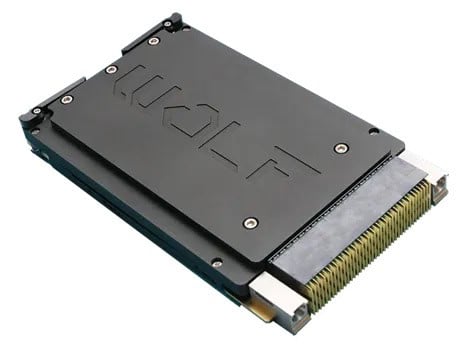
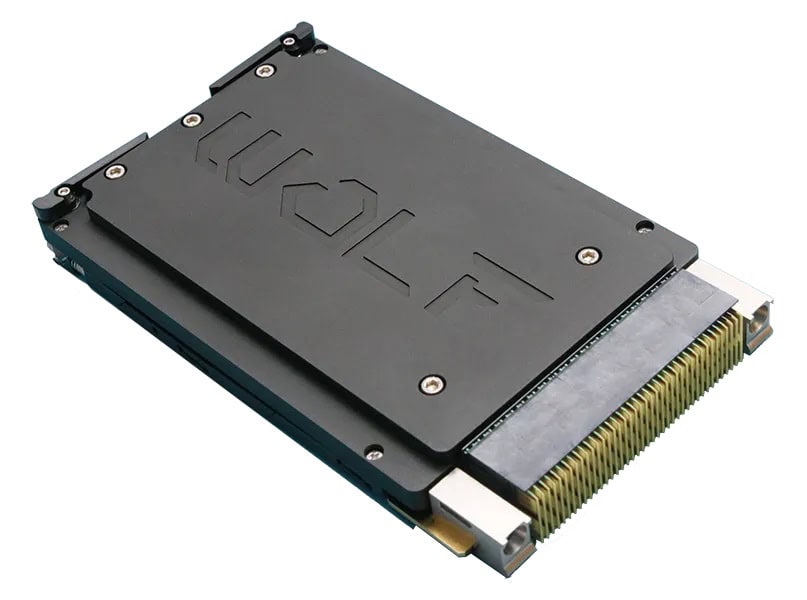
VPX3U-BW5000E-SWITCH (WOLF-163S).
WOLF’s high-performance radar processing systems utilize the power of NVIDIA GPUs as either standalone accelerators or in FPGA-GPU integrated hybrid platforms, which enable new levels of radar performance, adaptability, and mission readiness.
While traditional radar processing relies on FPGA-based architectures, WOLF’s modern solutions, designed in rugged VPX and XMC form factors, leverage real-time signal control of FPGAs alongside the parallel processing and AI-enhanced GPU radar capabilities.
The paper specifies advantages of WOLF’s innovations. For example, NVIDIA GPUs, integrated with WOLF VPX and XMC, optimize radar imaging and Doppler signal processing. NVIDIA Tensor Cores also accelerate AI workloads for adaptive radar processing.
With WOLF GPUs, radar engineers can develop applications using common AI and signal processing frameworks like CUDA, TensorFlow, and PyTorch, for faster prototyping and deployment. Users can also upgrade software and hardware without complete system redesign.
Application-Specific Radar Configurations
This whitepaper outlines optimal radar architectures by mission type:
- Airborne Surveillance (AWACS, UAV ISR) – The AESA + SAR hybrid radar has FPGA beam steering and tracking, alongside GPU for SAR image formation and object classification.
- Missile Defense: The FPGA-based Pulse-Doppler radar has optional GPU offline analysis of threat patterns, with fast target acquisition and velocity detection.
- Satellite-Based Reconnaissance: the SAR features onboard FPGA preprocessing, GPU-based ground imaging, AI-driven analytics, and GPU clusters for image processing.
- Border Surveillance: The MTI + SAR consists of FPGA MTI processing with GPU terrain imaging and AI classification.
- Electronic Warfare: GPU-driven passive or multistatic radar allows for time-frequency analysis and ML-based threat detection.
- Naval Operations: The FPGA-controlled 3D AESA Pulse-Doppler radar assists with data fusion and threat detection, with optional GPU for backend processing.
WOLF’s Integration of Rugged VPX & XMC Solutions
WOLF offers several rugged, SWaP-optimized GPU platforms matched to radar roles:
- WOLF-153L: Features an Ada RTX5000 GPU with ConnectX-7 SmartNIC, with 2× 10GBase-KR ports and 1× 40/100GBase-KR4 port through the CX-7.
- WOLF-1538: Designed for offline GPU processing platform, incorporating Ada RTX5000 GPU and PCIe Gen4 switch in SOSA and OPENVPX profiles.
- WOLF-163S: Integrates a Blackwell RTX5000 GPU with 200 Gbps Ethernet switch to support 8× 25GBase-KR ports.
- WOLF-1570: Utilizes Ada RTX2000 GPU, Xilinx FGX2 FPGA and PCIe Gen4 switch, offering up to 4× 12G-SDI inputs and outputs.
WOLF’s GPU-powered VPX and XMC solutions provide the necessary computational power for AI-enhanced radar applications, reducing development time and increasing scalability.
The company’s rugged, high-efficiency cooling designs and NVIDIA’s GPU technology allows non-FPGA-centric customers to achieve advanced radar performance across defense, aerospace, automotive, and environmental monitoring industries.
The paper provides breakdown of military and aerospace radar use cases involving digital signal processing (DSP), with an analysis of where GPU-based AI inference is viable, especially in RF signal environments like RF10.
WOLF discusses challenges and considerations of GPU-based solutions, including power consumption, thermal management and real-time constraints, followed by an analysis of future trends. The paper specifies these as edge AI integration, the influence of quantum computing, and 5G and IoT connectivity.
Meet Wolf Advanced Technology at DSEI London, on September 9th-12th 2025, at Booth S5-215.