Showcase your capabilities
If you design, build or supply Optical Flow Sensors, create a profile to showcase your capabilities and connect with visitors who have an active requirement for your solutions.




Optical flow sensors provide visual motion data that supports navigation, obstacle detection, and stabilization for military drones and autonomous systems operating in GPS-denied or signal-contested environments. These sensors enhance positioning accuracy and maintain situational awareness in complex settings such as urban terrain, tunnels, and electronic warfare zones.
Read the Technology Overview
State-Of-The-Art NDAA-Compliant Electronic Hardware Components for Mission-Critical Drone & Robotics Platforms. Made in the USA.

If you design, build or supply Optical Flow Sensors, create a profile to showcase your capabilities and connect with visitors who have an active requirement for your solutions.

Optical flow sensors play a critical role in defense applications, particularly for autonomous navigation, targeting, and mapping, where traditional satellite-based systems like GPS are unavailable or unreliable. These sensors use vision-based processing to interpret motion, making them indispensable in tunnels, urban canyons, forests, and contested battlefields where electronic warfare may disrupt standard positioning systems.
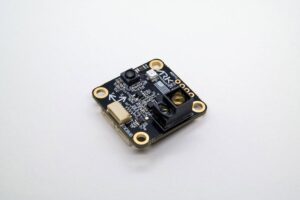
ARK Flow Sensor by ARK Electronics.
An optical flow sensor is a type of vision-based device that detects the motion of objects or surfaces relative to a camera’s field of view. It operates by analyzing sequential images and measuring pixel displacement over time, a concept rooted in computer vision known as optical flow. The resulting data can be used to estimate velocity, distance, and direction of motion, which are crucial for inertial navigation and control systems.
In military and UAV contexts, optical flow sensors are typically used alongside inertial measurement units (IMUs), inertial navigation systems (INS), and distance sensors to enable precise localization, especially during GPS-denied missions. These sensors often include embedded microcontrollers, DSPs, or FPGAs for real-time image processing.
Optical flow sensors are widely used across defense domains to support autonomous navigation, targeting, and motion estimation in GPS-denied or visually complex environments. Their ability to detect motion through visual data makes them suitable for a range of tactical and operational scenarios:
These use cases demonstrate the flexibility of optical flow technology in addressing diverse operational challenges, particularly in environments where other navigation systems may fail or underperform.
Military-grade optical flow sensors vary based on their processing approach, optics, and hardware integration:
Optical flow is often used in conjunction with, or compared against, other sensing modalities in defense:
| Technology | Description | Strengths | Limitations |
| IMU/INS | Uses accelerometers and gyroscopes to estimate motion | High update rate, compact | Drift over time, needs correction |
| Lidar Sensors | Laser-based range detection | Accurate depth, works in low light | Higher power consumption, cost |
| Vision-Based SLAM | Builds maps using camera input | High fidelity mapping | Computationally intensive |
| GNSS/GPS/GALILEO | Satellite-based positioning | Global availability | Vulnerable to jamming/spoofing |
| Optical Flow | Tracks pixel motion in sequential images | Lightweight, passive, or active | Requires textured surfaces and sufficient illumination (ambient or integrated) |
In GPS-denied environments, combining IMU/INS with optical flow provides complementary strengths: optical flow corrects inertial drift, while the IMU provides motion continuity during rapid maneuvers or visual occlusions.
Defense systems using optical flow sensors often adhere to industry and military standards (MIL-STD) to ensure reliability, interoperability, and environmental compliance:
Integration often involves ensuring compatibility with other avionics, secure data processing pipelines, and rigorous calibration procedures. Power management units are also critical for low-SWaP (size, weight, and power) configurations, particularly in small UAS or portable sensor platforms.
Ongoing advancements are expanding the role of optical flow sensors in defense:
Optical flow sensors are indispensable in the modern defense landscape. Their ability to enable GPS-denied navigation, obstacle avoidance, and precision targeting makes them foundational to autonomous systems and unmanned platforms. As defense applications evolve to operate in more complex and contested environments, the demand for advanced optical flow solutions, integrated with inertial systems, lidar, and onboard AI, continues to grow. These sensors will remain at the forefront of battlefield autonomy, supporting enhanced situational awareness, survivability, and operational precision.


 Searching Companies & Products