Showcase your capabilities
If you design, build or supply Force Sensors, create a profile to showcase your capabilities and connect with visitors who have an active requirement for your solutions.




Find suppliers and manufacturers of load cells, force sensors, and force transducers for defense and aerospace applications. These precision measurement devices deliver accurate, reliable force data for testing, calibration, and control systems used across land, sea, air, and space platforms.
Read the Technology Overview

Load cells are transducers that convert mechanical force into electrical signals, providing real-time insight into the structural and mechanical behavior of defense systems. These devices are fundamental to the measurement, control, and verification of forces in weapons testing, aircraft load monitoring, vehicle suspension analysis, naval instrumentation, and aerospace component validation.
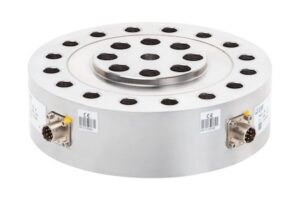
U10F Force Transducer by Hottinger Brüel & Kjær (HBK)
Force sensors are integral to modern defense testing and system monitoring architectures. From strain gauge sensors in structural health monitoring to piezoelectric transducers in vibration analysis, these instruments deliver the accuracy and reliability required in mission-critical environments. Their integration with position sensors, data acquisition systems, amplifiers, and digital signal conditioners ensures precision measurement and control across multiple domains of defense technology.
Load cells operate on various transduction principles, most commonly through resistive strain gauges, piezoelectric materials, or capacitive elements that change electrical properties in response to applied forces. The electrical output is proportional to the mechanical load, allowing it to be processed by analog-to-digital converters and interpreted through control systems or DAQ interfaces.
In defense applications, force sensors are often embedded in complex feedback loops to ensure accurate actuator calibration, vehicle dynamics testing, and weapons alignment. Signal conditioning modules enhance sensitivity and reduce noise, while temperature compensation circuits maintain performance stability under extreme thermal conditions.
Defense load cells are classified by sensing technology, mechanical configuration, and environmental suitability. Each type provides unique benefits depending on operational requirements.
The most widely used type employs Wheatstone bridge circuits to detect strain on metal diaphragms or beams. They deliver excellent linearity and stability across a wide load range. Commonly used for vehicle weight measurement, aerospace component testing, and structural monitoring.
Design features: Precision signal conditioning, temperature compensation, EMI shielding, and optional digital interfaces for integration with DAQ systems.
Utilize piezoelectric crystals to generate a voltage proportional to the applied force. Ideal for dynamic force measurement, vibration testing, and impact analysis. Suitable for applications where rapid load changes occur, such as missile testing or drone impact assessment.
Design features: High-frequency response, low-noise electronics, rugged sealed housings, and optional charge amplifiers.
Rely on fluid pressure changes within a confined chamber. Preferred in heavy-load defense applications such as tank suspension calibration, structural test rigs, and naval lifting systems.
Design features: Overload protection, sealed enclosures for submersion, corrosion-resistant materials, and analog pressure output ports.
Employ air pressure variations to measure force, providing stable readings with low hysteresis. Used in laboratory testing, calibration benches, and training simulators.
Design features: Adjustable pressure regulators, feedback valves, and shock isolation mounts.
Measure displacement through variations in capacitance between plates. Well-suited for precision assembly, avionics testing, and micro-force measurement in robotics.
Design features: Miniature size, high resolution, low power consumption, and digital output options.
Optical designs use light modulation to detect deformation, while inductive types rely on coil impedance variation. Both are used in environments where electrical isolation and EMI immunity are critical, such as radar systems and spacecraft instrumentation.
Design features: Non-contact sensing, radiation resistance, and compatibility with fiber-optic or inductive data links.
Measure forces along several axes simultaneously, providing vector data essential for aerospace and robotic control applications. Commonly employed in flight testing, satellite deployment, and robotic gripper systems.
Design features: Compact multi-channel architecture, internal calibration matrix, and smart sensor networking interfaces.
Load cells are widely deployed across defense testing, operational monitoring, and embedded system control. They ensure reliability, safety, and performance verification in a variety of military environments.
Used to monitor aerodynamic loads on airframes, measure thrust in propulsion systems, and verify control surface actuation. Load cells support aircraft fatigue testing, flight load measurement, and satellite launch systems in compliance with DO-160 environmental standards.
Integrated into suspension systems, drivetrain testing, and braking force measurement for tanks, armored vehicles, and tactical platforms. Load sensors enable calibration of control systems and validation of vehicle load distribution during mobility trials.
Used for mooring tension measurement, structural load assessment, and crane monitoring on naval vessels. Submersible, corrosion-resistant load cells operate reliably under high pressure and saltwater conditions and conform to MIL-STD-810.
Essential in impact, recoil, and detonation studies where high-speed force data is required. Piezoelectric and strain gauge load cells measure transient loads during projectile launch, missile stage separation, and munitions testing.
Provide real-time feedback for actuator control, payload balancing, and landing gear monitoring in UAVs, UGVs, and UUVs. Miniature multi-axis sensors are used in robotic arms, grippers, and unmanned assembly systems for precision handling.
Used to assess stress distribution in bridges, shelters, and mobile platforms under operational loads. Continuous load monitoring enhances predictive maintenance and safety management in long-term deployments.
Modern defense load cells interface directly with digital control systems via analog-to-digital converters, signal conditioning modules, and high-speed DAQ systems. Many feature built-in amplifiers, microcontrollers, and smart communication protocols for real-time telemetry. Integration with robotic systems and unmanned platforms enables the implementation of force feedback loops for autonomous control and adaptive load management.
Cable assemblies, mounting plates, and sensor housings are engineered for mechanical protection and electromagnetic shielding. Modular electronics and standardized connectors enable interoperability across test benches and in-field instrumentation systems.
Recent developments include the use of piezoelectric ceramics, optical fiber sensing elements, and micro-electromechanical systems (MEMS) to achieve higher sensitivity and reduced form factor. Smart load cells with embedded calibration circuits and self-diagnostic capability support predictive maintenance and long-term data integrity.
Hybrid designs combining strain gauges and piezoelectric elements enable dual-mode operation for static and dynamic force measurement, improving versatility in aerospace and military testing environments.
Defense load cells deliver critical measurement accuracy under the harshest operational conditions. Through rugged design, signal integrity, and compliance with established defense standards, these sensors play an indispensable role in validation, safety assurance, and real-time system control across all defense domains.
If you design, build or supply Force Sensors, create a profile to showcase your capabilities and connect with visitors who have an active requirement for your solutions.


 Searching Companies & Products