If you design, build or supply Meteorological Measuring Systems & Weather Stations, create a profile to showcase your capabilities and connect with visitors who have an active requirement for your solutions.
Rugged Weather Stations & Military Meteorology Equipment
Overview by
Sarah Simpson
Updated:
Military Meteorology
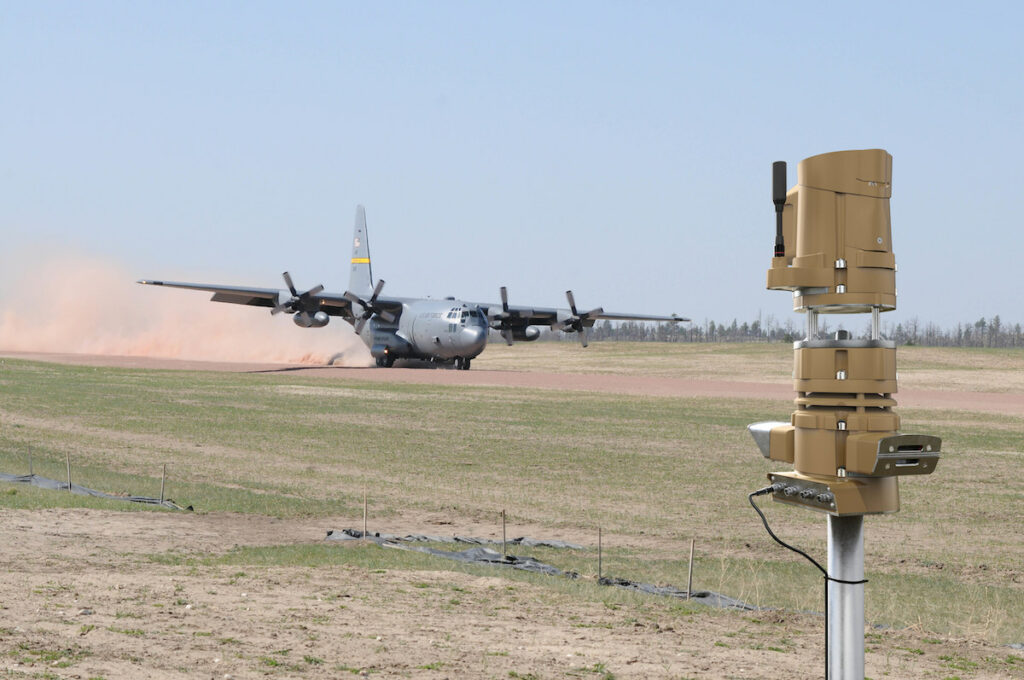
Meteorological and weather stations are essential for a wide range of military operations. They may be portable or fixed, and can be installed at air bases and remote air strips to provide weather information that will aid aircraft and drone operations, facilitating effective flight preparation, takeoff and landing. They provide essential situational awareness for operations planning that can be crucial for mission success.
Military weather sensors may also be installed on board naval and coast guard vessels to aid in visibility and navigation, and are used on armored vehicles and artillery platforms to increase ballistic effectiveness and reduce friendly fire. Rapid-deployment weather stations may also be set up in emergency response situations such as fires and nuclear, biological and chemical threats, as these situations can be exacerbated by wind and rain.
Rugged Weather Stations
Military weather stations can measure and record a wide range of parameters, including wind speed and direction, temperature, pressure, humidity, precipitation, and lightning. Sensors may be integrated into the station, or connected via expansion ports for additional flexibility. Additional sensors may include GNSS receivers, cameras for panoramic views and additional situational awareness, and LiDAR ceilometers for measuring cloud height.
Data may be recorded locally on internal storage, or communicated to the cloud via SATCOM (satellite communications), cellular or radio modem. This data may then be accessed and displayed on devices such as mobile phones, tablets or PCs. Wireless weather stations may also be connected directly to another system by serial RS-232 or RS-422, or Ethernet.
Weather stations deployed on bases or vehicles may be able to utilize existing power sources. Remote military weather stations may use batteries for power, as well as solar panels.
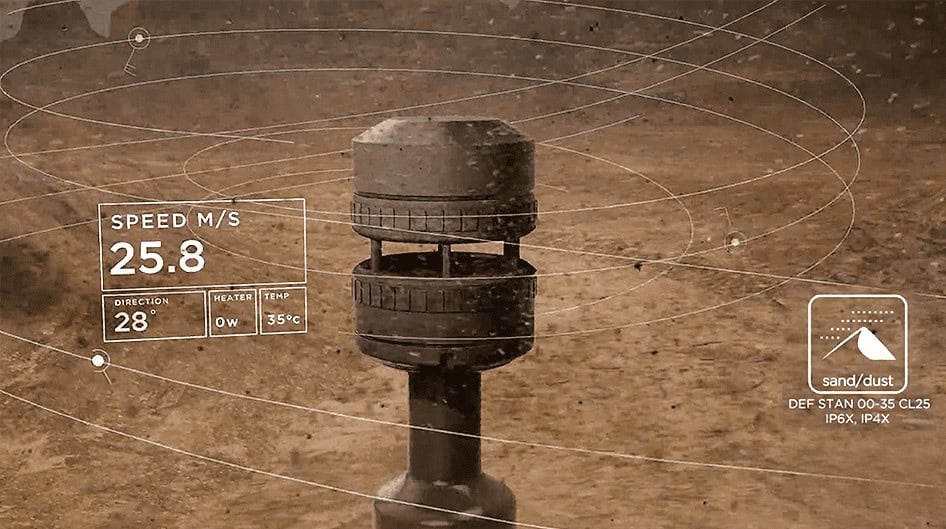
Rugged weather stations for military use need to be resistant to a wide variety of harsh environmental conditions. These include sand, dust, rain, ice, snow, gunfire, extreme operating temperatures, EMI (electromagnetic interference) and shock and vibration.
FT Technologies explains the importance of accurate wind data for uncrewed and autonomous vehicles and outlines how ultrasonic wind sensing mitigates limitations of pitot-based airspeed measurement in demanding operating environments
This whitepaper by FT Technologies explores how environmental conditions, such as wind, temperature, air pressure, and humidity, can influence ballistic flight performance and precision fire control
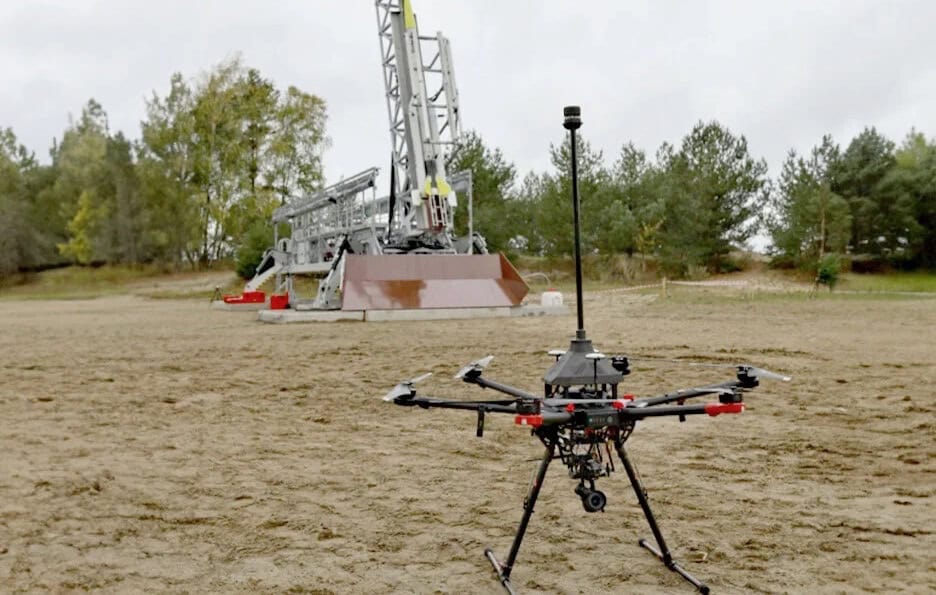
FT Technologies highlights how its Acoustic Resonance ultrasonic anemometer, integrated into a UAV system, provides precise real-time wind data for rocket launches while overcoming limitations of conventional measurement methods
The U.S. Air Force has provided Intellisense Systems with additional funding to further ruggedize its Integrated Weather Observation System (IWOS®), which incorporates over twelve weather sensors into an interlocking, cylindrical design
Benchmark Space Systems’ next-gen electric propulsion system has deployed to support the demonstration of cloud and weather data mapping for potential future military operations
Unmanned Aerial Vehicles (UAVs) equipped with advanced wind sensors, being a cost-effective and efficient solution, can obtain accurate wind data that can help improve the safety of rocket launches
MyRadar will be partnering with the Space Sciences and Engineering Center at the University of Wisconsin-Madison to develop an algorithmic tool that will provide more accurate forecasts for cloud representations through a 24-hour forecast lead-time
Advancing Defense Capability Through Strategic Collaboration
Defense Advancement works with major OEMs to foster collaboration and increase engagement with SMEs, to accelerate innovation and drive defense capabilities forward.