Showcase your capabilities
If you design, build or supply Master Clock Systems, create a profile to showcase your capabilities and connect with visitors who have an active requirement for your solutions.




Master clock systems provide an authoritative time and frequency reference for defense platforms, command facilities, and distributed sensor networks. These systems use GNSS, atomic references, disciplined oscillators, and secure timing architectures to synchronize critical equipment.
This page showcases leading master clock system suppliers, offering time and frequency distribution through NTP, PTP, IRIG-B, 1PPS, fiber, and Ethernet interfaces.
Read the Technology Overview



Network Synchronization Technology & Assured PNT Solutions for Defense Systems & Mission-Critical Infrastructure

Advanced Precision Timing and Frequency Synchronization Solutions for Mission-Critical Networks and Systems

If you design, build or supply Master Clock Systems, create a profile to showcase your capabilities and connect with visitors who have an active requirement for your solutions.

Master clock systems provide the authoritative time and frequency reference across defense platforms, command facilities, and sensor networks. In military operations, precise synchronization is a critical dependency required to correlate radar tracks, electronic intelligence, encrypted communications, and weapon system events.
These systems discipline high-stability internal oscillators using external references to distribute synchronized timing signals like NTP, PTP, 1PPS, and 10 MHz. On mobile platforms and fixed installations alike, they support continuous, resilient operation during periods when GNSS is jammed, degraded, or spoofed, depending on holdover capability, reference diversity, and timing integrity architecture.

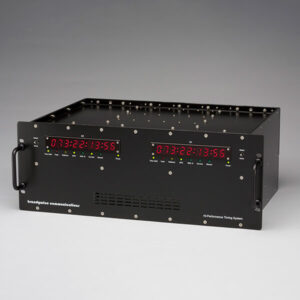
MMC by Brandywine Communications
The primary task of a military GPS master clock system is to establish a validated, authoritative time reference, typically derived from GPS and multi-constellation receivers. High-assurance platforms often cross-reference standard GNSS against local atomic clocks, while a SAASM GPS master clock can use encrypted military GPS signals to improve authentication and anti-spoofing resilience. This allows a suitably equipped master time clock system to flag or reject anomalous data to preserve accuracy for air defense, SIGINT, and sensor fusion.
Once established, the master clock system distributes synchronization to tactical communications, radar processors, and naval combat management systems. Modern installations often use a mixed topology where legacy hardware receives analog or discrete signals like 1PPS or IRIG-B over coax, while newer infrastructure uses an IP master clock system running PTP or NTP over Ethernet.
Modern distributed operations require sensors, data links, and computers across different vehicles or shelters to share a consistent view of time. A master slave clock system architecture aligns these secondary devices within defined accuracy limits, allowing multi-source data to be fused confidently. This precise synchronization supports fast decision-making and tactical geolocation techniques like time difference of arrival.
Holdover capability allows ruggedized defense master clock systems to maintain time accuracy when external references are lost due to jamming, obstruction, or signal degradation. The internal oscillator becomes the primary timing authority during these outages. Depending on mission constraints, platforms rely on oven-controlled crystal oscillators (OCXOs), rubidium standards, or compact chip-scale atomic clocks (CSACs).
Accurate time stamping is fundamental for mission reconstruction, system diagnostics, and forensic analysis. When all subsystems draw from a single master clock source, operators can correlate distributed actions with microsecond, sub-microsecond, or nanosecond-level precision depending on the timing architecture. This reliable data logging reduces post-mission analysis time across test ranges, flight trials, and cyber incident responses.

OSA 5422 Grandmaster Clock by Oscilloquartz
Defense master clock systems continuously monitor the health of their internal oscillators, inputs, and physical outputs to alert operators of drift or faults. Alarms are routed via interfaces like SNMP, syslog, or platform health software. Advanced units can evaluate multiple references to flag GNSS anomalies or spoofing attempts and switch to a secure alternative when supported by the system design.
Military networks leverage a diverse mix of networking standards and hardware signals to distribute precise synchronization across distributed tactical platforms.
| Protocol / Format | Description & Application |
| Network Time Protocol: NTP and Secure NTP | Standard for synchronizing computer clocks across IP networks, with secure implementations using mechanisms such as Network Time Security (NTS) for cryptographic authentication. |
| Precision Time Protocol: IEEE 1588 PTP | Delivers sub-microsecond synchronization in properly engineered networks, allowing an IP master clock system or secure GPS master clock to serve as a PTP grandmaster for software-defined radios and radar processors. |
| IRIG-B and Legacy Time Codes | Widely used time code format in range systems, telemetry recorders, and legacy defense electronics that cannot be easily or cost-effectively redesigned. |
| 1PPS and 10 MHz References | Physical hardware signals providing exact pulse-per-second triggers and ultra-stable frequency references for electronic instrumentation. |
| SyncE and White Rabbit | SyncE supports precise frequency synchronization, while White Rabbit extends Ethernet timing for sub-nanosecond synchronization in carefully engineered fiber networks. |
| Mixed Transmission Media | Distribution using fiber optics for EMI immunity, coaxial cables for RF references, and Ethernet for remote management. |
Master clocks accept diverse inputs including satellite antennas, atomic references, and serial data feeds. GNSS disciplined oscillators (GNSSDOs) are heavily utilized to correct local oscillator drift using long-term satellite accuracy. Consistent with CISA PNT guidance, these inputs may be actively monitored and cross-checked to detect spoofing rather than being blindly trusted.
The internal oscillator dictates holdover performance when external references fail. OCXOs offer excellent short-term stability for tactical vehicles, while rubidium and cesium standards provide greater long-term autonomy for strategic facilities. Chip-scale atomic clocks (CSACs) provide improved holdover stability within highly restricted SWaP environments.
In PTP networks, the grandmaster clock acts as the root timing authority for downstream slave clocks. Intermediate boundary clocks segment the network, while transparent clocks measure and compensate for switch packet delay. This strict hierarchy helps protect synchronization accuracy from network delay, although congestion, path asymmetry, and network design must still be engineered and managed.
Modular chassis designs allow a single master clock engine to drive interchangeable output cards, supporting multi-generational hardware topologies. To reduce single points of failure in high-criticality systems, architectures combine dual power supplies, dual oscillators, and hot-swappable modules to maintain continuous weapon and combat system operations.
Ruggedized timing hardware often requires formal qualification against strict military standards to demonstrate operation in harsh combat environments.
Meeting these compliance baselines helps ensure the timing node operates without degradation alongside powerful radar and communication systems.
Modern military operational realities are accelerating the evolution of timing infrastructure toward distributed, intelligent architectures.
These shifts help master clock installations maintain resilient timing across contested electronic environments.


 Searching Companies & Products


 Subscribe to the Weekly eBrief
The latest engineering and technical developments straight to your inbox - join thousands of engineers who receive it.
Subscribe to the Weekly eBrief
The latest engineering and technical developments straight to your inbox - join thousands of engineers who receive it.