Showcase your capabilities
If you design, build or supply VPX Timing Cards, create a profile to showcase your capabilities and connect with visitors who have an active requirement for your solutions.




VPX timing cards provide precise time, frequency, and synchronization services for OpenVPX-based defense and aerospace computing systems. These modules acquire references such as GNSS, IRIG-B, 1PPS, 10 MHz, PTP, and NTP, then discipline local oscillators and distribute clocks, triggers, timestamps, and time-of-day data across the backplane.
This page features manufacturers and suppliers of VPX timing cards and VPX radial clock modules for resilient synchronization, low-jitter clock distribution, and reliable system integration.
Read the Technology Overview
Advanced Precision Timing and Frequency Synchronization Solutions for Mission-Critical Networks and Systems

If you design, build or supply VPX Timing Cards, create a profile to showcase your capabilities and connect with visitors who have an active requirement for your solutions.

VPX timing cards are specialized plug-in modules that deliver precise time, frequency, and synchronization services for modern defense and aerospace computing systems. Operating within an OpenVPX chassis, these boards acquire external timing references, discipline a local oscillator, and distribute synchronized clocks, pulses, and time-of-day information across the backplane. This shared temporal baseline allows separate subsystems to operate from a common time and frequency reference, which is critical when measurements or actions must correlate at microsecond or nanosecond scales.
A VPX radial clock module performs a related but more specialized distribution function. Rather than managing external reference acquisition and clock discipline, a radial clock module routes low-jitter clock signals from a central source directly to multiple backplane slots using point-to-point paths. This topology minimizes loading, reflections, and slot-to-slot skew. In many architectures, a 3U VPX radial clock card pairs with a primary timing card to deliver phase-aligned frequency references to high-speed processing and data-conversion boards.
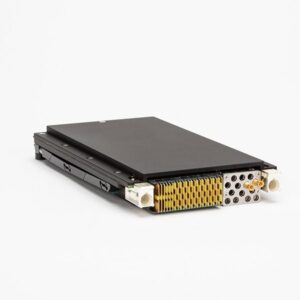
VPX Timing Card by Brandywine Communications.
The timing card first establishes traceability to an external source, such as a GNSS receiver, IRIG time code, or network reference. Input circuitry may monitor reference validity and identify signals that fall outside configured limits. Defense-grade cards may incorporate source validation, configurable reference priorities, and fault alarms rather than automatically trusting the first available input.
Synchronization requires aligning both absolute time epochs and frequency rates to prevent the local clock from drifting. A hardware control loop measures phase and frequency errors between the external reference and the local oscillator, applying gradual corrections. This loop filters short-term disturbances and ensures stable outputs during reference switching.
Hardware-level timestamping captures the exact instant an event occurs close to the physical interface, avoiding non-deterministic operating system or driver delays. FPGAs or dedicated timing logic referenced to the disciplined clock can generate high-resolution timestamp records. These timestamp records are then sent to host processors for accurate sensor fusion and post-mission analysis.
Timing modules synthesize clean reference frequencies for payload cards, including 10 MHz references, low-voltage differential signaling (LVDS) clocks, and custom programmable frequencies. Low phase noise and low jitter are vital to preserve signal-to-noise ratios in high-speed data conversion. In backplanes that support radial clock distribution, each selected slot can receive a dedicated, low-skew path.
Programmable triggers allow actions to occur at precise times relative to other system events. By offloading execution schedules from software to deterministic hardware, the timing card can generate radar, sensor, or acquisition triggers at precisely scheduled boundaries, potentially with nanosecond-level resolution. This approach significantly reduces software latency and jitter.
Beyond raw frequency references, subsystems require accurate calendar date and time-of-day information. The card distributes time-of-day data via serial links, IRIG streams, or network protocols. Internal firmware handles conversions between timescales and manages initialization states before lock to an external master clock reference is achieved.
Clock discipline continuously steers the local oscillator toward the chosen reference while tracking its unique drift and aging profile. If the external reference is lost, the module enters holdover mode, relying on this learned profile to maintain system timing accuracy. When the reference returns, the module can correct the accumulated offset according to its configured reacquisition and clock-steering policy.
Modern open-architecture platforms rely on a diverse array of physical and network-based inputs to maintain a robust time baseline.
Integrating multiple reference options ensures system flexibility and protects the timing environment against unexpected source failures.
Radar systems rely on precise timing for pulse generation, receiver gating, and signal conversion windows. In phased-array and AESA architectures, stable phase relationships dictate the ability to form and steer beams accurately. A centralized timing card supports phase-coherent operation by supplying common references and synchronized triggers across processing slots and, with suitable distribution and calibration, remote apertures.
Signals intelligence and direction-finding platforms combine samples from multiple RF channels, requiring local oscillators and converters to maintain exact phase relationships. Timing hardware supplies low-noise references and synchronized acquisition triggers to preserve spectral purity and allow accurate interferometry across separate receiver paths.
SIGINT payloads process large volumes of rapid, intermittent signal events. Hardware-level timestamping at the ingestion layer ensures metadata is not corrupted by software stack delays. This absolute temporal context lets analysts accurately correlate detections across separate platforms and reconstruct emitter behaviors.
Electronic warfare systems must coordinate sensing, waveform generation, and transmitter activation within very short timing windows. Precise timing enables multiple effectors to alternate transmissions or execute synchronized sweeps. This strict orchestration prevents mutual interference on multifunction platforms sharing the same RF apertures.
Rugged embedded hardware must undergo rigorous verification to prove it can withstand severe environmental and operational stress.
System integrators must review qualification reports and supporting evidence, because a statement that a product is designed to meet a standard does not demonstrate that the applicable tests have been completed.
Evolving multi-domain operations drive rapid innovation in onboard position, navigation, and timing capabilities.
These architectural advancements ensure that tactical computing networks retain high timing fidelity even when operating under sophisticated electronic warfare conditions.


 Searching Companies & Products