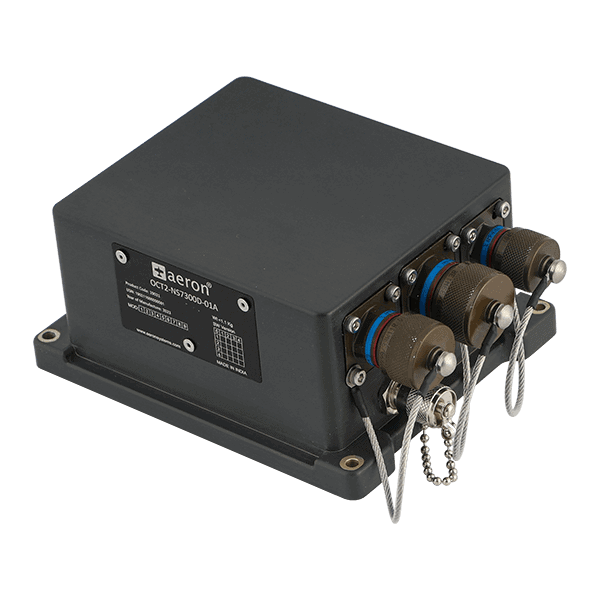
This technical report by Aeron Systems, a developer of electronic warfare resilient navigation solutions, outlines the integration of its PLX3-N Inertial Navigation System (INS) with the ArduPilot flight stack operating on the CubeOrange/Plus controller. Read more >>
The work details how the compact, low-SWaP INS is configured within ArduPilot as the external navigation source for fixed-wing unmanned aircraft, enabling autonomous operation in GNSS-denied conditions.
Using ArduPilot’s external AHRS capability, the system consumes pre-filtered attitude, velocity, and position outputs directly from the PLX3-N, eliminating the need for internal re-fusion while maintaining stable navigation performance. The PLX3-N incorporates MEMS-based inertial sensors, barometric input, optional magnetometer aiding, and GNSS receivers, with an internal Extended Kalman Filter that provides fused LLA, VNED velocity, and quaternion outputs.
During GNSS-denied operation, dead reckoning integrates inertial and barometric data to provide continuous navigation outputs, while optional external aiding such as airspeed supports uncertainty reduction within the EKF framework. The tightly coupled fusion architecture supports smooth transitions between GNSS-aided and inertial modes, preventing discontinuities when signals are lost or restored.
Validation flights conducted on a 1.7 m wingspan fixed-wing platform demonstrate the system’s ability to maintain waypoint navigation and execute Return to Launch during intentional GNSS denial. Across multi-kilometer denied segments, the integrated solution sustained mission continuity without triggering failsafe conditions, with measured drift remaining within operational tolerances and vertical performance maintained through barometric hold. Upon GNSS restoration, position corrections were blended smoothly, with no jumps greater than 1 m.
The report concludes that direct deployment of PLX3-N as an authoritative navigation source enables autonomous missions in GNSS-denied and contested environments while reducing flight controller CPU load. The integration is supported by detailed driver implementation and validated through structured autonomous flight testing across unmanned platforms.