Showcase your capabilities
If you design, build or supply Telescopic Mast Systems, create a profile to showcase your capabilities and connect with visitors who have an active requirement for your solutions.




Tactical telescopic mast systems are deployable elevation solutions designed to rapidly raise antennas, sensors, radar systems, and communications equipment above ground level to enhance line-of-sight performance and operational effectiveness. Used across tactical communications, ISR, electronic warfare, SATCOM, and force protection applications, these systems provide a compact stowed footprint combined with fast deployment and reliable structural performance.
This page showcases military telescopic mast manufacturers for vehicle-mounted, trailer-mounted, expeditionary, and shelter-integrated platforms, including pneumatic, hydraulic, electric, and mechanical designs.
Read the Technology Overview
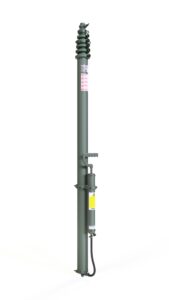
Rapidly-Deployable Mast Systems for Tactical Communications, Lighting & Surveillance

If you design, build or supply Telescopic Mast Systems, create a profile to showcase your capabilities and connect with visitors who have an active requirement for your solutions.

Tactical telescopic mast systems are deployable, highly engineered structures designed to rapidly elevate antennas, sensors, surveillance equipment, and other mission-critical payloads above ground level. Featuring a series of nested sections that extend from a compact stowed configuration, a military telescopic mast provides an efficient means of increasing line-of-sight range while maintaining a minimal transport footprint.
Compared with sectional masts, which require manual assembly from individual components, a tactical telescopic mast can typically be deployed faster and with far fewer personnel. While sectional designs may offer advantages in niche maximum height or heavy payload scenarios, telescoping mast systems are preferred where operational agility, rapid setup, and frequent redeployment are primary requirements.
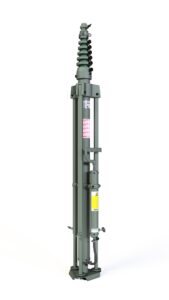
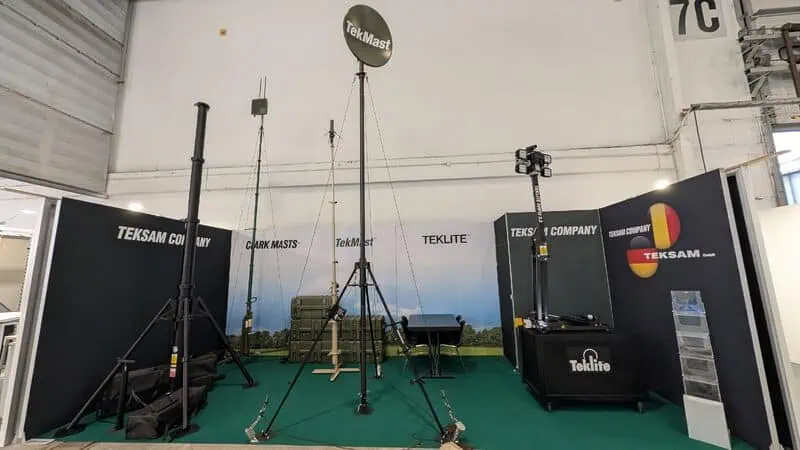
Tactical Telescopic Mast Systems from Teksam Company.
A military telescoping mast functions by extending a series of nested tubular sections vertically from a compact base structure. Each section progressively extends above the previous section, creating a tall yet rigid structure capable of supporting a military antenna, electronic warfare suites, or optronic sensors.
The deployment mechanism may be pneumatic, hydraulic, mechanical, or electric depending on the intended application, payload requirements, and environmental conditions. Once fully extended, the telescopic mast pole provides a stable elevated platform that improves line-of-sight performance and sensor effectiveness.
The defining characteristic of a telescopic mast is its nested construction. Multiple tubular sections are manufactured with progressively decreasing diameters, allowing them to fit inside one another during transport and storage.
When deployed, each section extends sequentially until the structure reaches its operational height. This design provides an exceptional ratio between deployed height and stowed length, making tactical telescopic masts particularly attractive for vehicle-mounted and expeditionary applications where space is at a premium. Precise engineering of section tolerances, guide mechanisms, and bearing surfaces is essential to ensure smooth operation while maintaining structural rigidity under operational loads.
| Deployment technology | Description | Key advantages | Typical applications |
| Pneumatic Telescopic Masts | Utilize compressed air to extend nested mast sections, with sections extending sequentially before being secured by mechanical locking mechanisms. | Rapid deployment, relatively low weight, simple operation. | Communications, surveillance, and temporary deployment applications. |
| Mechanical and Winch-Driven Systems | Use cables, winches, gears, or screw-drive mechanisms to extend and retract mast sections. | Precise control, lower maintenance requirements, operation without compressed air or hydraulic power. | Long-term deployments and environments where support equipment is limited. |
| Electric Telescopic Mast Systems | Employ an electric motor with a screw drive or belt system for automated mast elevation and positioning. | Highly controllable operation, precise height adjustment, easy integration with vehicle power systems. | C4ISR platforms and modern vehicle-mounted systems. |
| Hydraulic Telescopic Masts | Use pressurized hydraulic fluid to generate substantial lifting force for mast deployment. | High load-bearing capability, suitable for large and heavy payloads. | Radar systems, large sensor suites, electronic warfare equipment, and heavy vehicle-mounted platforms. |
| Hybrid Deployment Technologies | Combine multiple deployment methods, such as pneumatic deployment with mechanical locking or hydraulic lifting with electronic stabilization. | Optimized reliability, safety, payload capacity, and operational performance. | Mission-specific defense platforms requiring tailored deployment capabilities. |
Once extended, military telescoping mast systems must remain stable under varying environmental conditions. Locking mechanisms secure individual sections and prevent unintended movement caused by wind loading, vibration, or shock. Many systems incorporate redundant safety devices, emergency lowering procedures, overload protection, and automatic monitoring systems. Advanced platforms may also feature integrated sensors that continuously monitor mast position, alignment, and structural loading.
Telescopic masts are generally categorized as either guyed or self-supporting systems.
Guyed lightweight telescopic masts utilize tensioned support cables anchored to the ground to improve stability and increase achievable height. These systems can support greater payloads while maintaining relatively low structural weight, making them ideal for forward operating bases.
Self-supporting masts eliminate the need for guy wires, simplifying deployment and reducing footprint requirements. While generally requiring a heavy duty telescopic mast to handle equivalent heights or payload capacities without guy lines, they are particularly advantageous in confined operating environments and vehicle-mounted applications.
Military telescopic masts frequently operate in harsh environments including deserts, coastal regions, tropical climates, and arctic conditions. Protective coatings, anodization, specialized paints, and corrosion-resistant materials are therefore essential. Designers must ensure long-term reliability despite exposure to moisture, salt spray, sand, dust, ultraviolet radiation, and extreme temperature fluctuations.
Wind loading is one of the most significant design challenges affecting telescopic mast performance. Elevated structures experience substantial lateral forces that increase with both height and payload size. Military mast systems are engineered to maintain stability and operational effectiveness under specified wind conditions while minimizing vibration and structural deflection.
Vehicle-mounted and deployable military systems must withstand continuous vibration, transportation loads, and operational shock events. Structural reinforcement, damping technologies, and robust mounting systems help ensure long-term reliability in demanding military environments.
Size, Weight and Power (SWaP) considerations heavily influence mast design. Military users seek maximum operational capability while minimizing transport burden. Successful mast designs maximize payload capacity and deployed height while maintaining low weight, compact stowage dimensions, and minimal support requirements.
Man-portable systems are designed for rapid deployment by small teams operating in expeditionary environments. These lightweight solutions typically support communications antennas, lightweight sensors, and temporary surveillance payloads, often utilizing a telescoping mast for antenna deployments where a standard vehicle setup cannot access.
A vehicle mounted telescopic mast is among the most common military configurations. These systems provide rapid deployment capabilities for communications, ISR, electronic warfare, and force protection systems while maintaining platform mobility. A vehicle mounted telescoping antenna mast can be integrated into armored vehicles, tactical trucks, or command vehicles, drawing power directly from the vehicle subsystem.
A military telescopic mast antenna trailer offers greater payload capacity and deployment flexibility than vehicle-integrated systems. These mobile telescopic mast configurations are frequently used to support larger radar, surveillance, and heavy duty communications payloads that require extended heights or larger structural footprints.
Command shelters and tactical operations centers often incorporate integrated telescopic mast systems to support communications networks and surveillance assets, ensuring that command posts remain connected without relying on external structures.
Maritime mast systems must withstand saltwater exposure, high winds, vessel motion, and corrosive operating conditions while supporting communications and surveillance functions on surface vessels or coastal defense installations.
Expeditionary mast systems prioritize rapid setup, minimal logistical burden, and transportability for forward-deployed military units operating in austere environments where engineering support is limited.
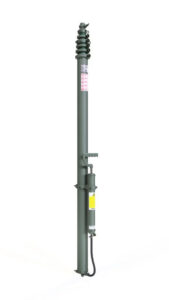
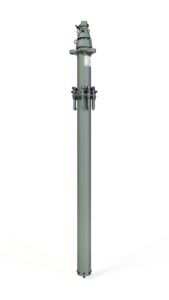
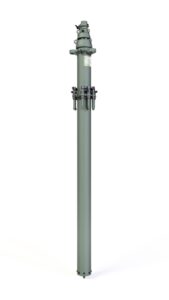
Vehicle mounted telescopic mast, Clark Masts QT Series, from Teksam Company.
Telescopic masts are extensively used to elevate HF, VHF, UHF, and microwave antennas, extending communication range, overcoming terrain masking, and improving network reliability across the battlespace.
Satellite communications terminals often require elevated mounting positions to reduce obstructions and improve connectivity, particularly in mobile and expeditionary deployments where local terrain blocks low-angle satellite horizons.
Electro-optical and infrared sensor systems benefit significantly from increased elevation, improving observation range, line-of-sight performance, and overall situational awareness for force protection.
Elevating radar systems improves target detection performance by extending radar horizons and reducing terrain masking effects, allowing operators to detect low-altitude or ground-based threats sooner.
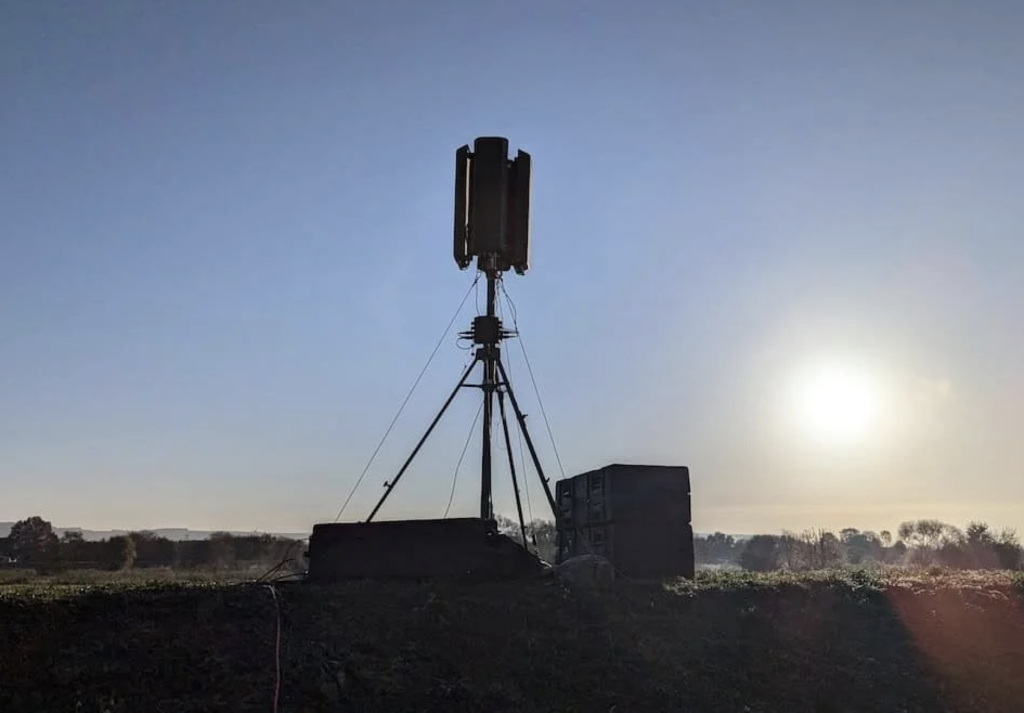
Counter-drone systems frequently utilize telescopic masts to position radar, RF detection equipment, EO/IR sensors, and electronic countermeasure systems at optimal operating heights to maintain a clear line of sight against small, low-flying targets.
Electronic warfare systems employ elevated antennas and sensors to improve signal collection, direction finding, and electronic attack effectiveness against adversary communication and radar nodes.
SIGINT operations benefit from improved line-of-sight access to communications and emissions across large operational areas, directly impacting the quality and range of intercepted intelligence.
Military and homeland security organizations use persistent, heavy duty telescoping mast systems to support radar and multi-sensor payloads for perimeter protection and long-range border surveillance.
Command posts rely on telescopic masts to establish communications infrastructure rapidly, enabling commanders to maintain operational connectivity and situational awareness during rapid maneuvers.
Observation posts and reconnaissance sites utilize elevated sensors to extend visual coverage, map terrain features, and improve threat detection capabilities in contested environments.
Telescopic masts support a wide range of radar systems including surveillance radars, air defense radars, counter-UAS radars, and border monitoring sensors, requiring highly stable, twist-resistant mast designs.
Electronic support and electronic attack systems frequently utilize mast-mounted antennas and signal collection equipment to maximize their operational footprint.
Modern military platforms increasingly combine multiple sensors on a single mast, providing integrated surveillance, communications, and situational awareness capabilities within a single SWaP-optimized head assembly.
When sourcing high-reliability systems, engineering teams must evaluate a telescopic mast manufacturer based on their capacity to deliver certified, field-proven equipment. Leading telescopic mast manufacturers offer customized engineering services to adapt payload interfaces, integration brackets, and deployment architectures to specific vehicle or trailer configurations, ensuring compliance with strict military specifications.


 Searching Companies & Products