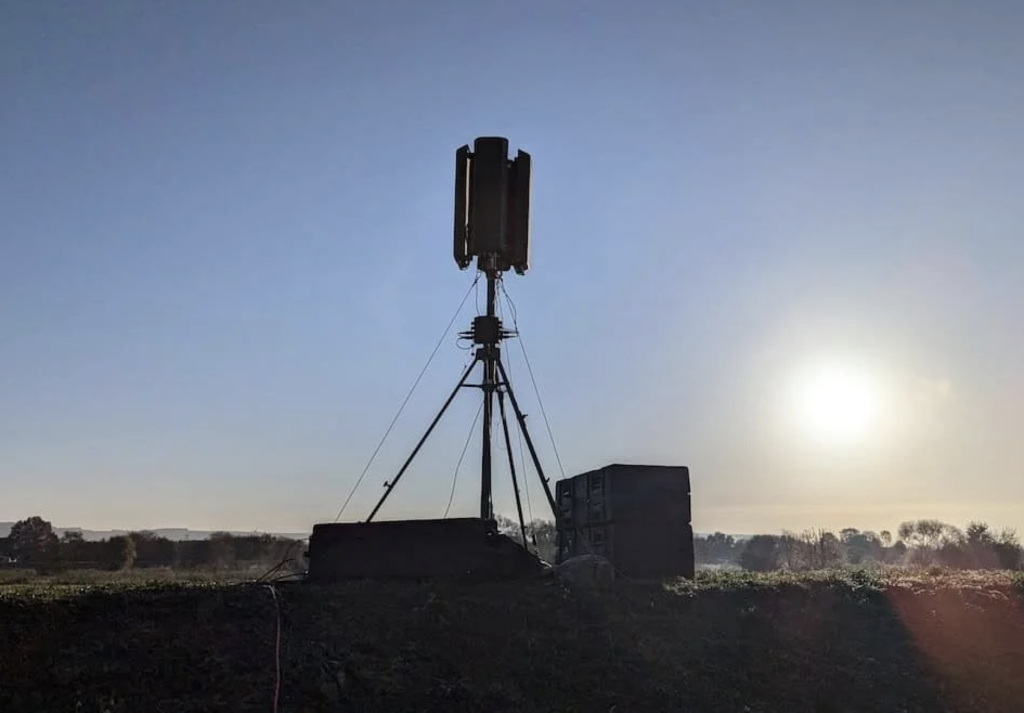
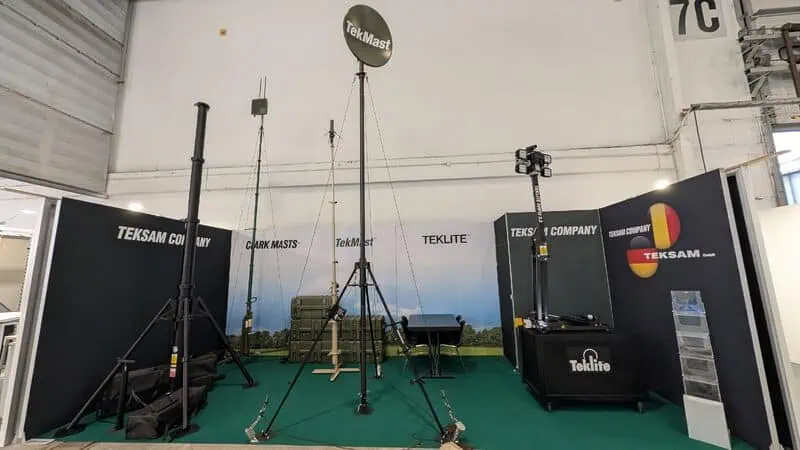
Showcase your capabilities
If you design, build or supply Sectional Mast Systems, create a profile to showcase your capabilities and connect with visitors who have an active requirement for your solutions.




Sectional masts are modular deployable structures designed to elevate antennas, sensors, radar systems, and communications equipment for military and defense operations. Built from stackable sections that can be configured to mission-specific heights, they provide a flexible solution for communications, ISR, force protection, electronic warfare, and counter-UAS applications.
This page showcases leading sectional antenna mast manufacturers offering systems with high payload capacities, structural rigidity, and scalable deployment heights while maintaining a transportable footprint.
Read the Technology Overview
Rapidly-Deployable Mast Systems for Tactical Communications, Lighting & Surveillance

If you design, build or supply Sectional Mast Systems, create a profile to showcase your capabilities and connect with visitors who have an active requirement for your solutions.

Military sectional mast systems are deployable, highly engineered structures designed to elevate antennas, sensors, surveillance equipment, and other mission-critical payloads. Constructed from modular components that are stacked and secured together during deployment, a sectional antenna mast provides a flexible means of achieving significant elevation while maintaining a compact, transportable logistics footprint.
Compared with telescopic masts, which extend from a nested structure and can typically be deployed rapidly by a small team, sectional masts generally require manual assembly and longer setup times. However, sectional mast systems offer distinct advantages for specific operational profiles. They excel when missions demand higher payload weight capacities, greater maximum deployment heights, exceptional structural rigidity, and reduced mechanical complexity.
Their modular architecture allows mast configurations to be tailored to specific mission requirements, making them a proven solution for military communications, surveillance, radar, and force protection applications.
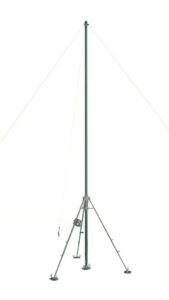
Sectional antenna mast, TekMast VMS Series, from Teksam.
The defining characteristic of a sectional mast is its modular architecture. Instead of extending from a single nested structure, the mast is built from multiple individual sections that are connected together during deployment. Each section is engineered to precise tolerances to ensure structural continuity, predictable load transfer, and reliable field assembly.
This modular approach enables operators to tailor mast height to operational requirements. A communications relay site may require only a modest elevation, while a surveillance installation supporting long-range sensors may utilize significantly greater heights by adding additional sections. The scalability of the design provides considerable flexibility without requiring multiple mast systems.
Deployment procedures vary according to mast design, payload weight, and final operating height. Most systems follow a standardized tactical sequence.
All structural loads generated by payloads, wind, environmental conditions, and dynamic forces must be safely transferred through the mast structure to the ground. This is achieved through carefully engineered section joints, reinforcement features, and load-bearing couplings.
As mast height increases, engineers must account for several critical environmental and mechanical forces.
Most military sectional masts utilize guy wires to provide stability at height while minimizing structural weight. Guyed systems allow taller deployments with lighter mast sections and a reduced transportation burden.
Self-supporting sectional masts eliminate the need for guy anchors, making them attractive in constrained environments like urban areas or dense jungle compounds. However, they require substantially stronger structures, larger foundations, and increased overall weight.
Sectional mast systems are specifically designed for deployment in remote and austere environments. Individual sections can be transported within tactical vehicles, shelters, containers, or dedicated transport cases. The ability to break the mast into manageable sections simplifies transportation logistics and allows deployment in locations inaccessible to larger fixed infrastructure systems.
Sectional mast engineering balances portability, strength, durability, and operational performance. Designs must withstand environmental loading while remaining sufficiently lightweight for transportation and field deployment. Structural engineers use advanced modelling techniques to predict mast behaviour under various operating conditions, ensuring stability throughout the intended deployment envelope.
Modern sectional mast systems employ a range of advanced materials and manufacturing techniques to maximize performance while minimizing weight. Precision machining, high-strength welding processes, and advanced fabrication methods ensure consistent dimensional accuracy and reliable field performance.
Historically and practically, military aluminum mast sections remain the dominant material choice for tactical construction. Aluminum sections strike the ideal balance of ruggedness and portability required for frequent field handling.
The connection points between mast sections are among the most critical structural elements within the entire system. These joints must transfer loads efficiently while allowing rapid assembly and disassembly.
Military mast systems routinely operate in maritime, desert, tropical, and arctic environments. Protective coatings, anodized surfaces, corrosion-resistant alloys, and specialist finishes help maintain structural integrity throughout extended service lives. Environmental protection measures are particularly important for systems deployed in salt-laden coastal regions where galvanic corrosion can significantly impact long-term performance.
Sectional mast configurations vary by weight capacity, deployment profile, and integration style to meet diverse tactical requirements.
| System Classification | Primary Operational Purpose |
| Lightweight Portable Sectional Masts | Designed for rapid deployment by small teams to support manpack radios, small antennas, and lightweight cameras. |
| Medium-Duty Tactical Mast Systems | The standard military configuration, delivering an optimal balance of deployment height, payload capacity, and field portability. |
| Heavy-Duty High-Load Sectional Masts | Engineered with enhanced structural strength to support large radar systems, electronic warfare arrays, and multi-sensor packages. |
| Rapid-Deployment Mast Systems | Utilizes optimized assembly methods and modular packaging to accelerate setup times while keeping a rigid sectional footprint. |
| Vehicle-Mounted Sectional Masts | Integrated directly onto tactical vehicles or trailers to provide high-elevation capabilities while keeping the unit mobile. |
| Containerized and Shelter-Integrated Solutions | Built directly into ISO containers, shelters, and command posts to form self-contained, rapidly deployable surveillance or network hubs. |
One of the primary functions of a sectional antenna mast is increasing antenna elevation to improve radio propagation and line-of-sight communications. Elevated antennas provide wider coverage areas, reduce terrain masking, and improve overall communications reliability across the battlespace.
Military tactical networks rely heavily on line-of-sight data transmission. Elevated antenna positions improve network resilience, increase operating range, and enhance connectivity between dispersed forces.
Sectional masts frequently support satellite communications equipment and associated networking infrastructure. This setup improves connectivity and backup link reliability in expeditionary environments where satellite tracking requires a clear view of the sky over local obstacles.
Deployable LTE and 5G systems are increasingly used to support military operations. Sectional masts provide the necessary elevation for cellular radios, sector antennas, and network management equipment.
EW and SIGINT systems benefit significantly from increased elevation. Raising the payload improves signal collection, threat detection, and electronic surveillance effectiveness across a broader radio frequency spectrum.
Sectional masts play a critical role in establishing temporary communications infrastructure during military operations, disaster response missions, and humanitarian assistance deployments.
To deliver maximum situational awareness, surveillance equipment must overcome ground-level obstructions and baseline distance limitations. Sectional masts provide key tactical advantages for elevated intelligence, surveillance, and reconnaissance assets:
Sectional masts serve as essential force multipliers across grouped operational contexts, streamlining logistics while ensuring maximum tactical efficacy.
| Application | Description |
| Intelligence, Surveillance, & Reconnaissance (ISR) | Elevating long-range optical, radar, and signal collection payloads to provide dynamic battlespace awareness and persistent border tracking. |
| Base Security & Force Protection | Supporting persistent surveillance loops and early-warning asset monitoring for forward operating bases and fixed defense perimeters. |
| Counter-UAS & Threat Tracking | Elevating highly specialized radar, radio frequency detection, and target defeat components to isolate and eliminate low-flying drone threats. |
| Electronic Warfare & Signal Congestion | Intercepting, monitoring, and jamming transmissions across broad terrain footprints to disrupt adversary communication corridors. |
| Austere Operations & Rapid Reaction | Outfitting special operations forces and rapid response teams with lightweight, highly portable masts for immediate communications deployment in remote areas. |
Military sectional mast systems must be qualified to perform under harsh conditions. Standard compliance testing profiles focus on several environmental, structural, and electrical hazards:
As tactical hardware becomes lighter and the digital requirements of the battlespace grow, sectional mast systems continue to adapt through advanced technologies:


 Searching Companies & Products