Showcase your capabilities
If you design, build or supply Stepper Motors, create a profile to showcase your capabilities and connect with visitors who have an active requirement for your solutions.




Military-grade stepper motors deliver rugged, high-precision motion control across defense sstems, from turret stabilization and military robotics to aerospace guidance and shipboard platforms. Engineered to meet MIL‑STD‑810, MIL‑STD‑461, and MIL‑STD‑901 standards, these stepper motor solutions offer reliable operation in extreme environments. Stepper motors enable accurate positioning, harsh-condition resilience, and seamless integration within motion control systems for military applications. These motors power manned and unmanned systems, supporting autonomous defense platforms, aerospace vehicles, and advanced targeting technologies with unmatched reliability.
Read the Technology Overview
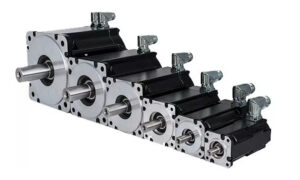
Innovative Precision Motor & Motion Solutions for Mission-Critical Military & Aerospace Applications

If you design, build or supply Stepper Motors, create a profile to showcase your capabilities and connect with visitors who have an active requirement for your solutions.

Stepper motors used in military applications are tailored for specific environments, motion requirements, and integration parameters. From miniature NEMA‑17 units in surveillance drones to large NEMA‑34 motors driving shipboard systems, their design is informed by platform-specific needs. Military-spec units undergo rigorous environmental, EMI, and power compatibility testing to ensure consistent operation in the most demanding defense environments. These motors play a vital role in motion control systems that require durability, precision, and compliance with defense-grade operational standards.
A stepper motor is an electromechanical device that converts electrical pulses into discrete mechanical movements. Each pulse causes the motor to move one incremental step, allowing precise control of angular or linear position without needing continuous feedback. Unlike traditional motors, stepper motors do not rotate continuously but move in fixed degrees based on input signals. This makes them ideal for tasks that require controlled positioning and repeatability, such as in gimbal stabilization or antenna tracking systems.
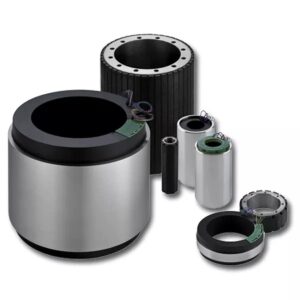
KBM Series by Kollmorgen.
Stepper motors sequentially energize multiple coils, generating magnetic fields that pull the rotor into discrete positions. This stepwise movement enables fine positional resolution, especially in hybrid stepper motors, which support microstepping for smoother motion. Open-loop stepper systems are cost-effective and straightforward, delivering reliable performance in applications with predictable load and inertia.
For more demanding use cases, closed-loop stepper systems combine the simplicity of stepper architecture with encoder feedback, offering improved accuracy, stall detection, and dynamic torque control.
In contrast, servo motors use fully closed-loop control with continuous encoder feedback, enabling higher speeds, adaptive torque, and real-time position correction. While servos excel in high-speed, variable-load environments, stepper motors, particularly hybrid or closed-loop forms, are often preferred in military automation and targeting systems for their deterministic motion, reliability, and rugged performance.
Stepper motors in aerospace systems manage critical flight-control surfaces, satellite antenna alignment, and avionics actuation with pinpoint precision. These motors offer reliable performance in high-altitude, low-pressure environments where temperature extremes and vibration are common. High-resolution hybrid stepper motors provide smooth microstepping to adjust flaps, sensor arrays, and EO/IR instruments onboard aircraft and spacecraft. Their brushless configurations minimize electromagnetic interference and mechanical wear, ensuring long-term operation without maintenance.
Types/methods used:
Stepper motors play a vital role in missile guidance systems and targeting pods, delivering precise, rapid positioning of sensors, fins, or gimbals under dynamic flight conditions. Their compact size, fast response time, and deterministic control make them ideal for fine angular adjustments during flight. Closed-loop hybrid stepper systems often enhance reliability and ensure positional accuracy even under rapid acceleration and vibration.
Types/methods used:
Stepper motors must withstand extreme environmental stresses in orbital payloads and near-space platforms, including vacuum, radiation, and thermal cycling. Radiation-hardened hybrid steppers are commonly deployed in satellite attitude control systems and scientific payloads requiring long-term reliability and fine-resolution movement. Closed-loop configurations help ensure repeatability and fault detection in high-radiation environments.
Types/methods used:
Turret systems on land vehicles and naval vessels rely on stepper motors to stabilize weapons platforms against motion and environmental forces. These motors provide precise torque control for azimuth and elevation axes, enabling smooth target acquisition even in rough terrain or high seas. In military robotics, stepper-driven manipulators enable accurate arm or sensor movement with repeatable precision under heavy loads. Thanks to bipolar and hybrid winding designs, these motors balance responsiveness with durability and EMI resistance, suitable for harsh field conditions.
Types/methods used:
Marine radar, sonar arrays, and SATCOM antennas depend on stepper motors for exact directional control and pattern scanning. These motors are ruggedized to resist harsh saltwater environments and to handle continuous operation amid vessel motion and vibration. Direct-drive steppers eliminate mechanical backlash, providing smoother, high-precision alignment essential for accurate signal acquisition. In naval deployments, they typically carry IP-rated protection and undergo MIL‑STD testing to verify immunity from spray, shock, and EMI.
Types/methods used:
Stepper motors form the backbone of military automation, powering systems like autonomous weapon stations, sensor gimbals, and robotic logistics handlers. These precision devices offer controlled motion profiles and repeatable positioning for applications requiring sensor synchronization or weapon deployment. High-efficiency hybrid steppers with microstepping lower noise and reduce heating, crucial in compact or enclosed systems. Closed-loop variants enable real-time feedback, ensuring accuracy during prolonged missions with variable loads or environmental changes.
Types/methods used:
In electronic warfare and tactical comms systems, stepper motors adjust directional antenna arrays, RF filter mechanisms, and RFI/EMC calibration stages. Their compact hybrid and brushless designs support high-speed adjustments with stability, even when operated in electronic warfare-degraded environments. EMI-hardened models meet demanding MIL‑STD‑461 standards, enabling operation within jamming-resistant or stealth communications arrays. The motors’ durability under vibration and shock also ensures consistent operation aboard airborne or ground tactical platforms.
Types/methods used:
Permanent-magnet stepper motors feature a rotor made of a permanent magnet and offer simple construction and operation. They provide moderate torque with relatively coarse steps, making them suitable for low-load, low-precision applications. In defense settings, PM steppers are often used in straightforward positioning tasks such as compact targeting subsystems or basic antenna rotation, where ruggedness and simplicity outweigh the need for fine resolution. Their robustness and minimal maintenance requirements are advantageous in remote or unattended field deployments.
Variable reluctance stepper motors align a soft iron rotor with energized stator poles through magnetic reluctance. They are known for rapid response and minimal rotor inertia but typically offer lower torque and coarser resolution than hybrid or PM types. In military contexts, they are sometimes used in lightweight targeting systems or low-torque automation mechanisms where responsiveness and simplicity are prioritized over torque density. Due to their design, they are also less susceptible to demagnetization, making them suitable in radiation-prone environments like high-altitude or orbital platforms.
Hybrid stepper motors combine the strengths of permanent-magnet and variable reluctance designs to deliver high torque and fine resolution. These motors are the most commonly used in military motion control systems due to their balance of power, efficiency, and microstepping capability. They are versatile enough for integration into high-precision applications such as EO/IR gimbal systems, robotic manipulators, flight control actuators, and missile fin control mechanisms. Hybrid designs are available in closed-loop and open-loop variants, and they often serve in roles requiring both reliability and adaptability to varying environmental conditions.
These terms describe two types of drive wiring configurations. Unipolar stepper motors use simpler driver electronics but typically offer lower torque, making them suitable for compact or lower-power defense electronics. Bipolar motors, which energize windings in both directions, provide higher torque output and are better suited for demanding mechanical loads. In military applications, bipolar stepper motors are often selected for robotic systems, turret elevation and rotation, and stabilization systems where torque and responsiveness are crucial under stress or rapid maneuvering.
Direct-drive stepper motors remove the need for gearboxes or couplings by directly linking the motor shaft to the load. This architecture minimizes backlash and improves positional accuracy, making them ideal for precision scanning and targeting systems. In defense, they are used in radar and sonar positioning, stabilized camera platforms, and antenna control, where smooth, uninterrupted motion is necessary. Their quiet operation and low mechanical complexity also make them valuable in systems requiring reduced acoustic or mechanical signatures.
Closed-loop stepper motors incorporate feedback mechanisms such as encoders to continuously monitor position and correct deviations in real time. This feedback loop enables the motor to react dynamically to changing loads or unexpected resistance, improving reliability and efficiency over traditional open-loop configurations. In avionics, missile control surfaces, and other precision-guided applications, closed-loop steppers are essential for maintaining accurate control even during rapid or unpredictable movement. Their self-correcting capabilities make them ideal for mission-critical applications where error margins must be minimal.
Military stepper motors are designed and tested according to:
With robust construction, precision control, and MIL‑STD compliance, military-grade stepper motors support a wide range of defense platforms. Their ability to perform reliably in challenging conditions makes them essential for aerospace, land, naval, and unmanned systems. Whether managing flight controls, stabilizing turrets, or guiding autonomous vehicles, stepper motors deliver the performance, ruggedization, and motion control reliability demanded by modern defense applications.


 Searching Companies & Products