Amphibious Tracked Vehicles for Military and Armed Forces Applications
Amphibious tracked vehicles, also known as underwater crawlers or autonomous amphibious ground vehicles (AUGVs), are specialized robotic platforms designed to operate in terrestrial and submerged environments. In military and naval contexts, these vehicles deliver critical functionality for reconnaissance, inspection, logistics, and explosive ordnance disposal (EOD) operations across complex amphibious and underwater terrains.
If you design, build or supply Amphibious Tracked Vehicles, create a profile to showcase your capabilities and connect with visitors who have an active requirement for your solutions.
Amphibious Tracked Vehicles for Military and Armed Forces Applications
Overview by
Summer James
Updated:
Amphibious tracked vehicles are a type of unmanned underwater vehicle that supports modern military missions by bridging the operational gap between terrestrial and underwater environments. These unmanned platforms are designed for direct contact with challenging terrain such as muddy shorelines, rocky seabeds, and submerged infrastructure. In contrast to hovercraft or wheeled amphibious systems, tracked vehicles offer precise mobility, payload versatility, and stealth, enabling defense forces to conduct logistics, surveillance, and ordnance disposal in environments that are otherwise inaccessible or hazardous. Their role in next-generation naval robotics continues to expand with advances in autonomy, sensing, and modular payload integration.
What is an Amphibious Tracked Vehicle?
An amphibious tracked vehicle is a mobile robotic platform capable of traversing terrestrial and underwater environments using continuous tracks. Often categorized as autonomous amphibious ground vehicles (AUGVs) or underwater crawlers, these machines are tailored for dual-domain missions involving land and subsea terrains. Unlike amphibious wheeled vehicles, which rely on buoyancy and propellers, tracked amphibious systems are engineered for physical contact with the surface, soil, sand, silt, or seabed.
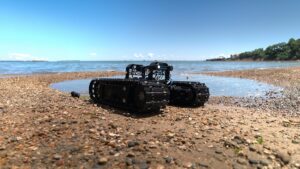
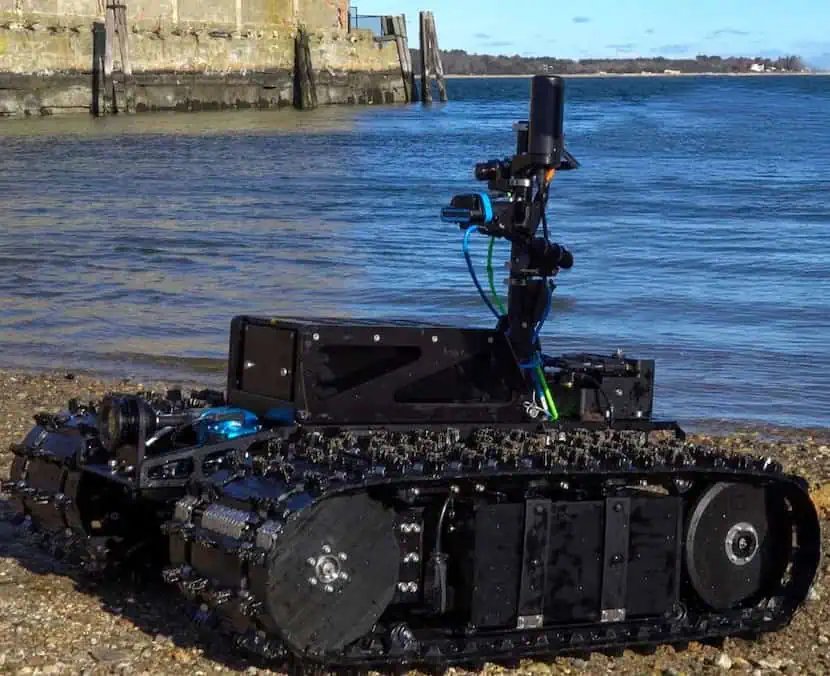
Bayonet 250 by Greensea IQ.
Their military-grade design features waterproofed systems, pressure-tolerant electronics, and reinforced hulls to endure saltwater immersion, sediment abrasion, and varying hydrostatic pressure. These vehicles are commonly used in naval robotics roles that demand stealthy, terrain-following mobility without reliance on traditional marine propulsion systems.
Key Applications in Military and Armed Forces
Amphibious tracked vehicles fulfill multiple mission profiles across the defense and naval sectors. Typical applications include:
Embedded vehicle control unit and autonomy framework
Navigation and localization modules to ensure accurate tracking and mission execution
Sealing systems, including dynamic O-rings and pressurized compartments, are used to ensure waterproofing
Design priorities include operational endurance, modularity, and ruggedization in compliance with military standards.
Sensors, Tools, and Payload Loadouts
Amphibious tracked vehicles support a wide range of modular payloads, allowing them to be customized for specific mission objectives. Typical integrations include:
Sonar systems: forward-looking sonar, side-scan sonar, and multibeam sonar for navigation and target detection
Optical systems: underwater cameras (optical, low-light, thermal) for surveillance and underwater inspection
Manipulator arms: for physical interaction, object removal, EOD tool deployment, or sample collection
EOD payloads: cutters, shape charge delivery tools, and detonator placement systems
Acoustic communication modems: for subsea data transmission
Environmental sensors: magnetometers, chemical sensors, and laser scanners for seabed and object profiling
Winch or tether modules: for retrieval or connection to surface assets
These payloads enhance the vehicle’s capability to perform multi-domain operations autonomously or via operator control.
Underwater Crawler Types and Variants
Amphibious tracked vehicles are available in a range of sizes, autonomy levels, and mission-specific configurations:
Teleoperated vehicles: ideal for direct human control in line-of-sight or tethered configurations
Semi-autonomous systems: capable of executing pre-programmed mission paths with minimal operator input
Fully autonomous crawlers: leveraging onboard AI and advanced sensing for complex task execution
Variants also differ by size:
Compact crawlers: lightweight and portable for rapid deployment
Medium platforms: balance between payload capacity and maneuverability
Heavy-duty crawlers: large-scale vehicles designed for high-load transport or deep submergence
Specialized variants exist for riverine, littoral, and cold-water operations.
Comparisons of Amphibious Platforms
When compared with other amphibious and underwater systems, tracked amphibious vehicles offer several advantages:
Platform Type
Terrain Capability
Payload
Stealth
Autonomy
Operational Limitations
Tracked amphibious vehicle
Land & seabed
High
High
High
Slower transit speeds
Amphibious wheeled vehicle
Land & surface water
Moderate
Moderate
Low-Med
Limited submerged capability
Hovercraft
Surface only
High
Low
Low
No submerged capability
ROV
Water column only
Moderate
Low
Med
Cannot transition to land
AUV
Water column only
High
High
High
Cannot interact physically with terrain
Tracked vehicles bridge the gap between terrain-interacting mobility and subsea autonomy, making them ideal for reconnaissance and logistic tasks in constrained environments.
Relevant Standards and Military Specifications
Military-grade amphibious tracked vehicles are subject to various standards to ensure reliability, safety, and interoperability. These include:
Greensea IQ demonstrated autonomous UXO detection using the Bayonet 350 AUGV and APEX system, delivering reliable data collection and classification in complex nearshore and surf zone environments
Greensea IQ will deliver Bayonet 250 Amphibious Unmanned Ground Vehicles under a USMC contract to enhance littoral mine countermeasure and threat mitigation capabilities
The latest defense technology news, straight to your inbox.
Get our weekly roundup of technology developments, new products and industry news.
THANK YOU FOR SIGNING UP
Thanks for joining us. Check your inbox.
We've sent you an email. Click the confirmation link to complete your subscription to the weekly eBrief. In the meantime, explore the latest news, suppliers and technologies on DA.
Advancing Defense Capability Through Strategic Collaboration
Defense Advancement works with major OEMs to foster collaboration and increase engagement with SMEs, to accelerate innovation and drive defense capabilities forward.