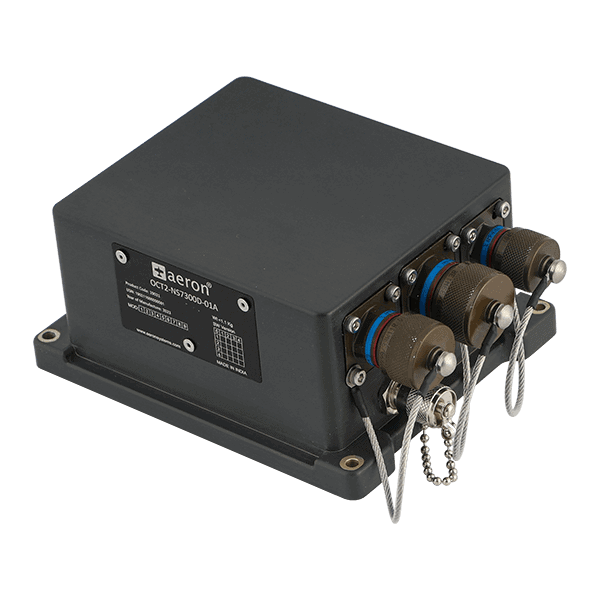
Aeron Systems develops inertial navigation solutions designed to support the localization and movement requirements of autonomous mobile robots across industrial and commercial applications. Read more >>
As robotic systems continue to see wider adoption, reliable navigation and positioning technologies remain essential for enabling consistent operation and task execution.
Autonomous mobile robots are designed to move between locations in order to complete defined tasks. Effective operation depends on accurate localization, as navigation commands are directly based on the robot’s current position.
An appropriate navigation system must address several key factors. Cost plays an important role in enabling large-scale deployment. Compact design is necessary to support integration within space-constrained platforms. Security is an increasing consideration, particularly in environments where systems may be exposed to interference. In addition, a high level of accuracy is required for applications involving controlled movement and object interaction.
Multiple technologies are used to provide localization and navigation capability, each with distinct characteristics.
MEMS Inertial Navigation Systems (INS)
Inertial navigation systems use gyroscopes and accelerometers to measure motion. Acceleration data is integrated to estimate displacement and position. Technologies such as Fibre Optic Gyro (FOG) and Ring Laser Gyro (RLG) offer high accuracy with minimal drift, but their size and cost generally limit their use in mobile robotic platforms.
MEMS-based inertial navigation systems provide a compact and cost-efficient alternative. These systems are subject to drift, as small measurement errors accumulate over time and affect positional estimates.
GPS/GNSS-Based Navigation
Satellite-based positioning systems provide global location data but present limitations in robotic applications. Accuracy may not meet the requirements of precision tasks, and signal availability indoors is unreliable. These systems may also be susceptible to interference or manipulation, which can introduce operational risks.
Camera-Based Localization Systems
Vision-based systems determine position by analyzing environmental features such as lighting, structures, and surface patterns. These approaches remain in relatively early stages of deployment and may require further development to achieve consistent performance across varying environments.
Hybrid INS-GNSS Systems
A hybrid approach combining MEMS-based inertial navigation with GNSS correction can address several limitations of standalone systems. In this configuration, the inertial system provides continuous localization, while GNSS data is used periodically to correct accumulated drift.
Advances in filtering algorithms have improved the performance of MEMS-based systems, enabling increased accuracy and stability over time. Under certain conditions, these improvements allow performance levels that approach those of higher-grade inertial technologies, while maintaining lower size and cost.
Characteristics of MEMS INS-GNSS Hybrid Systems
Hybrid systems provide a combination of attributes relevant to mobile robotics:
- Cost Efficiency – MEMS-based architectures support scalable deployment.
- Operational Resilience – Reduced dependence on continuous GNSS signals can limit exposure to interference.
- Improved Accuracy – Periodic correction of inertial drift enables more reliable positioning compared to standalone GNSS systems.
Conclusion
Navigation systems for autonomous mobile robots must balance cost, size, security, and accuracy. MEMS INS-GNSS hybrid architectures provide a practical approach by combining continuous inertial tracking with periodic external correction, supporting reliable operation across a range of environments.