Analog Modules Inc. (AMI) applies switch mode power conversion techniques to laser diode driver design in order to address key limitations of linear architectures, particularly in efficiency, size, and power handling. Read more >>
By extending multiphase and polyphase switching concepts, the company’s approach enables precise current pulse generation while reducing component stress and minimizing energy loss. These characteristics are particularly relevant in defense systems, where compact, high-performance laser drivers must operate reliably under varying electrical and environmental conditions.
Evolution of Switch Mode Laser Diode Drivers
As switch mode power supplies began replacing linear designs, improvements in efficiency and size became achievable across a range of electronic systems. A resonant buck converter disclosed by Hughes Aircraft Company in 1994 demonstrated how switch mode techniques could be adapted for laser diode driving applications.
In such designs, switching losses in the transistor are not directly dependent on the storage capacitor voltage. This allows the capacitor voltage to droop to a greater extent than in linear systems, reducing the number of capacitors required to maintain the same operating point. The result is a smaller and more efficient implementation. Switching devices also operate in saturation, which reduces both electrical stress and conduction losses.
AMI’s Multiphase Approach
AMI extended this concept by operating multiple buck converter stages in parallel with offset timing. This multiphase configuration minimizes ripple in the output current pulse supplied to the laser diode. Patented implementations describe current-controlled, voltage-output power supplies in which multiple switching stages are combined to produce a regulated current waveform.
Key characteristics of this architecture include:
- Distribution of current across multiple stages enables the use of small surface-mount components without requiring heat sinks
- Typical efficiency is approximately 90%, with power FETs carrying only a fraction of the total current and operating in saturation for reduced conduction loss and improved reliability
- Turn-on occurs at zero current, resulting in low switching loss without the need for resonant transition techniques
- Digital signal processing can be employed to compensate for storage capacitor droop and variations in load conditions
- Storage capacitor size can be reduced to approximately 25% of that required in a comparable linear design
- Variations in equivalent series resistance and capacitance are tolerated, allowing operation across a wide range of storage capacitor voltages without increasing stress on switching devices
- Load voltage variations caused by temperature changes or aging are compensated
- No output choke or filter is required, as the current waveform is directly synthesized
This approach is suited to diode-pumped laser systems such as designators, where battery efficiency and controlled peak input current are critical. The design has been qualified for military use and maintains stable performance over long operational lifetimes.
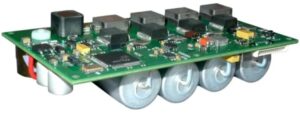
AMI Model 774A
High-Power Implementation
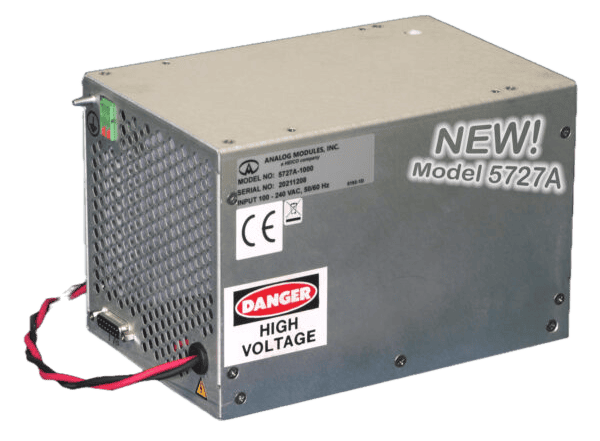
AMI’s Model 774A applies the multiphase architecture to deliver up to 200 amps at 44 volts, corresponding to 8 kW peak power. The unit includes an integrated power conversion stage for charging the storage capacitor from a range of input sources, along with a sealed, high-quality storage capacitor.
Supporting Circuit Techniques
Additional circuit techniques have been developed to further enhance performance. One method allows the recharge rate of the storage capacitor to be adjusted, minimizing peak current draw from the power source as repetition rate varies.
Another technique uses a pre-charged inductor to achieve fast rise times and high current delivery. This is particularly effective in overcoming load series inductance in high-current applications.
Miniaturized Dual-Phase Design
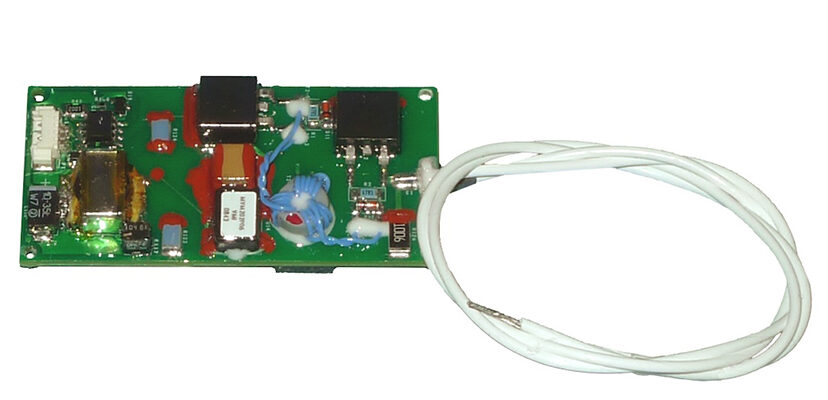
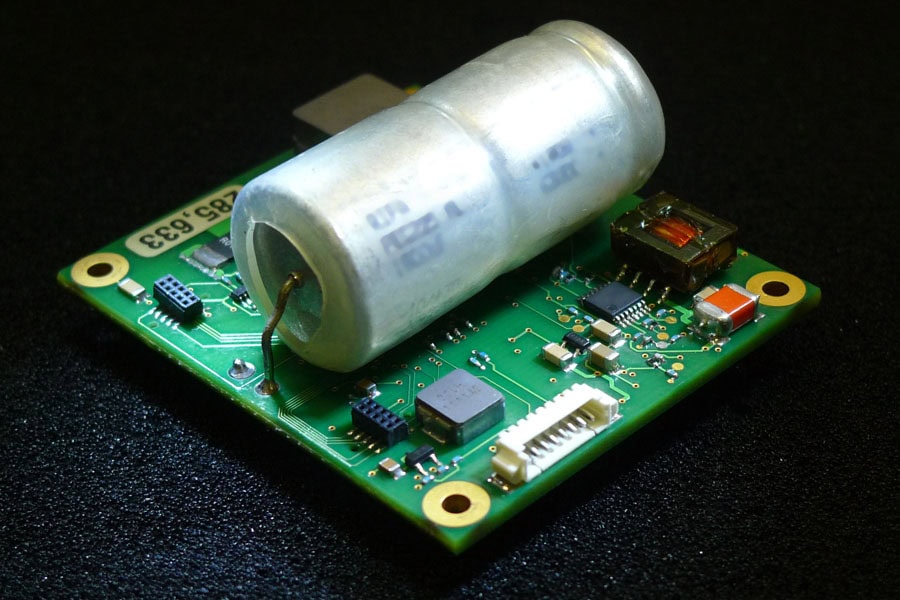
For lower repetition rate laser rangefinder applications, AMI developed a dual-phase switching design that was reduced to approximately the size of a small gum stick. The design was subsequently adapted for digital control and repackaged for use in portable rangefinders with burst-mode capability.
The architecture remains tolerant of variations in capacitor characteristics and diode load behavior, enabling the use of commercial electrolytic capacitors. Switching transitions occur with continuous current flow, which increases switching losses relative to the polyphase approach and results in slightly lower efficiency, although still significantly higher than linear designs.
Timing and duty cycle are dynamically adjusted as the storage capacitor discharges to maintain low ripple and maximize usable stored energy. This contributes to reduced system size. Typical peak output currents are around 100 amps. An extended configuration using multiple phases and a shared intelligent controller has been developed to produce pulsed currents up to 200 amps for designator applications where battery life is critical.
Latest Developments
AMI’s latest switch mode laser diode driver designs incorporate patented polyphase switching across multiple inductors. These systems achieve virtually zero turn-on losses and low ripple through high-frequency operation. Efficiency can exceed 90%, while supporting a wide range of laser diode load voltages and accommodating input voltages both below and above the required output level.
These developments enable efficient, compact laser diode driver designs capable of supporting demanding defense applications, particularly where power density, thermal performance, and input current control are critical.