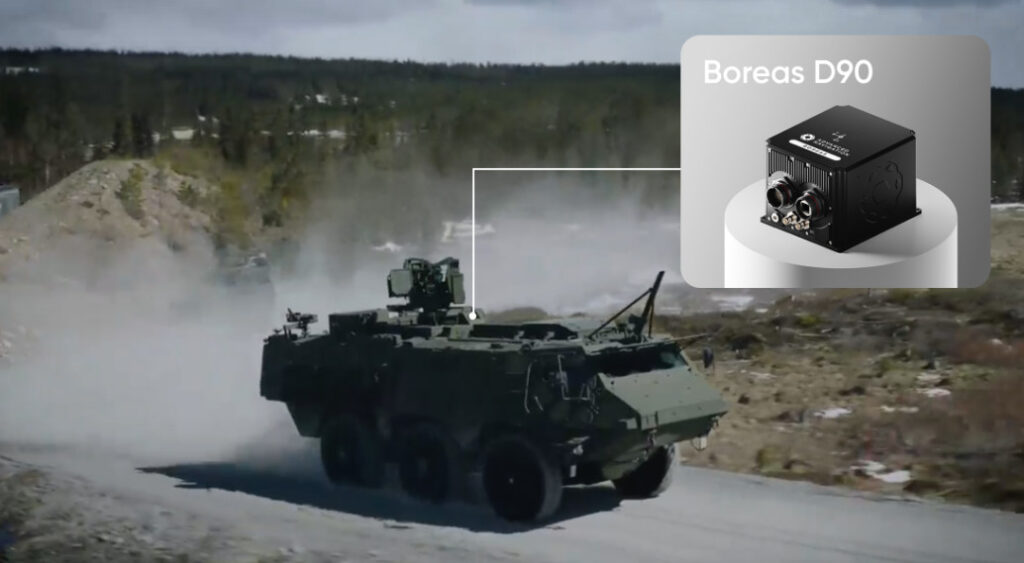




Cost-effective all-band GNSS/INS is becoming increasingly important for maintaining reliable positioning across defense applications, where consistent and accurate navigation data supports operational effectiveness. Advanced Navigation integrates all-band GNSS with inertial navigation systems to enhance positioning resilience, consistency, and overall system performance in challenging environments.
Modern defense platforms rely on precise and continuous positioning. Applications such as autonomous ground systems, unmanned platforms, and coordinated vehicle operations require a consistent flow of accurate localization data to function effectively.
In challenging operating conditions, positioning degradation can directly affect performance. Loss of RTK lock, intermittent satellite visibility, or reduced signal quality can impact navigation accuracy and disrupt coordination between assets. Inconsistent localization may also introduce uncertainty in asset tracking, limiting overall operational efficiency.
Many existing solutions continue to rely on GNSS-only architectures, often based on dual-band L1/L2 receivers. While these systems have traditionally provided a balance between cost and capability, they can struggle to maintain consistent performance in complex environments. Even when supported by RTK corrections, dual-band configurations may lack the robustness required for dependable positioning.
Integrating All-Band GNSS with Inertial Navigation
Advanced Navigation addresses these limitations by combining Inertial Navigation System (INS) technology with cost-effective all-band GNSS capability. This enables simultaneous access to multiple constellations and frequencies, including modernized signals such as L6 and E6.
Access to additional GNSS frequencies and constellations improves positioning availability and consistency, while the inertial navigation component provides real-time motion and orientation data. Together, these capabilities support continuous navigation performance during periods of degraded GNSS availability.
All-band GNSS has historically been limited to high-end systems due to cost considerations. However, recent developments have improved accessibility, allowing defense programs to adopt enhanced positioning performance without significant increases in system complexity or cost.
Improving Consistency and Reducing Infrastructure Dependence
Transitioning beyond dual-band GNSS provides incremental improvements in accuracy while significantly enhancing consistency and reliability. With a broader range of signals available, RTK solutions can achieve fixed positioning more quickly and maintain it more consistently, improving overall RTK availability.
Modernized signals such as L6 and E6 also support high-accuracy positioning under clear sky conditions without requiring local RTK base stations or subscription-based correction services in certain scenarios. This reduces reliance on RTK base stations and subscription-based correction infrastructure, which may not always be practical in deployed environments.
Improved positioning consistency supports more reliable tracking of vehicles and equipment, enabling more effective coordination and informed operational decision-making.
Scalable Navigation Solutions for Defense Platforms
Advanced Navigation provides a range of all-band GNSS-enabled inertial navigation systems designed to support a variety of defense applications.

Certus Evo
Certus Evo is a compact MEMS-based INS developed for integration across a wide range of platforms, including both autonomous and crewed systems. Its low size, weight, power, and cost profile supports efficient integration with minimal impact on existing platforms.
The system is suited to applications requiring accurate positioning and orientation data, particularly where multiple systems must operate in coordination.
Boreas D50
For more demanding applications, the Boreas D50 fiber-optic gyro INS provides enhanced performance in environments where GNSS availability may be reduced.
With reliable north-seeking capability and extended dead-reckoning performance, the system maintains accurate navigation during GNSS interruptions, supporting continuity of operation when satellite signals are temporarily unavailable.
Enabling Reliable Navigation in Complex Environments
The adoption of cost-effective all-band GNSS/INS supports a shift toward more dependable positioning across defense operations. Rather than being a limitation in challenging conditions, positioning systems can provide consistent and reliable data for operational use.
By improving positioning accuracy, increasing reliability, reducing reliance on RTK base stations and subscription-based correction infrastructure, and helping to avoid vendor lock-in, Advanced Navigation’s solutions support enhanced operational efficiency and system performance.
This approach enables defense operators to maintain accurate situational awareness, improve coordination between assets, and ensure reliable navigation across a range of operational scenarios.