Aeron Systems develops Electronic Warfare (EW)-resilient navigation solutions for contested and GNSS-denied environments.
In this exclusive conversation with Defense Advancement, Abhijeet Bokil, Co-founder, Managing Director & Chief Technology Officer of Aeron Systems, shares how the company’s MEMS-based inertial navigation technology is delivering reliable performance in GNSS-denied environments, AI-driven sensor fusion, and ITAR-free availability for modern defense platforms while helping reduce SWaP-C and supply chain constraints.
How is Aeron Systems positioning its MEMS-based inertial navigation technology within today’s defense market?
Aeron competes on four vectors: SWaP-C optimization, performance-per-dollar value, supply chain independence, and ITAR-free availability.
The core proposition is that MEMS-based inertial systems now deliver accuracy and reliability that were previously exclusive to FOG/RLG technology – at significantly lower cost, weight, and form factor.
In a global defence market disrupted by supply chain fragility and geopolitical realignment, Aeron offers qualified, in-service solutions across platform categories without export control encumbrances.
How are your MEMS-based INS solutions addressing the drift, accuracy, and reliability requirements of modern military platforms compared to legacy FOG/RLG systems?
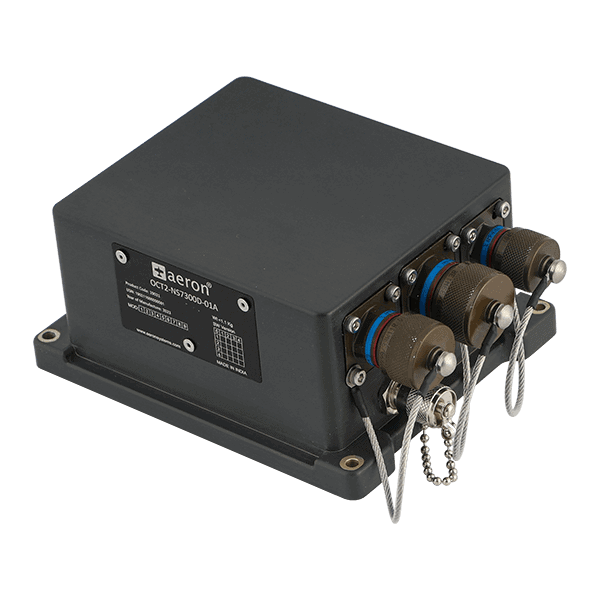
MEMS vs. Legacy FOG/RLG: Aeron’s Nav Pro Engine combines AI-driven algorithms with multi-sensor fusion to close the historical performance gap between MEMS and fibre-optic systems. The result is competitive drift and accuracy performance with improved size, weight, and cost advantages. Key products, PLX, OCT-3 HP, and OCT-2 INS, demonstrate GNSS-denied navigation capabilities that were previously unachievable with MEMS architectures before recent algorithmic advances.
How are your systems being adapted for high-dynamics, high-vibration defense platforms such as tactical UAVs, loitering munitions, and guided weapons?
All systems undergo MIL-STD qualification and platform-specific environmental testing. Benchmarking against higher-order reference systems is conducted by customers themselves, providing independent validation. Testing covers real operational environments, including deserts, cold deserts, high-altitude valleys, and urban terrain across variable temperature ranges.
How do your solutions maintain performance in GNSS-denied and electronically contested environments?
The core of our GNSS-denied capability is the Nav Pro Engine an AI-driven fusion engine that pulls in multiple aiding sources: airspeed, visual odometry, terrain mapping. So even when GPS is jammed or spoofed, the system doesn’t degrade, it switches sources and keeps navigating.
What sets us apart is that even on pure inertial alone, our systems deliver performance that’s operationally useful not just technically alive. The system is smart enough to detect when it’s being jammed or spoofed, and respond automatically without operator intervention
How do you approach validating system performance against military standards and real-world operational requirements?
Aeron Systems subjects every product to a rigorous dual-track validation process. All systems are qualified to applicable MIL-STD specifications, ensuring compliance with military requirements for environmental stress, shock, vibration, EMI, and temperature extremes.
Beyond laboratory qualification, each unit undergoes operational field testing in representative real-world environments including hot deserts, high-altitude cold deserts, mountain valleys, and dense urban terrain across the full operational temperature range. Performance is benchmarked against higher-order reference systems, providing customers with independently verifiable accuracy and reliability data before fielding.
What key trends are you seeing in defense procurement for inertial sensing and navigation, and how are customer requirements evolving?
The market is converging around four key demands: autonomous system navigation, EW-zone operability, resilient supply chains with non-Chinese and non-ITAR sourcing, and all-environment performance without GNSS dependency. Aeron’s roadmap and product qualification strategy are aligned with each of these vectors.
Thank you for your time, X. We look forward to following the continued advancement of Aeron Systems’ MEMS-based inertial navigation solutions for GNSS-denied and autonomous defense applications.