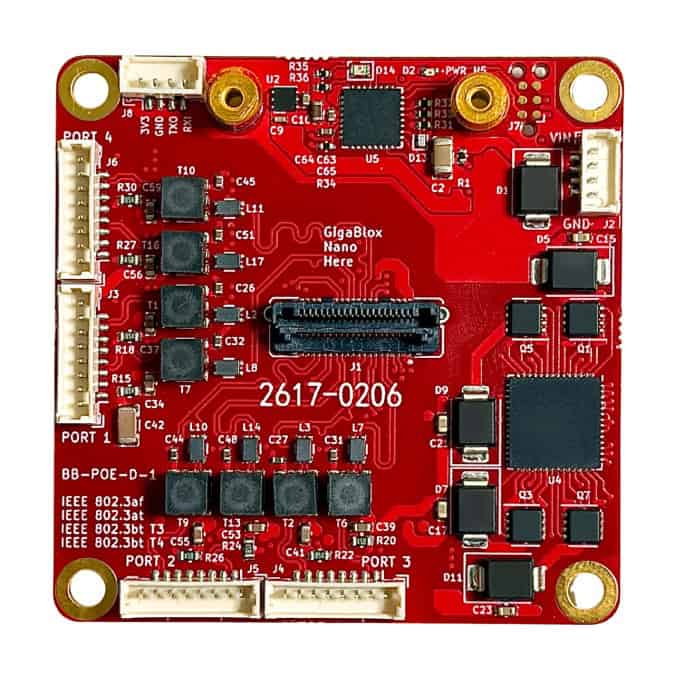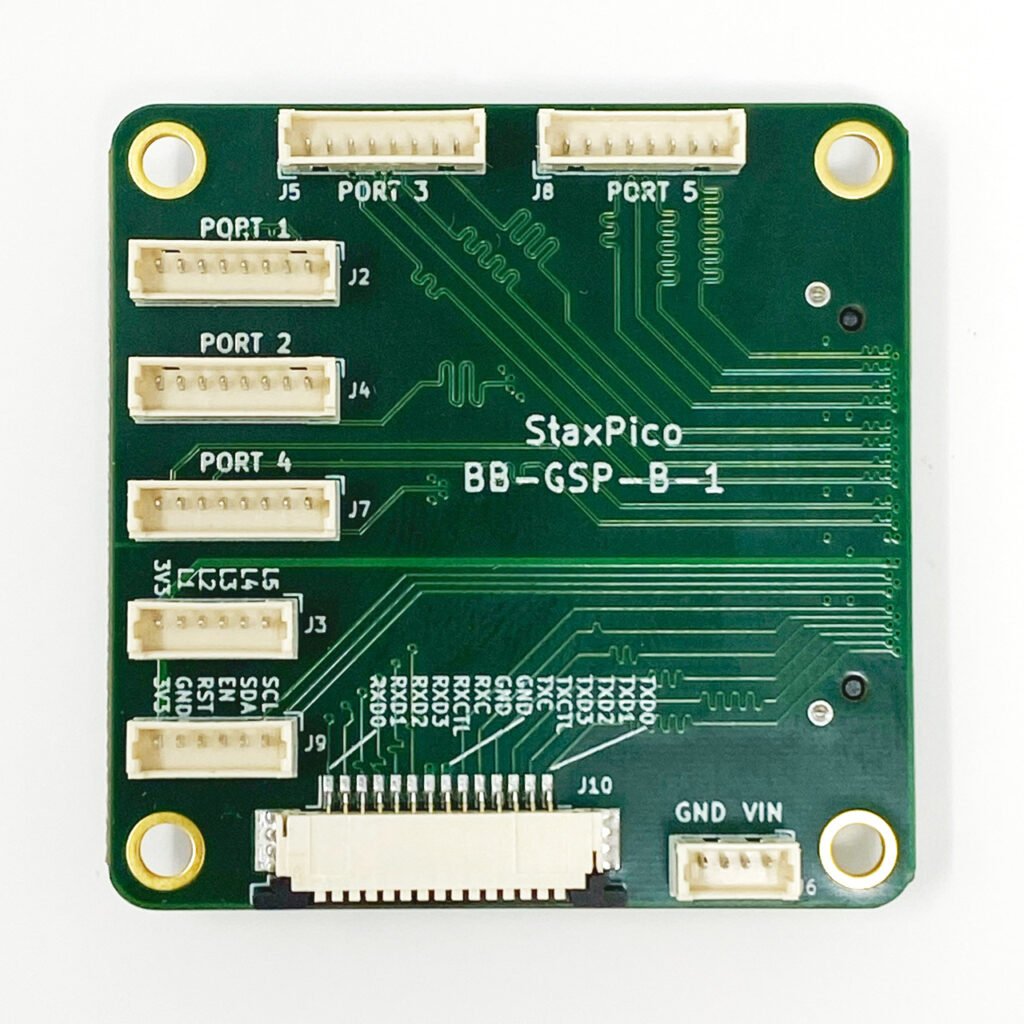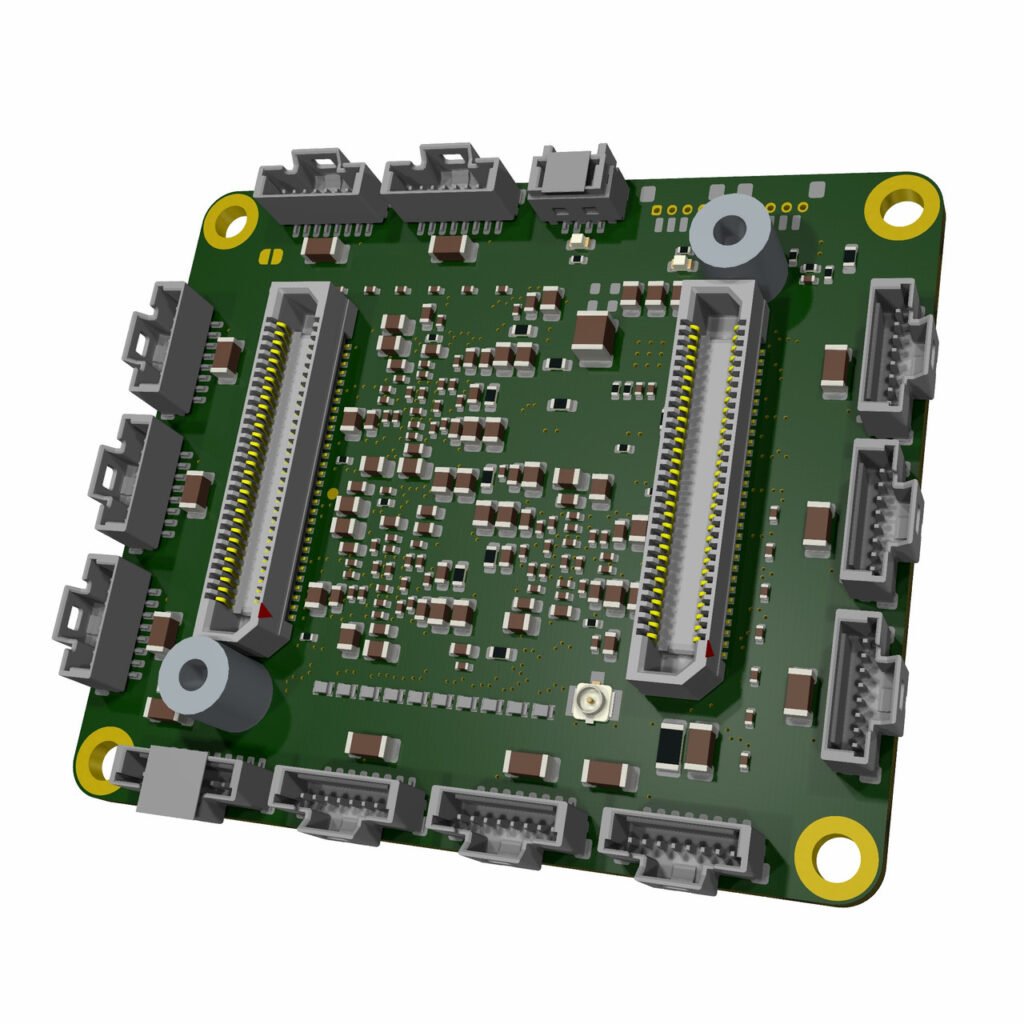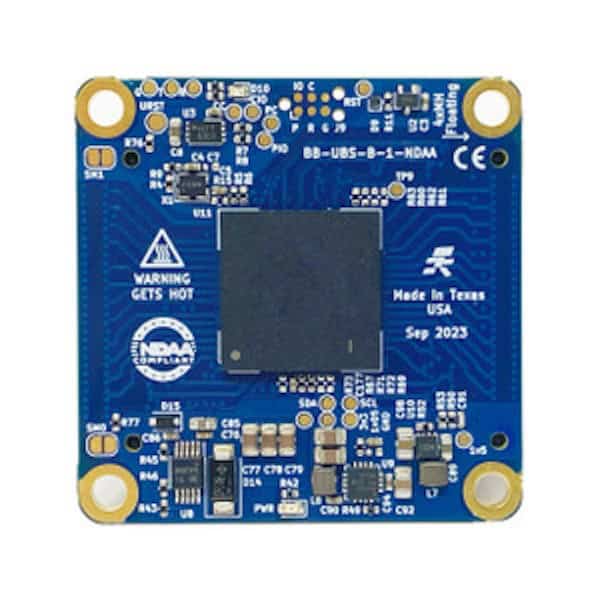




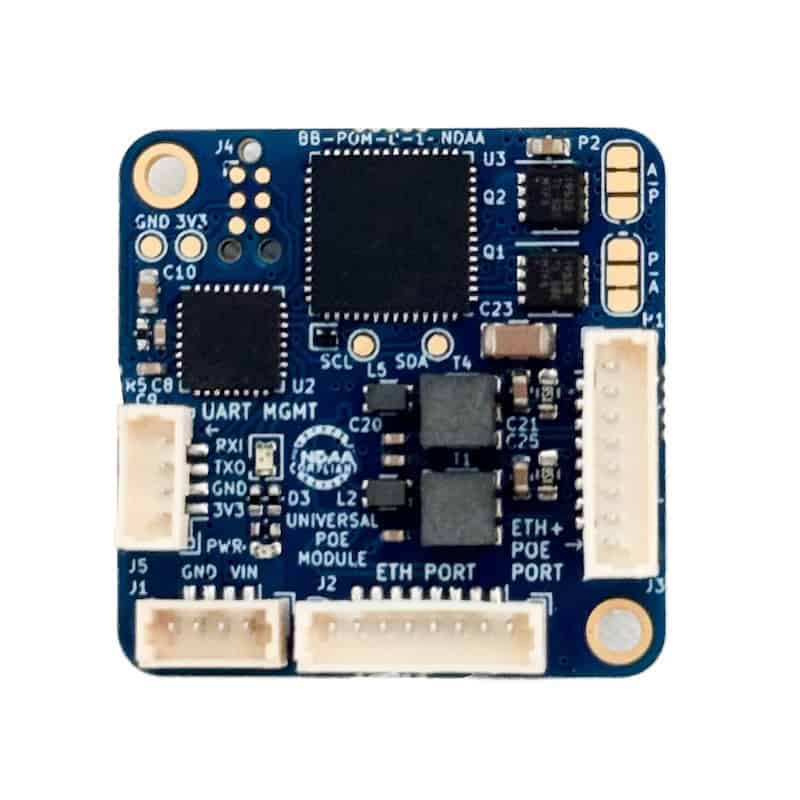
BotBlox has introduced the Universal PoE Module, a compact Power over Ethernet (PoE) injector engineered to support multiple PoE standards in a single embeddable device.
PoE technology enables ethernet cabling to deliver both data and power, reducing the need for additional wiring. This can significantly reduce cabling and complexity in mobile, Size, Weight, and Power (SWaP)-limited platforms.
However, inconsistent implementation of PoE across third-party hardware can create challenges for system integrators. The Universal PoE Module has been developed to address this issue by providing a single solution that supports active PoE standards up to IEEE 802.3bt Type 4, as well as passive PoE for legacy and non-standard devices via onboard solder jumpers.
Designed for demanding deployment environments, the module measures 28mm x 28mm x 11mm, giving it a highly compact footprint for embedded systems. It features an operating temperature range of -40°C to 85°C, rugged positive-locking Molex PicoBlade connectors for vibration tolerance, and two M2 mounting holes for straightforward integration.
The module is designed to withstand vibration, freezing, and heating while maintaining stable PoE output and ethernet data connectivity.
BotBlox states that the hardware is NDAA compliant, with a supply chain based entirely outside of China.
In terms of technical standards, the Universal PoE Module supports active PoE variations including IEEE 802.3af at 15.4W, IEEE 802.3at at 30W, IEEE 802.3bt Type 3 at 60W, and IEEE 802.3bt Type 4 at up to 84W maximum output. BotBlox also positions the module as supporting the wider 90W PoE class.
To accommodate older or lower-cost devices, such as budget cameras that rely on non-standard passive voltage injection directly onto ethernet lines, the board includes two solder jumpers that can be soldered to enable passive PoE support.
The system features one upstream port and one downstream port, supporting data transfer speeds across 10BASE-T, 100BASE-T, and 1GBASE-T ethernet standards. For active PoE operation, the voltage input ranges from 58V to 60V, while passive PoE mode accepts an input range of 0V to 65V, with a maximum input voltage rating of 70V.
Additionally, the module integrates an onboard microcontroller and UART port to support future serial control of the PoE port, though this software functionality is currently unimplemented.