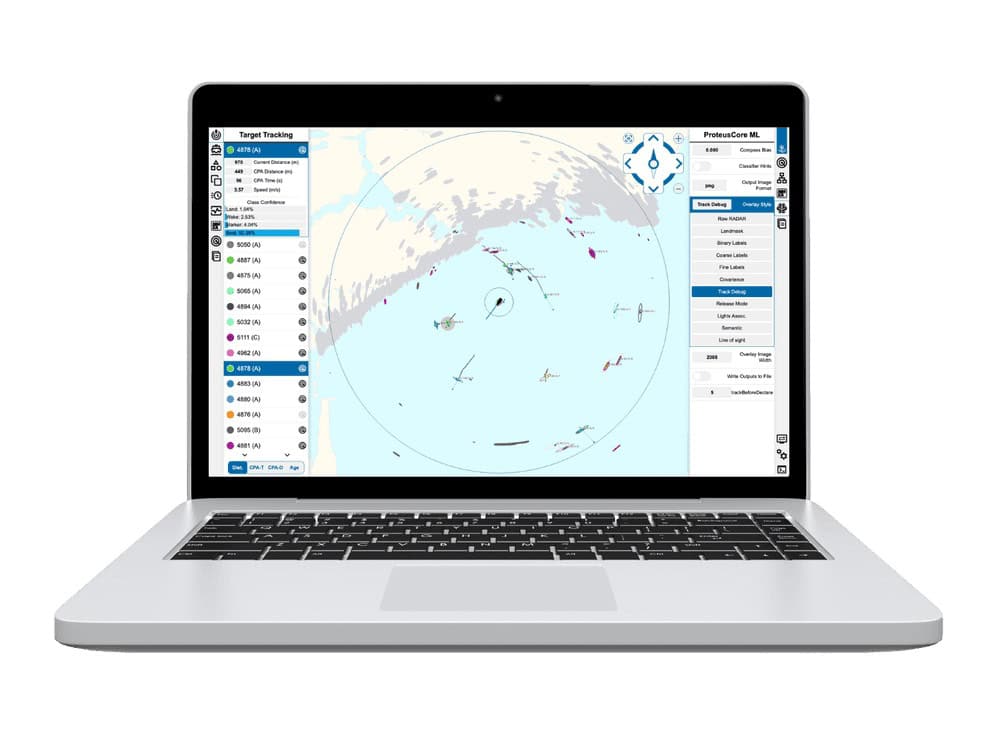

Tocaro Blue addresses growing demand for automated maritime perception with ProteusCore, a machine learning radar processing platform for Unmanned Surface Vehicles (USVs) and autonomous navigation systems operating at sea.
For defense programs developing tactical craft and USVs, ProteusCore provides a perception capability that can integrate with existing radar infrastructure and support sensor-fusion-based situational awareness systems.
Traditional marine radar remains highly effective for detection, but interpreting radar imagery can require significant operator experience.
Radar and Cameras as Collaborative Sensors for Maritime Awareness
Rather than competing technologies, radar and cameras can function as complementary sensors within a modern perception system. Radar provides reliable distance measurement and detection capability across wide areas, performing effectively even in fog, rain, darkness, and other degraded visibility conditions. Cameras add visual confirmation and further target identification.
When used together, radar can detect and track objects across a 360-degree field of view while directing EO/IR pan-tilt-zoom cameras toward areas of interest. This slew-to-cue approach allows each sensor type to contribute distinct strengths to a unified situational awareness capability, an architecture well suited to the endurance and autonomy demands of unmanned systems.
Bringing Intelligent Perception to Marine Radar
While industries such as automotive have rapidly advanced sensor perception and autonomy technologies, the maritime sector has historically progressed more slowly. Many vessels still rely on radar displays that present raw echoes requiring manual interpretation.
Machine learning provides a way to extract more meaningful information from radar imagery. The company has developed a proprietary marine radar dataset containing more than three million radar frames, which is used to train the machine learning models embedded within ProteusCore.
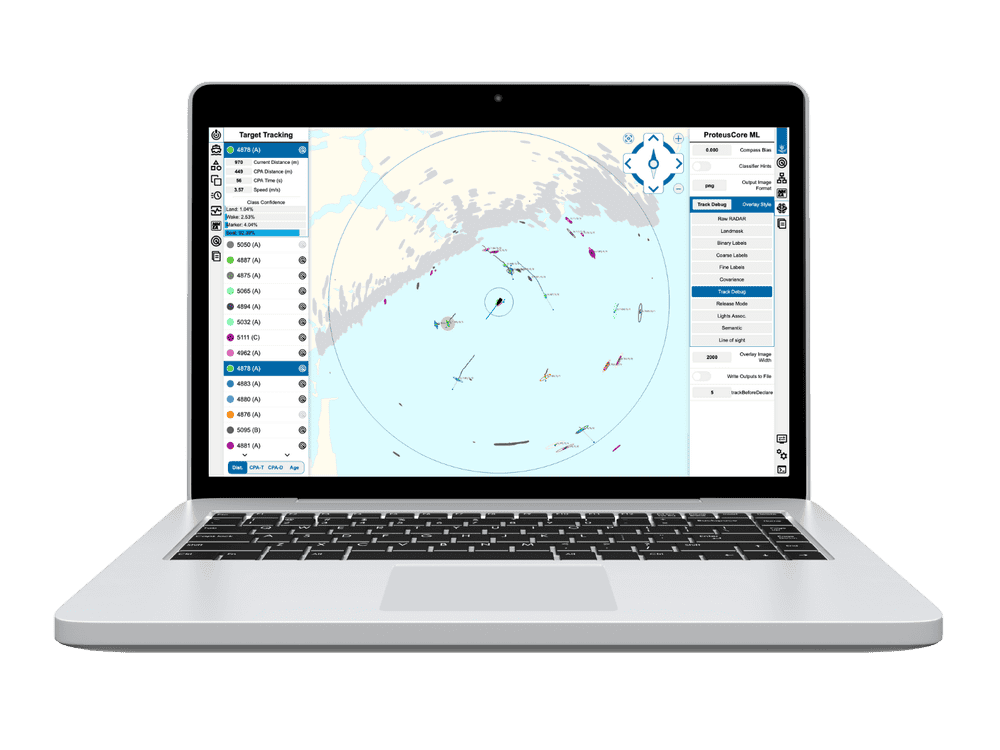
By applying these models to conventional radar feeds, the software enables automated interpretation of radar scenes, providing detection, classification, and tracking data for navigation systems, situational awareness interfaces, and vessel control technologies.
Automated Radar Detection and Classification
ProteusCore enhances radar performance through several automated capabilities designed to reduce manual configuration while improving detection accuracy.
A patent-pending Autofocus function automatically adjusts radar gain and range settings according to environmental conditions, sea state, and proximity to land. By dynamically optimizing these parameters, the software ensures that radar data entering the machine learning pipeline is suitable for accurate object detection.
Once targets are identified, ProteusCore applies proprietary machine learning models to analyze radar imagery and determine the likely class of detected objects. The system can distinguish between categories such as vessels, buoys or markers, land, and wake patterns, providing additional context that traditional radar displays do not typically offer.
The software also maintains real-time tracks for hundreds of objects simultaneously. For each target, ProteusCore reports parameters including position, velocity, closest point of approach, and predicted trajectory, creating a continuously updated view of surrounding maritime activity.
Supporting Autonomous and Assisted Navigation
Radar’s wide-area coverage and 360-degree monitoring capability make it well suited to autonomous vessel development and defense applications. ProteusCore outputs ML-classified radar tracks that can be integrated into collision detection and avoidance systems, enabling autopilot platforms to use this information to support throttle or steering adjustments when objects are detected in a vessel’s path. Onboard interfaces can also generate alerts to assist human operators in crewed configurations.
For defense programs, this capability supports the development of next-generation situational awareness interfaces for both crewed tactical craft and USVs operating in complex maritime environments.
Sensor Fusion with Camera Systems
ProteusCore tracking data can be used to guide pan-tilt-zoom EO/IR cameras toward detected targets, improving tracking performance and enabling coordinated sensor operation.
Similarly, ProteusCore can provide ML classifications and tracking data to fixed onboard camera systems, including static EO/IR sensors and stereo vision cameras. This allows radar and optical sensors to work together to provide more comprehensive situational awareness, with each modality reinforcing the other.
Flexible Deployment Across Maritime Platforms
ProteusCore is designed for flexible deployment across a wide range of marine vessels. The software operates using standard CPU processing resources, allowing it to run on existing onboard computing hardware.
Deployment typically begins with a development kit sea trial that allows integrators to evaluate ProteusCore performance within their operating environment. Following evaluation, the software can be delivered as a tailored executable that accounts for the dependencies of the customer’s onboard system. For full integration, Tocaro Blue can also provide custom software components designed to operate directly within a customer’s technology stack.
The technology is applicable across the marine sector, including recreational vessels, fishing boats, workboats, and uncrewed surface vessels. In defense environments, ProteusCore’s radar-based perception supports situational awareness for tactical craft and USVs while enabling next-generation user interfaces and advanced navigation assistance systems suitable for both crewed and autonomous operations.