



In this Q&A, Adam Gavrich, Senior Technical Sales Manager (Avionics) at Honeywell Aerospace, discusses how the company’s 360 Display system delivers an immersive, head-tracked mixed-reality view for vehicle crews operating in complex and degraded environments.
He covers the 360 Display architecture and platform integration, alongside its ultra-low-latency, stereoscopic performance, U.S. Department of Defense evaluation results, and a hands-on demonstration at the International Armoured Vehicles Conference.
What are the key hardware and software elements that make up the Honeywell Aerospace 360 Display system, and how do they work together to provide a full mixed-reality view for operators?
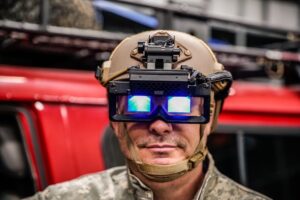
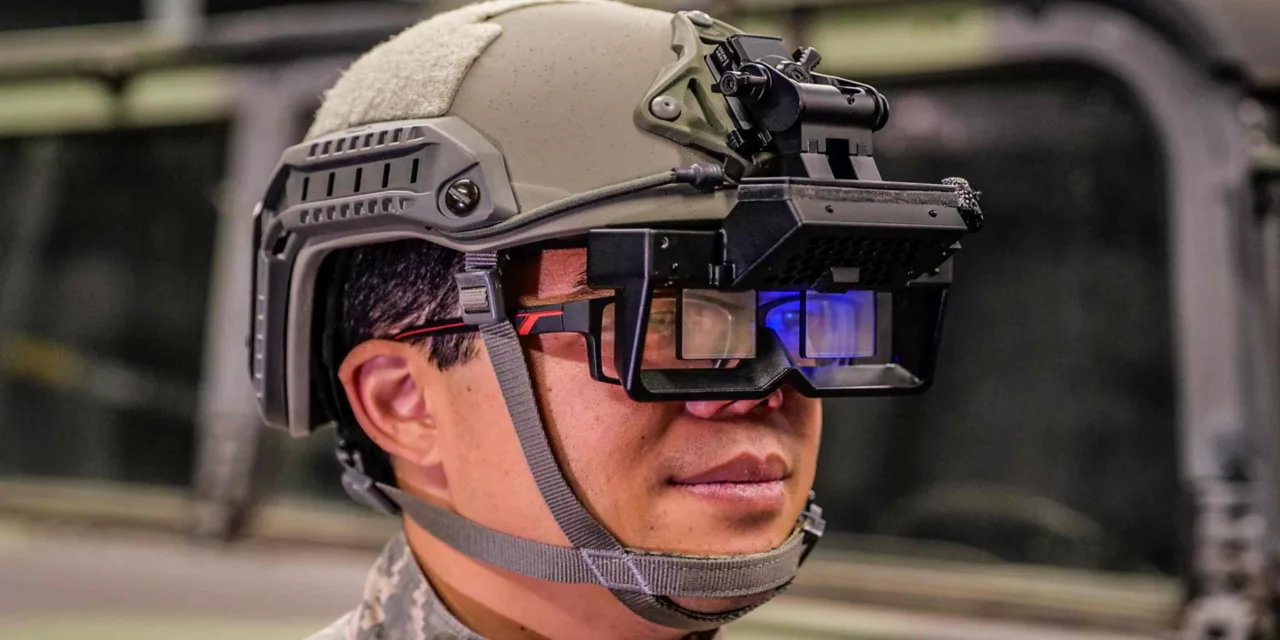
The Honeywell Aerospace 360 Display System is comprised of one or more display headsets that mount to a standard Night Vision Goggle helmet mount, a head-tracking camera for each headset (mounted above the operator), a software application, cameras and sensors mounted around the vehicle, and a rugged computer for hosting the 360 Display software and interfacing with cameras, sensors, and other vehicle systems.
These components work together to provide a fully immersive, head-tracked, 3D mixed-reality visualization system that allows vehicle crews to operate without any outside visual reference for extended periods of time, without experiencing visual fatigue or motion sickness. In addition, graphical overlays on top of the visualized camera and sensor feeds provide greatly enhanced situational awareness, increasing mission and operational effectiveness.
How does the 360 Display interface with a vehicle’s existing sensors, cameras, and mission systems, and what level of integration is required on armoured or tactical platforms?
The key components of the system can be easily interfaced with existing cameras and sensors mounted around a vehicle, provided they meet a few minimum and common requirements. However, most vehicles with existing cameras do not have tightly spaced, forward-looking cameras to enable the stereoscopic depth perception that Honeywell Aerospace 360 provides, so these often must be installed.
With respect to mission system integration, the standard 360 Display system can interface with basic vehicle systems and provides a rich set of features for vehicle operation and enhanced situational awareness. Integration with unique mission systems does require some level of engineering effort; however, Honeywell Aerospace has significant mission system integration experience and can perform this efficiently. The software architecture is designed to be easily adaptable to unique mission systems and requirements.
What differentiates the 360 Display from other wearable or head-mounted situational-awareness systems currently on the market?
The biggest differentiator of the 360 Display system, when compared to competing solutions, is its ultra-low-latency head tracking and stereoscopic depth perception. The 360 system was designed from the ground up to fully simulate the user’s natural vision. This allows vehicle crews to operate at high rates of speed, without any outside visual reference, for extended periods of time, without experiencing visual fatigue or motion sickness.
How does the 360 Display improve situational awareness and decision-making for both ground-vehicle crews and aircrew, especially when operating in degraded-visibility or high-stress conditions?

The core Honeywell Aerospace 360 system includes a set of standard overlays that greatly enhance situational awareness. Three picture-in-picture displays are presented within the user’s field of regard and can be configured with camera feeds (such as a rear-facing camera) to provide an easy view of that camera without requiring head movement. Additionally, the picture-in-picture windows can be used to display other critical situational awareness information, such as maps, vehicle status data, drone camera feeds, or communications data.
Also included is a top-down view of the vehicle and surrounding camera feeds, providing at-a-glance awareness of objects and personnel outside the vehicle. Field-of-view cones are overlaid on the top-down view to indicate where each crew member is looking at any given time, enabling high levels of awareness and efficiency when crew members need to communicate what they are seeing and where to look. Other overlay features, such as rally points and geo-located aircraft traffic, further enhance situational awareness in dynamically changing mission environments.
What operational benefits have evaluations or field trials shown for crews using the 360 Display – for example in terms of safety, reaction time or mission effectiveness?
The Honeywell Aerospace 360 Display has been evaluated by various U.S. Department of Defense entities, including the U.S. Army and U.S. SOCOM. These evaluations have highlighted the system’s low-latency head tracking and nausea-free operation as critically important to mission effectiveness. It has also been noted that the depth perception provided by the system enables easier navigation of difficult terrain and can help prevent vehicle rollovers, which are a common and serious safety hazard in military vehicle operations.
At the International Armoured Vehicles Conference, what aspects of the 360 Display will you be showcasing, and what can attendees expect to learn or experience hands-on?
Honeywell Aerospace will have its famous red Jeep showcased in the booth, which has been used to conduct Honeywell Aerospace 360 driving and static demonstrations throughout Europe and the UK. Attendees will have the opportunity to climb in, put on a helmet, and experience Honeywell Aerospace 360 directly at the show. While attendees will not be able to drive the vehicle, they will be able to look around and experience the true sense of depth provided in the forward field of view, along with the standard overlays and situational awareness tools.
Thank you for your time. It has been a pleasure speaking with Adam Gavrich, and we look forward to following Honeywell Aerospace’s continued advancements in mixed-reality display and situational awareness technologies.