Showcase your capabilities
If you design, build or supply Tent Heaters, create a profile to showcase your capabilities and connect with visitors who have an active requirement for your solutions.




Military tent heaters are deployable heating systems that maintain safe, workable temperatures inside temporary military shelters and expeditionary camps. Used in field tents, command posts, medical shelters, and cold-weather training sites, they support personnel protection, equipment readiness, and mission continuity in harsh environments.
This page features leading military tent heater suppliers and manufacturers of indirect-fired ducted heaters, direct-fired units for ventilated workspaces, convective space heaters, diesel or multi-fuel burners, and self-powered tactical heaters.
Read the Technology Overview
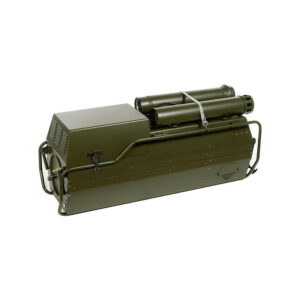
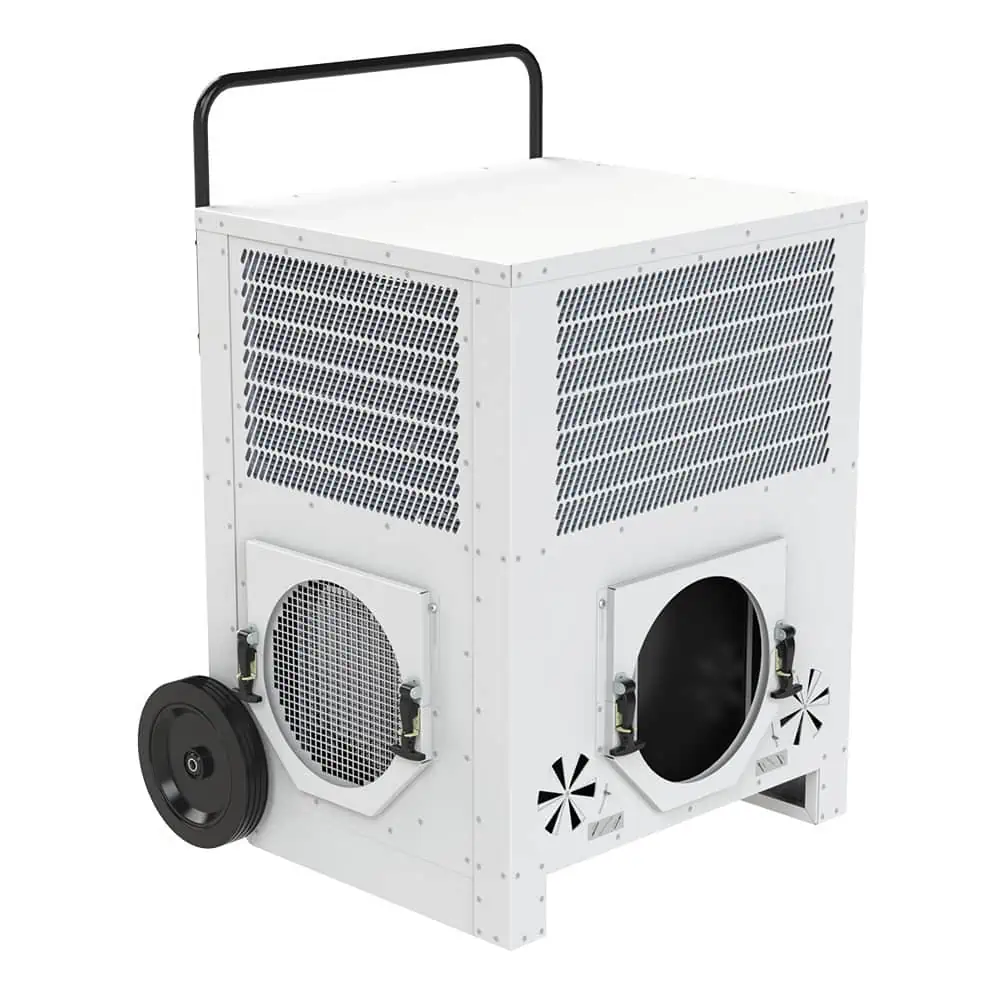
Military Air Conditioners, HVAC & Environmental Control Units for Tents, Containers and Temporary Buildings

If you design, build or supply Tent Heaters, create a profile to showcase your capabilities and connect with visitors who have an active requirement for your solutions.

Military tent heaters are deployable heating systems designed to maintain safe, workable temperatures inside temporary military shelters, including field tents, mobile command posts, medical shelters, maintenance bays, decontamination tents, and expeditionary camps. Their role is not simply to provide comfort. In cold-weather operations, reliable shelter heating helps prevent cold injury, supports sleep and recovery, enables dexterous work with tools and medical equipment, and keeps mission-critical electronics, batteries, fluids, and weapon components within usable temperature ranges.
A properly selected military tent heater system also helps manage condensation, one of the most persistent problems in fabric shelters. Warm air, moisture from personnel, wet clothing, medical activity, and temperature cycling can quickly create water accumulation on tent liners and equipment surfaces. Heating, ventilation, airflow distribution, and safe combustion management must therefore be treated as one integrated environmental control problem rather than as a standalone heat source.
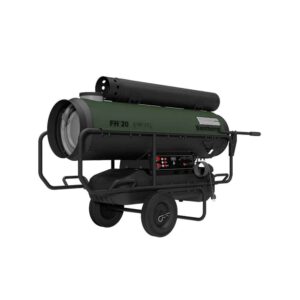
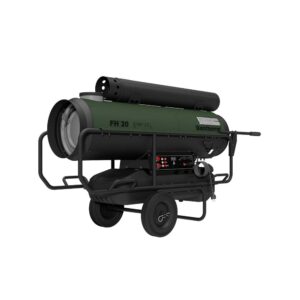
FH 20-40 Tent Heater by Dantherm Group
Portable military tent heaters provide the essential thermal baseline for infantry units operating in arctic, sub-arctic, or mountainous terrain. A military portable heater must rapidly achieve survivable temperatures and run steadily overnight, serving as a core component of a broader cold weather system that includes insulated liners, sleeping gear, and strict ventilation discipline.
Large scale camps require aggregated heating for accommodations, tactical command centers, and maintenance bays. At this scale, a military diesel tent heater network can integrate directly into the broader logistics plan, impacting fuel burn and generator loads. Planners often standardize on an army large capacity field heater to simplify maintenance and parts tracking across dense shelter layouts.
Tactical operations centers often rely on a stable army diesel tent heater setup to safeguard sensitive C4ISR electronics from condensation and rapid thermal cycling. The climate control system must maintain uniform heat distribution to preserve dry cable routes without creating direct, disruptive drafts for operators.
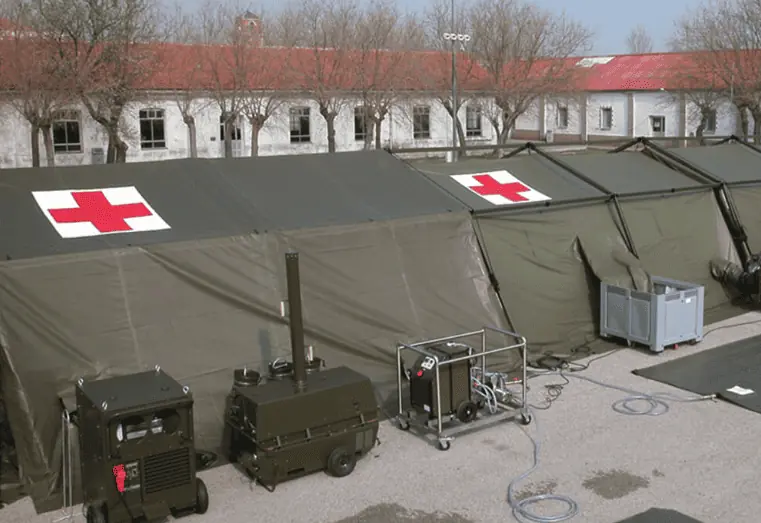
Medical shelters require exceptional climate stability to protect hypothermic or immobile patients who cannot regulate their own body temperature. A specialized military diesel heater can preserve critical supplies, including intravenous fluids and diagnostic devices, allowing clinical staff to work efficiently.
To guarantee safety, field hospitals prioritize ducted indirect fired systems. This architecture isolates the combustion process entirely, delivering clean air to patient spaces free of toxic by-products.
Warmed maintenance tents preserve the manual dexterity required for technicians to service tools, weapons, and electronics in sub zero environments. Controlled heating also accelerates repair turnaround by keeping lubricants, sealants, and test instruments within operational specifications.
Selecting a military heater for these large structures requires accounting for wide entry doors, high air turnover, and exhaust management.
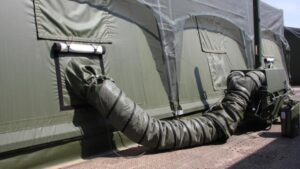
Military Tent Heaters by Dantherm Group
CBRN support and decontamination tents combine airflow filtration, water management, and high capacity heating to protect personnel during wash down cycles. Integrated military tent heaters prevent cold stress while supporting rapid transitions through containment zones. This deployment requires strict pressure balancing to ensure the warm air supply does not disrupt collective protection boundaries.
During disaster relief and civil support missions, military heaters provide continuous warmth within public facing shelters and temporary clinics. Because these sites often operate with limited power and untrained personnel, the equipment must prioritize simple controls and foolproof safety features. Guarded hot surfaces and robust exhaust configurations are mandatory to eliminate operational risks.
Cold weather exercises subject an army tent heater to heavy wear, frequent transport, and varying levels of operator experience. These demanding environments make reliable startup and straightforward field maintenance essential. Deploying these systems helps units establish solid operational routines, including duct inspections and carbon monoxide monitoring.
To add clarity for specifiers and logistics planners, the primary configurations of military heaters can be evaluated by their mechanical architecture and operational parameters:
| Heater Type | Operating Principle | Primary Applications | Key Engineering Advantages | Critical Constraints |
| Indirect-Fired Forced-Air Heaters | Fuel burns inside an isolated combustion chamber. A heat exchanger transfers thermal energy to a separate clean-air stream. | Sleeping quarters, medical tents, command posts, high-density camps. | Very low carbon monoxide risk in breathable air, low internal noise, clean airflow delivery. | Higher weight and packed volume, requires external placement and flexible ducting. |
| Direct-Fired Heaters | Passes combustion heat directly into the air stream, discharging by-products into the heated area. | Ventilated workspaces, drying areas, equipment preheating, unoccupied zones. | Maximum thermal efficiency, mechanically simple, rapid shelter startup. | High carbon monoxide risk, depletes oxygen, prohibited in enclosed or sleeping shelters. |
| Ducted External Heaters | Places the combustion system entirely outside the tent and moves warmed air into the shelter via supply ducting. | Tactical operations centers, modular shelters, multi-tent configurations. | Keeps fuel, flame, and exhaust noise away from personnel, flexible intake options. | Requires precise duct routing to prevent collapse, blockage, or exhaust recirculation. |
| Convective Space Heaters | Warms the surrounding air through natural or fan-assisted convection using localized burners or electric elements. | Smaller shelters, crew tents, guard posts, austere field positions. | Low mechanical complexity, compact footprint, minimal ducting required for setup. | Localized heat concentration, internal hot surfaces, high ventilation discipline required. |
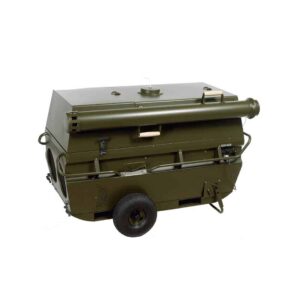
VA-M40MKII Tent Heater by Dantherm Group
Military heater fuel selection relies on single fuel logistics, favoring options compatible with standard aviation turbine fuels. JP-8 and NATO F-34 are kerosene type fuels containing anti icing additives, static dissipaters, and corrosion inhibitors. Running a military multi fuel heater from the same supply lines as tactical vehicles and aircraft drastically simplifies forward distribution.
Multi fuel burners provide the flexibility needed to handle varying fuel grades across coalition environments. The burner must manage atomization consistently to maintain stable combustion at high altitudes or low temperatures. While a classic military diesel heater provides maximum energy density, hybrid systems can integrate custom military grade heating elements for localized, spark free control via camp microgrids.
Self powered tactical heaters generate their own operational electricity, making them ideal for remote observation posts without generator access. These systems utilize internal thermoelectric modules to convert burner heat into electrical power via the Seebeck effect. This localized energy drives the fuel pumps and air distribution fans, ensuring continuous performance during grid failures.
External fuel infrastructure keeps volatile liquids away from occupied shelters, using elevated stands, supply lines, and glove friendly quick connect fittings. These external delivery components must withstand sub zero environments without cracking or clogging from fuel contaminants.
Deploying high-capacity environmental systems within fabric structures requires strict adherence to safety protocols and seamless shelter integration.
Maintaining these rigorous safety baselines ensures continuous operation without risking personnel health or structural integrity.
The field of tactical climate control continues to evolve as manufacturers focus on optimizing deployment footprints and thermal efficiency.
These technology developments ensure that modern forces maintain maximum combat readiness while minimizing the logistical footprint in harsh climates.


 Searching Companies & Products