Electronic Assembly Services for Defense and Military Applications
Source providers of electronic assembly services for defense and military programs, including mission-critical PCB assemblies, microelectronics, subsystem builds, and specialized manufacturing for air, land, sea, space, and cyber applications.
If you design, build or supply Electronic Assembly Services, create a profile to showcase your capabilities and connect with visitors who have an active requirement for your solutions.
Electronics pre-production assembly & working prototype services for defense OEMs
Electronics pre-production assembly & working prototype services for defense OEMs
...ly designs for defenseelectronics equipment into prototype and production reality. ... ...tro-mechanical assembly and complete product build, allow for the beta testing and refinement of new...
Electronic Assembly Services for Defense and Military Applications
Overview by
Eleanor Widdows
Updated:
Electronic assembly services for defense and military applications support the manufacturing and integration of mission-critical electronics, including PCB assemblies, microelectronics, wiring harnesses, sensor modules, box builds, power systems, and rugged enclosures for air, land, sea, space, and C4ISR platforms. These services ensure reliability under extreme environmental and electromagnetic conditions and adhere to strict military standards, including MIL-STD-810, MIL-STD-461, and IPC workmanship requirements.
Service providers support prototype development, low-rate initial builds, and full-rate production using advanced components, including FPGA devices, secure processors, sensor modules, DC-DC converters, and MIL-spec connectors. Defense programs depend on these capabilities to deliver high-reliability electronics for avionics, autonomous systems, communications equipment, ISR payloads, ground systems, and naval platforms, ensuring operational readiness, resilience, and long-term sustainment.
Defense Applications For Electronics Assembly Services
Electronic assembly services enable the deployment of critical technologies across multiple defense domains. Typical applications include:
PCB assemblies and microelectronics for avionics, mission computers, and embedded processing units in aircraft, UAVs, rotorcraft, and space systems
Box-build and enclosure-level assemblies for shelters, ground stations, hardened communication nodes, and remote systems
These services also support modernization programs, system upgrades, sustainment operations, and prototype builds for rapid capability development.
Types Of Electronic Assembly Services Used In Defense
Electronics assembly providers deliver a wide range of specialized electronics manufacturing and integration capabilities. Core service categories include:
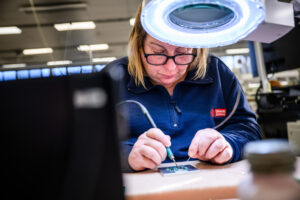
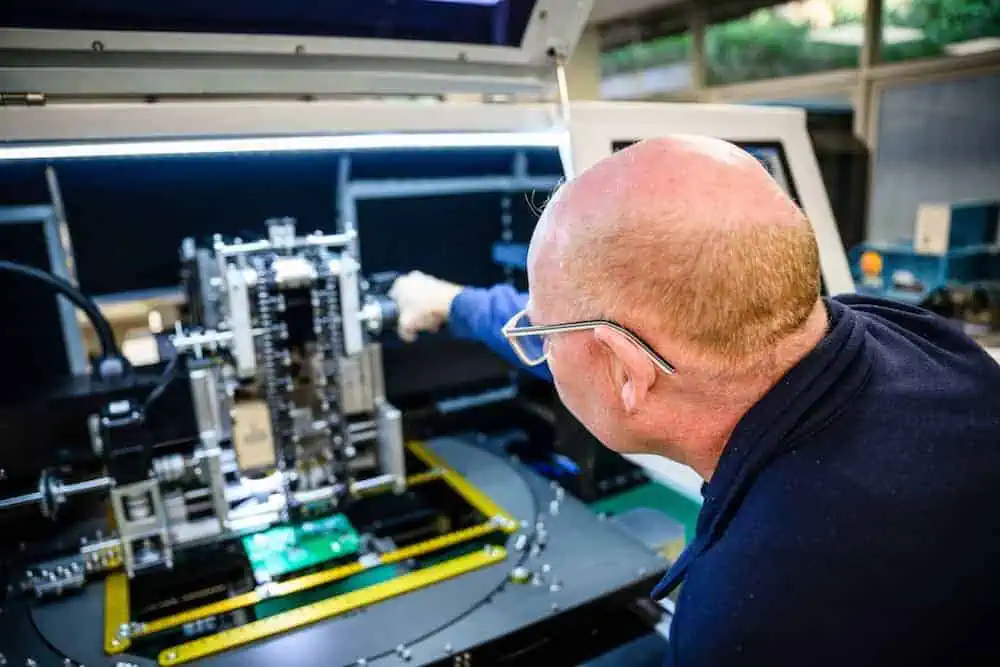
Electronics assembly and prototyping services for defense OEMs by Offshore Electronics.
PCB Assembly Services
Printed circuit board assembly services include surface-mount, through-hole, mixed-technology, and complex multilayer PCB assembly. Defense PCBs often incorporate HDI designs, rigid-flex architectures, specialized materials, and controlled impedance requirements. Associated capabilities include solder paste deposition, SMT placement, BGA component assembly, x-ray inspection, thermal profiling, and reflow control.
Microelectronics And Component-Level Assembly
Microelectronics assembly supports application-specific integrated circuits, FPGA devices, microcontroller units, memory modules, IC packages, and SMD components. Precision processes include wire bonding, die attach, BGA rework, QFN component placement, and micro-soldering for miniaturized and high-density designs. These assemblies are critical for small-form-factor mission computers, secure processors, guidance systems, and RF modules.
Cable, Wiring, And Harness Assembly
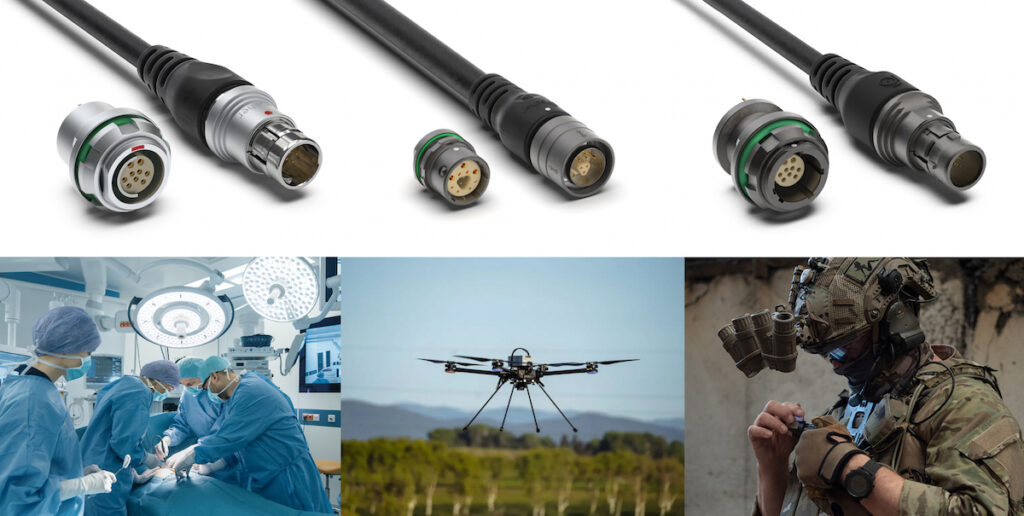
Cable assemblies, wiring harnesses, and connector integration support interconnects for airborne systems, naval platforms, armored vehicles, and missile subsystems. Providers must support MIL-spec connectors, shielded enclosures, header pins, socket connectors, strain relief, and custom cabling configurations designed for harsh environments. Electromagnetic compatibility requirements, EMI filters, and EMC shielding are commonly incorporated.
Box-Build And Subsystem Integration
Box-build assembly covers enclosure assembly, chassis wiring, component mounting, thermal interface placement, heatsinks, processors, and mechanical integration. Subsystem integration includes embedded electronics, RF modules, communication modules, power distribution systems, and sensor electronics. Rugged enclosures, shock isolation, environmental sealing, and conformal coatings protect electronics in demanding defense environments.
Prototype And Rapid Assembly Services
Rapid PCB assembly, prototype electronics assembly, and low-volume builds support R&D programs and rapid response needs. Programs requiring rapid iteration cycles, such as unmanned systems payloads, ISR electronics, and new sensor modules, depend on these services to accelerate development.
Electronics Manufacturing Support Services
Support services may include electronic manufacturing services, ECM services, EMS service offerings, component sourcing, traceability management, testing, inspection, serialization, conformal coatings, and environmental stress screening. These services ensure compliance and reliability throughout production.
Materials, Components, And Technologies In Defense Electronics Assembly
Defense manufacturing relies on advanced components and specialized materials engineered for reliability, durability, and high-performance operation. Key elements include:
Printed circuit boards and multilayer PCB stackups
Microprocessors, secure processors, microcontroller units, and processing units
FPGA devices, sensor modules, RF modules, and communication modules
Application-specific integrated circuits, memory modules (RAM modules and flash memory)
SMD components, BGA components, QFN components, and IC packages
Power management components, including DC-DC converters, voltage regulators, power converters, and EMI filters
Connector systems, including MIL-spec connectors, header pins, sockets, and interconnect hardware
Specialized coatings, including conformal coatings and conformal coating processes
PCB-specific structures, including vias, ground planes, solder paste, and SMT pads
These components must be selected, assembled, and verified to ensure reliability under vibration, temperature extremes, salt fog, shock loads, RF exposure, and electromagnetic interference.
Standards And Requirements For Defense Electronics Assembly
MIL-STD-275 and associated PCB design and fabrication standards
IPC-A-610 and IPC-J-STD-001 for soldering and electronic assembly workmanship
AS9100 for aerospace quality management systems
ITAR and other export control regulations for defense hardware
Requirements for secure handling, serialization, and traceability
Compliance ensures assemblies meet the performance, durability, and safety requirements essential for military readiness.
Comparison Of Defense Electronics Assembly Services
Defense procurement professionals evaluate electronics assembly services across several differentiating factors. Key comparison areas include:
Manufacturing Capability And Complexity
Providers vary in their ability to produce HDI PCBs, rigid-flex designs, microelectronics, and high-density assemblies. Some specialize in prototype and low-volume defense programs, while others support full-rate production.
Ruggedization And Harsh Environment Expertise
Defense systems require assemblies capable of withstanding vibration, thermal cycling, dust, moisture, and electromagnetic fields. Providers with experience in rugged enclosure manufacturing, conformal coatings, thermal management, and environmental sealing offer added value.
Component-Level Security And Traceability
Secure processors, encryption modules, and controlled microelectronics require verified sourcing and chain-of-custody documentation. Providers supporting full component traceability mitigate supply chain risks.
Integration Depth
Some providers focus exclusively on PCB assemblies, while others handle subsystem integration, box builds, cable harnessing, testing, and final system verification. Integrated providers reduce supply chain fragmentation.
Testing Capabilities
Defense programs often require advanced test services, including functional testing, burn-in, environmental stress screening, in-circuit testing, and x-ray validation for BGA components.
Compliance Credentials
Providers must demonstrate adherence to military standards, IPC quality requirements, and defense-related certifications. This reduces program risk and ensures compatibility with existing systems.
Considerations For Selecting A Defense Electronics Assembly Provider
Defense procurement teams evaluate several factors when selecting suppliers:
Ability to support classified or controlled programs
Experience with long-life, high-reliability defense components
Capability to handle mixed-technology assemblies with tight tolerances
Integrated production services reducing supply chain fragmentation
Compliance with MIL-STD, IPC, AS9100, and ITAR requirements
Proven track record in aerospace, defense, and military programs
Ability to support prototype, low-rate initial production, and full-rate manufacturing
Strength in documentation, reporting, traceability, and program support
Capacity to manage custom materials, ruggedized hardware, and advanced component technologies
These considerations ensure the supplier meets the technical, regulatory, and performance requirements of defense agencies and prime contractors.
Future Trends In Defense Electronics Assembly
Defense electronics manufacturing is evolving due to advances in materials, miniaturization, processing power, and mission requirements. Key trends include:
Increased use of secure processors and hardware-based security
Higher density PCB designs using HDI and rigid-flex architectures
Expansion of chip-level integration and application-specific integrated circuits
Enhanced electromagnetic protection using advanced EMI filters and shielding
Growth of rapid PCB assembly and accelerated prototyping
Integration of AI-enabled processors and high-performance computing modules
Adoption of ruggedized enclosures supporting autonomous and remote operations
Continued emphasis on traceability and supply chain assurance
Additive manufacturing influences in component carriers and housings
These trends support next-generation mission computing, sensor processing, electronic warfare systems, and autonomous platforms.
OSI Electronics, represented by KT Technical Solutions, deliver end-to-end EMS support from prototype to production for defense and aerospace applications
KT Technical Solutions is highlighting ASC, a vendor and trusted provider of high-performance PCB solutions with a focus on speed, quality, and application-specific expertise
Fischer Connectors has introduced new USB 3.2 Gen 2 connectors and cable assemblies, expanding its Core, MiniMax™, and UltiMate™ series for high-speed data transfer in various applications
In collaboration with Atotech an MKS Brand, at the Delhi production site, MKS Instruments is now offering local assembly, support, and service capabilities, tailored to support customers in India
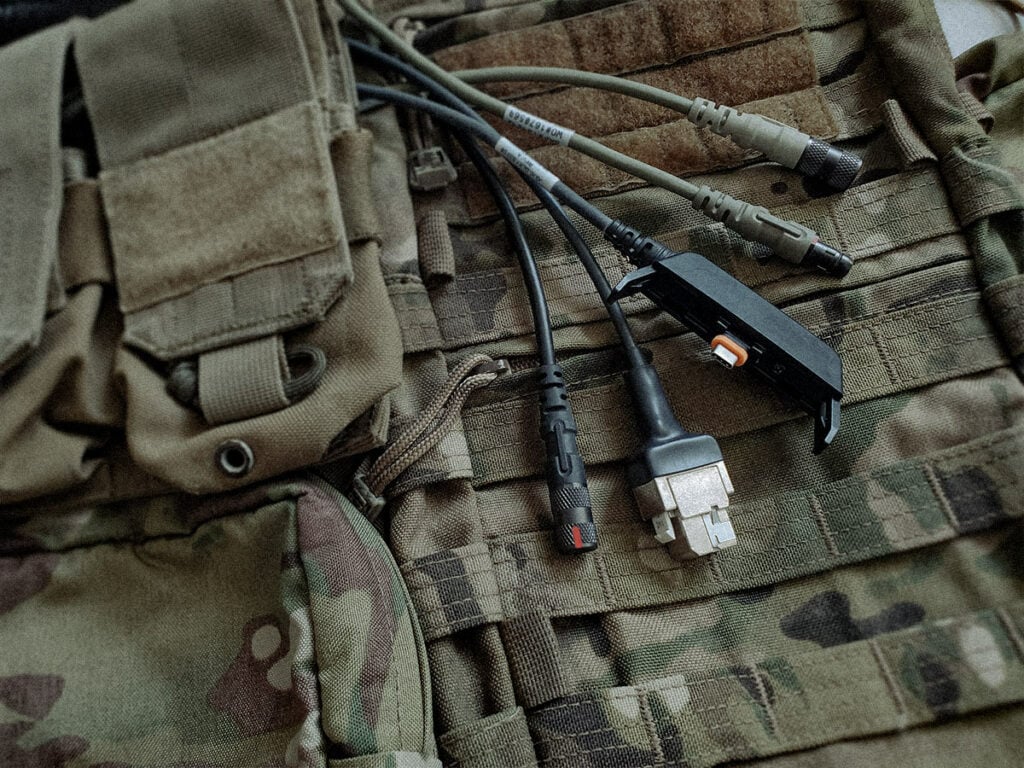
Fischer Connectors has released an expanded set of cable assemblies for the Fischer KEYSTONE tactical hub, including three cables for L3Harris, Silvus and Bittium tactical radios
The latest defense technology news, straight to your inbox.
Get our weekly roundup of technology developments, new products and industry news.
THANK YOU FOR SIGNING UP
Thanks for joining us. Check your inbox.
We've sent you an email. Click the confirmation link to complete your subscription to the weekly eBrief. In the meantime, explore the latest news, suppliers and technologies on DA.
Advancing Defense Capability Through Strategic Collaboration
Defense Advancement works with major OEMs to foster collaboration and increase engagement with SMEs, to accelerate innovation and drive defense capabilities forward.