
Tyto Robotics explains how measuring propeller performance coefficients provides UAV developers with a more rigorous and scalable way to evaluate aerodynamic efficiency and operating suitability.
Propeller performance coefficients are dimensionless values that non-dimensionalize thrust, torque, and power, enabling direct comparison between different propeller geometries regardless of size or rotational speed. Unlike static thrust or static efficiency alone, these coefficients provide deeper insight into how a propeller performs across varying operating conditions, particularly when forward velocity and advance ratio are considered. This is especially valuable for VTOL and tilt-rotor platforms, where performance shifts between hover and forward flight regimes.
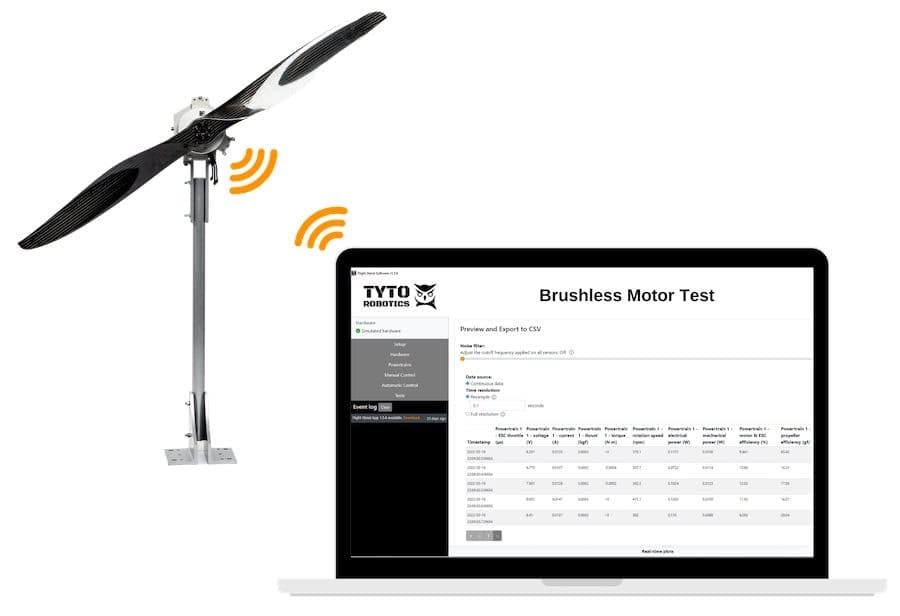
Using the Input Transformations feature in Tyto Robotics’ Flight Stand software, engineers can calculate thrust, torque, and power coefficients in real time during automated testing. By entering the required formulas once, performance metrics are generated automatically for each test and exported for further analysis.
While factors such as Reynolds number and advance ratio must be accounted for, performance coefficients enable meaningful, apples-to-apples comparisons, ultimately saving time and resources in UAV propulsion development.