



Accelerate Defense Modernization through Strategic Sourcing
Discover cutting-edge solutions from leading global suppliers
This whitepaper by Rotron Aerospace, a developer of Vertical Take-Off and Landing (VTOL) Unmanned Aerial Vehicles (UAVs) and propulsion systems, examines the UK’s Defence Industrial Strategy (DIS) 2025 and its implications for industrial resilience, procurement reform, and export growth in the UK defense sector. Read more >>
The UK’s DIS 2025 sets out a transformative vision for the nation’s defense and industrial base, positioning national security as a driver of economic growth, technological innovation, and regional opportunity.
Building on the Strategic Defence Review (SDR) 2025, the DIS aims for a “tech-enabled defence power” by 2035, supported by a resilient industrial ecosystem capable of sustaining high-intensity operations and rapidly exploiting emerging technologies.

This paper explains key priorities of the DIS, which include making defense an engine for growth, backing UK-based business, leading in defense innovation, ensuring industrial resilience, and reforming procurement. The overall defense spending is projected to rise to 2.6% of GDP by 2027 and potentially 5% by 2035.
Central to the DIS is the role of Small and Medium-sized Enterprises (SMEs), as drivers of agility, innovation, and regional prosperity. Initiatives include the Defence Office for Small Business Growth, the SME Action Plan, a streamlined Commercial Pathway for contracts, and a revised SME definition to encourage scaling. MOD SME spend is set to increase by £2.5 billion by 2028, supported by digital procurement platforms, simplified market access, and test infrastructure modernization.
Rotron Aerospace explains how innovation is further accelerated through UK Defence Innovation (UKDI). It unifies MOD research initiatives under a single body with a £400 million budget, the ability to bypass conventional procurement rules, and a focus on technologies such as autonomous systems, uncrewed vehicles, AI, quantum, and digital architectures.
The DIS also integrates exports, industrial resilience, and procurement reform. The “Procure to Export” model ensures equipment is designed with market viability and allied interoperability in mind, supported by a £20 billion boost in UK Export Finance.
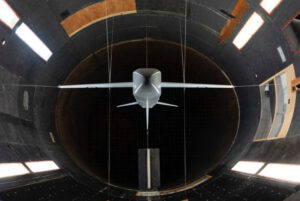
Rotron Aerospace Stratos UAV wind tunnel testing.
Investments in munitions, sovereign engine production, and energy incentives strengthen industrial resilience, while structured acquisition pipelines, segmented procurement cycles, and a central supplier platform simplify processes and attract private capital.
Companies such as Rotron Aerospace exemplify strategy’s vision, delivering UK-based rotary engines, propulsion systems and UAV platforms with rapid prototyping, vertical integration, and export potential.
Rotron Aerospace’s Stratos UAV platform combines high-efficiency propulsion with modular payload architecture for long-endurance autonomous operations, leveraging national test infrastructure and collaborative aerodynamic trials.
This highlights how SMEs can drive innovation, sovereignty, and global competitiveness under DIS 2025.
Download the full whitepaper ‘Defence Industrial Strategy 2025: Building the Engine for Growth’ here >>