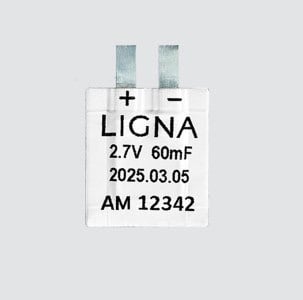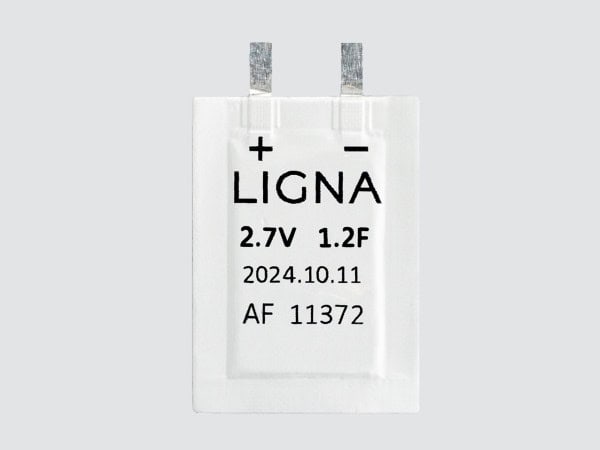




Ligna Energy discusses the structural and performance differences between supercapacitors and batteries, highlighting how sustainable materials and advanced design contribute to evolving energy storage technologies.
The company’s ultra-thin supercapacitors, developed using renewable biomaterials, illustrate the growing role of environmentally responsible innovation in defense and industrial applications.
Structural Principles
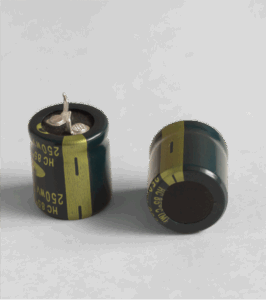
Supercapacitors are based on physical charge separation rather than chemical conversion. Their design features two high-surface-area electrodes, an electrolyte, and an ion-permeable separator, creating a straightforward structure that supports rapid charge and discharge. Batteries, conversely, rely on electrochemical reactions between a cathode and anode, generating higher energy densities at the cost of slower charge rates and finite cycle life.
The simplicity of supercapacitor construction enables flexible form factors, ranging from cylindrical and prismatic housings to thin-film and pouch configurations. Batteries must accommodate containment requirements for reactive electrolytes, influencing shape and packaging.
Material and Electrolyte Considerations
Supercapacitors utilize carbon-based materials such as activated carbon, graphene, or carbon nanotubes to achieve large surface areas and high electrical conductivity.
Ligna Energy’s sustainable materials strategy demonstrates how renewable carbon sources can achieve similar performance to synthetic materials while reducing ecological footprint.
Electrolytes in supercapacitors may be aqueous, organic, or ionic liquids, each presenting trade-offs between safety, cost, and voltage capacity. Batteries employ electrolytes specific to their chemistry, for instance, lithium salts in lithium-ion cells or sulfuric acid in lead-acid batteries, dictating energy density, temperature performance, and lifespan.
Performance and Efficiency
The primary distinction between the two technologies lies in the balance between power density and energy density.
Supercapacitors deliver exceptionally high power over short durations, ideal for energy recovery, load leveling, and short-term backup. Batteries provide sustained energy output over longer periods, serving applications such as electric mobility, grid storage, and portable electronics.
In high-demand systems, hybrid configurations can exploit the strengths of both. Supercapacitors manage transient power peaks and energy buffering, while batteries supply the sustained output. This complementary approach improves efficiency and component longevity in defense, aerospace, and industrial equipment.
Reliability and Longevity
Supercapacitors exhibit extended cycle life, often exceeding one million charge-discharge cycles, with minimal degradation. They are highly tolerant of temperature variation and less susceptible to failure mechanisms like thermal runaway. Batteries, while capable of higher total energy storage, degrade over time due to electrode wear and electrolyte decomposition.
Ligna Energy’s supercapacitors address environmental and safety aspects through the use of non-toxic, sustainable materials, aligning performance requirements with ecological objectives.
Limitations and Design Trade-Offs
Supercapacitors’ lower energy density limits their role in applications that require extended operational time without recharging. Their linear voltage discharge also requires additional power management circuitry. Batteries, on the other hand, face longer charge times, higher sensitivity to temperature, and end-of-life disposal concerns linked to their chemical components.
Both technologies are evolving. Solid-state batteries are improving safety and flexibility, while advanced supercapacitors continue to enhance energy density through novel materials and hybridization strategies.
Outlook
As industries pursue greater efficiency and sustainability, the distinction between batteries and supercapacitors is increasingly viewed as complementary rather than competitive.
Ligna Energy’s S-Power series exemplifies how supercapacitor technology can meet modern power requirements while supporting material circularity and reduced environmental impact.
In defense and advanced industrial contexts, where power availability, reliability, and operational longevity are essential, the integration of both technologies offers an adaptable path forward. Ongoing improvements in materials, system integration, and hybrid storage architectures will further define the role of supercapacitors and batteries in next-generation energy systems.