Showcase your capabilities
If you design, build or supply Onion Tanks, create a profile to showcase your capabilities and connect with visitors who have an active requirement for your solutions.




Onion tanks are flexible, self-supporting liquid storage systems designed for rapid deployment in military, defense, emergency response, and expeditionary operations. These portable tanks support temporary storage of potable or non-potable water for field camps, firefighting, decontamination, water treatment, and disaster response, while compatible designs may also support controlled fuel handling.
This page showcases manufacturers of onion bladder tanks including open-top, roll-top, zipper-top, and enclosed designs.
Read the Technology Overview
Expeditionary Fuel, Water Storage & Spill Containment Solutions for Defense Operations

If you design, build or supply Onion Tanks, create a profile to showcase your capabilities and connect with visitors who have an active requirement for your solutions.

Onion bladder tanks provide rapidly deployable liquid storage for military, defense, emergency response, and expeditionary operations. Their flexible, self-supporting construction allows compact transport, field positioning, and filling without the rigid framework required by many conventional temporary tanks.
An onion bladder tank is most commonly used for water or other compatible liquids, with suitability determined by its fabric, coating, seams, and fittings. For defense users, key considerations include capacity, liquid compatibility, deployment speed, ground conditions, connection interfaces, contamination control, draining, transport, and redeployment.

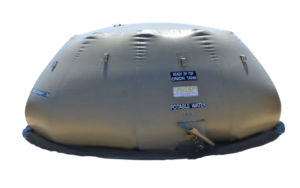
Onion Tanks from Ready Containment
Military onion tanks typically use reinforced fabrics with coatings selected for the intended liquid and environment. The reinforcing textile provides structural strength, while the coating helps control permeability and protects against moisture, chemicals, abrasion, ultraviolet exposure, and weathering. A fabric suitable for general water storage may not be appropriate for potable water, wastewater, chemicals, or hydrocarbon fuels.
Individual fabric panels are joined to create a liquid-tight structure capable of supporting the forces generated as the tank fills. Depending on the material system, seams may use thermal, radio-frequency, or compatible welding methods. Seam quality is critical because joints are stressed during filling, draining, folding, transportation, and redeployment. Inspection for separation, abrasion, punctures, and fitting damage supports reliable field use.
Tank fittings provide interfaces for filling, pumping, draining, and connecting the tank to a wider liquid-handling system. An onion water tank may incorporate inlet and discharge fittings for field pumps, hoses, valves, or water bladder systems. Fitting location and reinforcement affect flow control, connection security, and drainage before packing.
Closure arrangements differ according to access and contamination requirements. Open-top designs provide straightforward filling and visual access, while roll-top, zipper-top, or covered configurations provide greater separation from dust, debris, precipitation, insects, and other contaminants. The appropriate design depends on the liquid and operation.
Flexible tanks should normally be deployed on stable, prepared ground free from sharp stones, debris, and objects that could damage the fabric or affect stability. Ground sheets or protective liners provide an additional barrier against the terrain. Site drainage and, where required, secondary containment should also be considered for leakage, overflow, or spills.
Open-top onion tanks are designed for quick deployment and direct access to stored liquid. They are commonly suited to firefighting, washdown, raw-water storage, treatment processes, or other non-potable applications. Some designs may also be suitable for potable water when manufactured from appropriate materials and managed accordingly.
Roll-top designs incorporate an upper section that can be folded or secured after filling. This provides more environmental protection than a fully open tank while preserving the flexible construction associated with portable onion tanks. They can be useful when rapid handling and improved coverage are priorities.

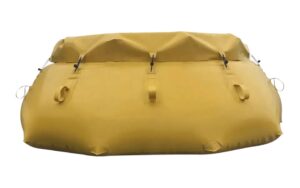
Military Zipper Top Onion Tanks from Ready Containment
Zipper-top and enclosed onion tanks provide greater separation between the stored liquid and the surrounding environment. Their closure systems can help limit entry of airborne debris, insects, and precipitation. They may be favored where water cleanliness or controlled fluid handling is important, although closure does not replace proper sanitation.
Potable-water onion tanks are manufactured from materials suitable for drinking-water contact and must be managed to preserve water quality throughout deployment. Cleaning, sanitization, closure integrity, and dedicated hoses, pumps, or fittings may form part of the wider process. For onion tank water storage, potable-water suitability should be verified rather than assumed.
Non-potable tanks can support firefighting, equipment washing, decontamination, construction support, water-treatment processes, or other field requirements that do not involve drinking water. Separating potable and non-potable equipment helps simplify operational control and reduce cross-contamination risks.
Fuel-compatible flexible tanks require coatings, seams, fittings, and accessories suitable for the particular fuel being stored. In military fuel systems, purpose-designed closed bladder or pillow tanks are commonly used because they isolate fuel from the environment. Any onion-style configuration intended for fuel requires explicit suitability for the specific product and operating conditions, along with appropriate spill containment and transfer controls.
Temporary camps and forward operating locations may require water reserves before permanent infrastructure is available. Onion tanks pack compactly when empty and can be integrated with pumps, hoses, filtration equipment, treatment systems, and distribution points after deployment.
Water-treatment systems often require temporary storage before or after filtration, purification, or conditioning. An onion tank can serve as a buffer between treatment stages, helping operators manage variations in supply and demand. Separate tanks can also maintain isolation between raw water and treated water.
Purpose-designed fuel-compatible flexible tanks can form part of temporary military fuel storage and distribution systems. They may support generators, vehicles, aircraft ground-support equipment, or other fuel consumers when connected to compatible pumps and transfer equipment. Fuel type, material compatibility, containment, grounding or bonding, and safe transfer procedures must be addressed for the specific system.
Onion tanks can provide temporary water reserves where hydrants, mains, or permanent reservoirs are unavailable or insufficient. Their rapid deployment makes them useful for firefighting support at remote facilities, training areas, temporary aviation sites, and emergency response locations.
Defense decontamination and washdown activities can create short-term requirements for significant volumes of process water. Flexible tanks can provide feed water for washing systems or, where compatible, temporary containment within a controlled fluid-handling setup. Tank selection should account for chemicals or contaminants that may contact the fabric.
Military and civil defense organizations supporting disaster relief may need temporary water storage when local infrastructure is damaged or inaccessible. Portable onion tanks can be transported to affected areas and connected to treatment or distribution equipment, providing storage while longer-term systems are restored.
Flexible storage formats differ in deployment requirements, protection levels, and operating characteristics. Alternatives include:
Choosing between these systems depends on the required liquid, site conditions, access requirements, contamination control, transport constraints, containment needs, and desired deployment method.


 Searching Companies & Products