Accelerate Defense Modernization through Strategic Sourcing
Discover cutting-edge solutions from leading global suppliers
Naval Air Systems Command has selected Near Earth Autonomy to lead the Medium Aerial Resupply Vehicle – Expeditionary Logistics (MARV-EL) Increment 2 program to prototype autonomous logistics aircraft.
The program, awarded through an Other Transaction Agreement under the Naval Aviation Systems Consortium, involves a collaborative effort with Bell Textron, Moog Inc., and XP Services. The project utilizes the Uncrewed 505 aerial logistics aircraft, which integrates Near Earth’s Captain autonomy architecture with the Bell 505 platform and Moog’s Genesys avionics. This system is intended for tactical-edge resupply where Distributed Maritime Operations and Expeditionary Advanced Base Operations concepts create high sustainment demands in contested areas. The development of a risk-worthy, cargo-moving asset aims to sustain forces where crewed aircraft may be too vulnerable or constrained by crew-rest cycles during high-tempo operations.
“The program is to develop an uncrewed aerial logistics aircraft for where the risk and need are highest,” said Lyle Chamberlain, CTO of Near Earth. “We are combining our Captain autonomy architecture with a proven Bell 505 platform to move cargo without putting Marines in harm’s way. To be as intuitive as possible, we are designing the aircraft around existing Marine Corps workflows. Operators will be able to request, dispatch, and manage missions through familiar command-and-control pathways, including MAGTAB and MANGL integration. At the same time, cargo can be loaded with standard pallet jacks and forklifts. This approach reduces infrastructure burden and helps make autonomous resupply practical for expeditionary operations.”
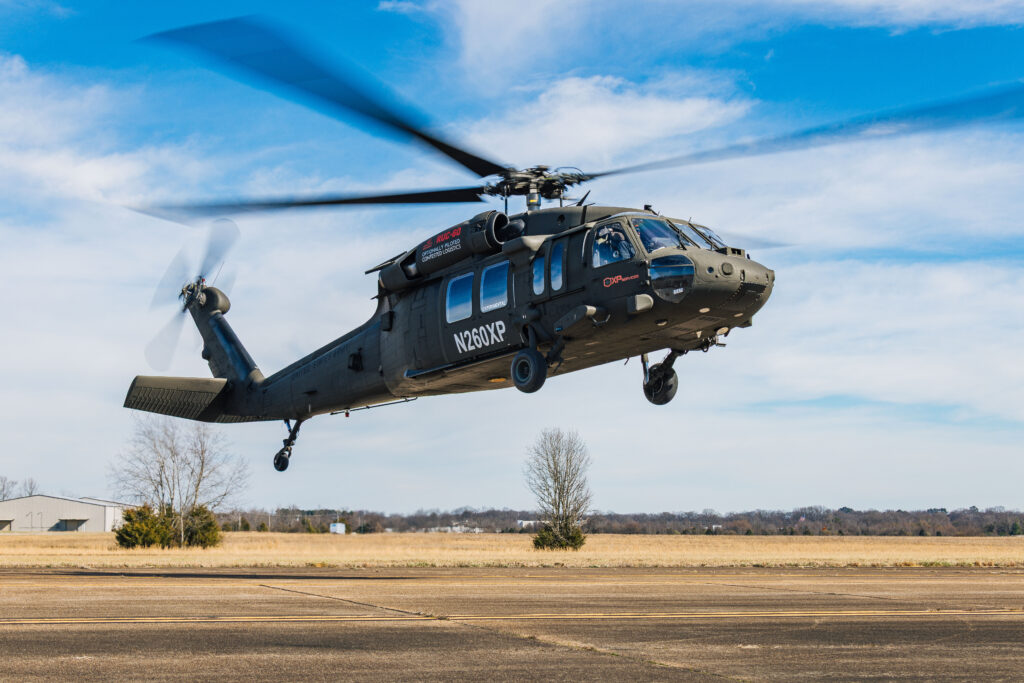
Chamberlain noted that the program builds on lessons learned from the Tactical Resupply Unmanned Aircraft System and Aerial Logistics Connector programs, while extending the same shared autonomy framework used with the Army for optionally piloted Black Hawk helicopters. Samuel Dinnar, Chief Strategy Officer at Near Earth, stated that the approach optimizes for fast progress on a mature, OEM-supported aircraft. “Each of our collaborators brings a great deal to the table. Bell Textron provides the proven Bell 505 platform, the technical data, and the airworthiness foundation needed for derivative military configurations. Moog delivers the certified flight control system that connects autonomy to the aircraft with high-integrity flight control. XP Services provides the modification, integration, maintenance, and experimental flight-test support needed to progress through every step of development.”
The prototype is designed to meet threshold requirements for a 1,300-pound payload and a 100-nautical-mile combat radius. The proposed configuration aims to exceed these objectives by offering higher payload capacity, the ability to carry a full Joint Modular Intermodal Container, and increased combat radius. Additionally, the aircraft is designed for efficient transportability, allowing two units to fit inside a C-130 transport plane with minimal disassembly.
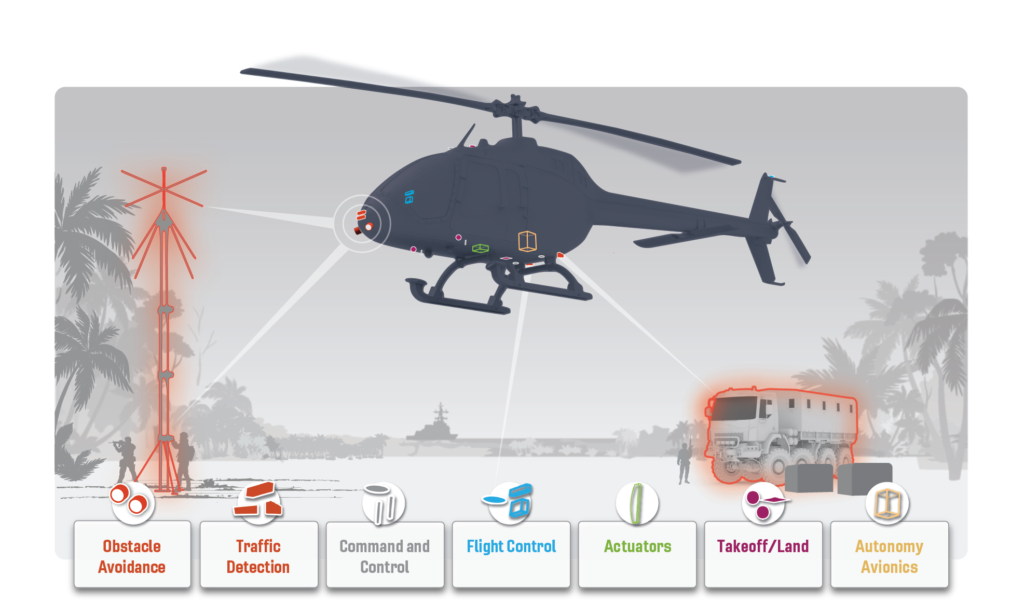
The Captain autonomy architecture is a safety-critical, Modular Open Systems Approach (MOSA) based framework. It supports autonomous takeoff, navigation in GPS-denied environments, obstacle avoidance, and dynamic mission updates while preserving the assurance artifacts needed for future military flight release processes. Jason Hurst, SVP of Engineering at Bell, added, “By combining that aircraft maturity with Near Earth’s autonomy and integration expertise, this program has a strong foundation for delivering an effective autonomous logistics capability for the Marine Corps.”
“Moog is proud to bring our innovative design capabilities in autopilots, avionics, and flight-control hardware to a program focused on autonomous logistics for the Marine Corps,” said Sharmila Durairaj, General Manager of Moog Avionics. Ken Pfleger, Program Manager of XP Services, noted that his team has the resources to support these modifications at the rate and standard required, drawing on experience from hundreds of previous aircraft conversions.
Near Earth Autonomy brings over 13 years of experience to the project, with a history of development on platforms including the Kaman K-MAX, Bell 412, Leonardo AW139, and Sikorsky UH-60. Over the next 36 months, the team will focus on integrating the autonomous flight system and conducting flight tests to reach full mission capability while helping inform future Marine Corps operational procedures for autonomous aerial logistics.